











 Secure payments
Standard refund policy
Trade Assurance
Secure payments
Standard refund policy
Trade Assurance
| Model | M386B4G70DM0-YH930 |
|---|---|
| Product Type | Memory Module |
| Compliance Standards | EU RoHS,FCC |
| Memory Capacity | 32 GB |
| Memory Technology | DDR3 |
| Product Voltage | 1.35V |
| RAM Speed | 1333MHz |
| RAM Standard | DDR3-1333/PC3-10600 |
| Error Identifying | ECC |
| Signal Type | Registered |
| Column Access Strobe (CAS) | CL9 |
| Rank | Quad Rank x4 |
| Quantity of Pins | 240-pin |
| RAM Genre | RDIMM |
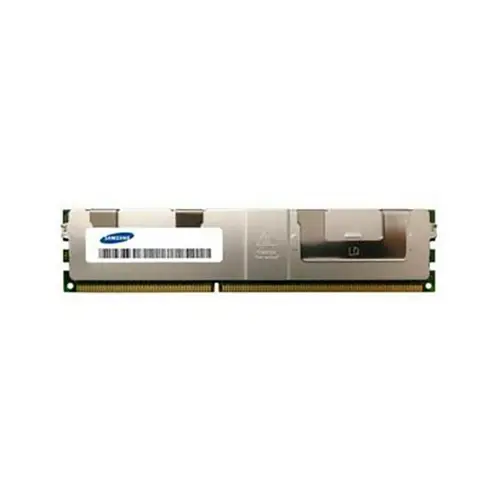
This Samsung 32GB DDR3-1333 RDIMM, operating at a low 1.35V, is a server-grade module designed for platforms requiring high memory density and data integrity. Its registered quad-rank x4 configuration with ECC ensures stable signal buffering and error correction, making it ideal for virtualization hosts and memory-intensive enterprise workloads where reliability under heavy load is critical.
1. Quad Rank x4 configuration doubles the number of ranks to keep the server’s memory channels deeply saturated, boosting throughput for in-memory databases and heavy virtualization workloads.
2. ECC actively detects and corrects single-bit errors in real time, preserving data integrity in mission-critical enterprise applications where silent corruption is unacceptable.
3. Registered signal buffering decouples the DRAM loads from the CPU’s integrated memory controller, enabling the deployment of dense 32 GB modules across all slots without compromising stability.
4. 1.35 V low-voltage operation substantially cuts per-DIMM power draw in a fully populated rack, directly lowering data center cooling overhead and energy costs at scale.
5. The massive 32 GB capacity per module dramatically increases memory headroom, allowing more VMs per physical host and smoother performance under intense multi-tenant consolidation.
The Samsung M386B4G70DM0-YH930 is a server-class 32GB DDR3 Registered DIMM engineered for mission‑critical enterprise workloads. Its four defining characteristics translate directly into real‑world resilience. The built‑in ECC corrects single‑bit errors on‑the‑fly, quietly preventing silent data corruption that could crash a hypervisor hosting dozens of virtual machines or poison transaction records inside an in‑memory database like Redis. Deep in a virtualisation cluster, where dozens of DIMMs operate in parallel, the Registered buffer stabilises signal integrity, permitting fully populated memory channels without sacrificing uptime—an essential safeguard when a single uncorrected fault can trigger cascading VM failures. The Quad‑Rank x4 organisation exploits bank‑interleaving to drive sustained bandwidth, dramatically shrinking query response times for memory‑hypertensive analytics. Meanwhile, the 1.35 V low‑voltage operation curbs power draw and heat across racks of servers, directly lowering cooling overhead in colocation cages. Together, these features let IT architects confidently scale RAM‑cache nodes and dense virtualised environments, knowing that data integrity, high capacity, and energy efficiency are not compromised.
General Virtualization
For dense virtualization hosts, populate at least six to eight identical M386B4G70DM0-YH930 modules to balance memory capacity and channel interleaving. A typical dual-socket server using 8×32 GB (256 GB total) comfortably hosts dozens of moderate VMs, leveraging registered ECC for stability during live migration. Configure one DIMM per channel (1DPC) at 1333 MHz to maintain low latency and avoid speed downgrades from quad-rank loading.
In-Memory Database
In-memory databases demand both large capacity and data integrity. Install a full set of 12 or 16 modules (384–512 GB) across all memory channels to maximize bandwidth and support massive datasets entirely in RAM. The ECC and registered design of this quad-rank RDIMM ensures data correctness under sustained 24/7 operations, while 1.35 V low-voltage operation reduces thermal load in fully populated chassis.
High-Performance Computing (HPC)
HPC clusters benefit from balanced memory per core. Deploy 6 or 8 modules per node (192–256 GB) to feed dual-socket processors with up to 4 GB per core, ideal for simulation and finite-element workloads. Stick to one DIMM per channel to preserve 1333 MHz speed; quad-rank registration allows high capacity without sacrificing signal integrity in dense node configurations.
Rigorously tested, this 32GB DDR3-1333 RDIMM is compatible with Dell PowerEdge R720, HP ProLiant DL380p Gen8, and similar servers.
Q: Can I mix this M386B4G70DM0-YH930 with other memory modules of different brands or speeds?
A: Mixing is strongly discouraged. Mismatched brands or speeds can cause signal integrity issues, disable ECC protection, and lead to system instability on registered server platforms.
Q: Is this memory compatible with my Intel Xeon E5-2600 v2 server platform?
A: Yes, this DDR3-1333 ECC Registered RDIMM is fully compatible with Intel Xeon E5-2600 v1/v2 and AMD Opteron 6300 series. Please verify your server board's qualified vendor list for final confirmation.
Q: What is the recommended DIMM population order for optimal performance with this module?
A: Populate identical DIMMs per channel, starting with the slots farthest from the CPU. Balance memory across all memory channels to maximize bandwidth and ensure symmetric configurations.
Q: Does this module support overclocking or XMP profiles?
A: No. This server-grade RDIMM adheres strictly to JEDEC DDR3-1333 CL9 standards at 1.35V. Overclocking or XMP is not supported, as reliability and data integrity are prioritized over performance tuning.
Q: What warranty and typical failure rate can I expect?
A: This Samsung module comes with a one-year warranty. Typical AFR is below industry average due to rigorous screening, delivering high MTBF suitable for 24/7 enterprise environments.