











 Secure payments
Standard refund policy
Trade Assurance
Secure payments
Standard refund policy
Trade Assurance
| Model | M386B4G70DM0-YH93Q |
|---|---|
| Product Type | Memory Module |
| Compliance Standards | EU RoHS,FCC |
| Memory Capacity | 32 GB |
| Memory Technology | DDR3 |
| Product Voltage | 1.35V |
| RAM Speed | 1333MHz |
| RAM Standard | DDR3-1333/PC3-10600 |
| Error Identifying | ECC |
| Signal Type | Registered |
| Column Access Strobe (CAS) | CL9 |
| Rank | Quad Rank x4 |
| Quantity of Pins | 240-pin |
| RAM Genre | RDIMM |
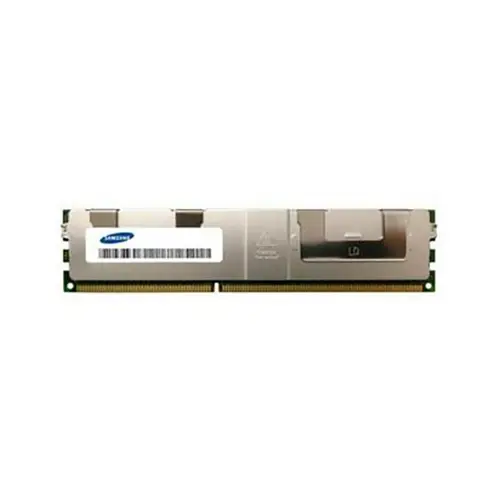
This 32GB DDR3-1333 RDIMM, with its quad-rank x4 organization and registered signal topology, delivers the high-density memory scaling essential for virtualized environments and in-memory databases while the integrated ECC ensures rigorous data integrity. Operating at a low 1.35V, it significantly reduces power consumption in dense server deployments without compromising the stable CL9 latency required by compute-intensive workloads.
1. A 32GB capacity per module allows servers to scale up memory-intensive workloads like virtualization and in-memory databases without adding extra physical hosts, boosting consolidation density while keeping license costs in check.
2. ECC error correction silently detects and fixes single-bit corruption, preserving end-to-end data integrity for financial transactions and mission-critical enterprise applications that cannot tolerate silent data decay.
3. Registered signal type buffers clock and command signals, maintaining electrical stability across fully loaded memory channels, which is essential for large-scale deployments requiring dozens of DIMMs per rack without intermittent faults.
4. Operating at 1.35V ultra-low voltage drops the thermal footprint and power budget of every memory slot, directly cutting energy bills and cooling demands in continuously running data centers.
5. Quad Rank x4 organization maximizes logical bank utilization while managing loading per channel, sustaining reliable throughput under mixed read-write traffic typical in high-concurrency analytics and database clusters.
When you are running a virtualization cluster or an in-memory database, memory is not just a resource—it is the foundation of uptime. The Samsung M386B4G70DM0-YH93Q is a 32 GB DDR3 Registered ECC RDIMM built to solve the real failures that keep IT administrators awake at night. In a VMware or Hyper‑V host packed with dozens of VMs, a single uncorrected bit flip can silently corrupt a guest operating system file or a financial transaction. The integrated ECC engine catches and corrects these single‑bit errors on the fly, turning a potential physical memory defect into a harmless statistical event. That same host relies on the Registered DIMM architecture: the onboard register buffers command and address signals, dramatically reducing the electrical load on the processor’s memory controller. This allows you to populate every available slot with high‑density Quad Rank x4 modules like this one without sacrificing signal integrity or clock speed, giving a four‑socket server the 512 GB or more of reliable capacity that production databases such as SAP HANA demand. Meanwhile, the 1.35 V operating voltage cuts power consumption by roughly 20 percent compared to legacy 1.5 V DDR3. In a fully loaded data center rack, that reduction directly lowers electricity bills and shrinks thermal hotspots, extending the life of fans and power supplies. The combination of ECC protection, registered buffering, low‑voltage efficiency, and quad‑rank density means you can confidently host both latency‑sensitive analytics and business‑critical virtual infrastructure on the same platform without surprises.
Capacity Planning Guide for DDR3 Registered ECC Server Memory
This 32GB DDR3-1333 RDIMM (Quad Rank x4, 1.35V) targets enterprise servers where reliability under sustained load is essential. Plan capacity around memory-channel population rules and rank limitations to avoid performance penalties.
General Virtualization
Populate all memory channels identically to provide balanced bandwidth for multiple virtual machines. A typical mid‑range host benefits from 128–256 GB using four or six of these modules, supporting 20–40 light VMs comfortably. Registered ECC safeguards guest uptime during saturation, while the 1.35V operation helps curb power overhead in dense virtualization clusters.
In-Memory Database
Maximize total capacity by filling every DIMM slot for databases that keep entire datasets in RAM. Configurations of 256 GB or more are common, but with quad‑rank DIMMs the memory controller may reduce speed to 1066 MHz when two modules share a channel. To preserve latency, populate one DIMM per channel first and add a second only if absolute capacity trumps clock speed; always validate your server’s rank‑per‑channel limits.
High-Performance Computing (HPC)
HPC workloads favor memory bandwidth over raw density. Install one module per channel—often 6 or 8 DIMMs in a dual‑socket system—to prevent down‑clocking caused by quad‑rank loading. The 32GB granularity supplies sufficient capacity for simulation checkpoints while keeping rank counts low. ECC correction is mandatory for node‑level results integrity over week‑long jobs, and registered signaling guarantees signal integrity across large memory arrays.
Rigorously tested server DDR3L RDIMM, compatible with Dell PowerEdge R720, HP DL380p Gen8, Lenovo RD530, and more.
Q: Can I mix this M386B4G70DM0-YH93Q with other memory modules of different brands or speeds?
A: Mixing different brands or speeds is not recommended for this registered ECC module. It can cause instability or system failure. Always use identical part numbers to guarantee reliable performance and avoid compatibility issues in server environments.
Q: Is this memory compatible with my system?
A: This DDR3-1333 registered ECC RDIMM is compatible with servers using Intel Xeon E5-2400/2600, 5500/5600, or AMD Opteron 6300/8300 platforms. Please verify your motherboard’s qualified vendor list to confirm support for 32GB quad-rank modules.
Q: What is the recommended DIMM population order for optimal performance?
A: Populate identical quad-rank modules in matching banks per channel, starting with the slots furthest from the CPU. Follow your server’s population guide to balance memory across channels and avoid mixing ranks, ensuring maximum bandwidth and stability.
Q: Does this module support overclocking or XMP profiles?
A: No. As an enterprise-grade registered ECC DIMM, it runs strictly at JEDEC-standard DDR3-1333 speeds and latencies. Overclocking and XMP profiles are not supported, as system stability and data integrity are prioritized.
Q: What warranty and typical failure rate can I expect?
A: This module includes a one-year warranty. Typical annualized failure rate is below 0.5% under normal operating conditions, reflecting high reliability for 24/7 server workloads with rigorous ECC data protection.