











 Secure payments
Standard refund policy
Trade Assurance
Secure payments
Standard refund policy
Trade Assurance
| Model | M392B4G70BEB-YH9 |
|---|---|
| Product Type | Memory Module |
| Compliance Standards | CE,WEEE,RoHS |
| Memory Capacity | 32 GB |
| Memory Technology | DDR3 |
| Product Voltage | 1.35V |
| RAM Speed | 1333MHz |
| RAM Standard | DDR3-1333/PC3-10600 |
| Error Identifying | ECC |
| Signal Type | Registered |
| Column Access Strobe (CAS) | CL9 |
| Rank | Quad Rank x4 |
| Quantity of Pins | 240-pin |
| RAM Genre | VLP RDIMM |
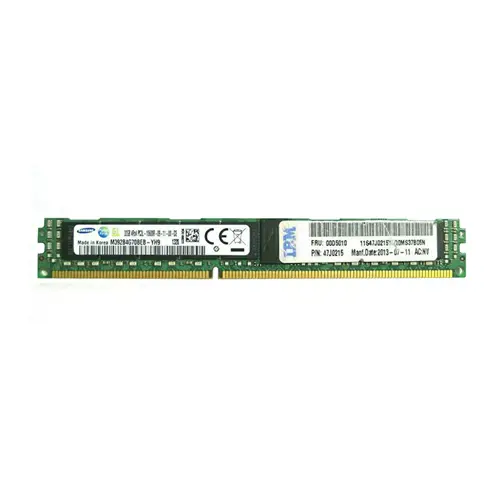
This 32GB DDR3-1333 VLP RDIMM is a server-class module tailored for virtualization, in-memory databases, and enterprise workloads where data integrity and high capacity are paramount. Its registered ECC architecture and quad-rank x4 organization ensure robust signal stability and extreme memory density in dense rack servers, while the 1.35V low-voltage operation combined with a CAS latency of 9 delivers power efficiency and responsive performance.
1. ECC protection detects and corrects single-bit errors in real time, safeguarding transactional databases and financial computations from silent data corruption.
2. Registered signal buffering stabilizes command and address lines, enabling fully populated memory channels for large-scale virtualization without compromising signal integrity.
3. 32GB capacity per module lets IT architects pack more memory into each server node, dramatically raising VM density in cloud and enterprise environments.
4. Quad Rank x4 organization delivers high per-module capacity and deep bank interleaving, keeping memory bandwidth steady under the heavy parallelism of in-memory analytics.
5. VLP RDIMM's ultra-low profile reduces airflow obstruction in dense 1U and blade servers, helping sustain lower fan speeds and higher compute density within strict thermal envelopes.
When you are managing a virtualized cluster or an in-memory database, the memory module you choose either fortifies your data or silently corrupts it. The Samsung M392B4G70BEB-YH9, a 32 GB DDR3 Very Low Profile Registered DIMM, is engineered specifically to eliminate those risks in dense server environments. Its ECC technology actively detects and corrects single-bit errors caused by background radiation, preventing flipped bits from cascading into transactional discrepancies or filesystem metadata corruption — a non-negotiable safeguard for financial databases and ERP systems. Because this is a Registered DIMM with a dedicated command/address buffer, the memory bus remains electrically stable when you fully populate all 24 slots in a dual-socket host, enabling you to confidently scale up to 768 GB for a hypervisor hosting dozens of VMs without signal degradation. The quad-rank x4 organization packs high capacity per channel, boosting bandwidth in write-heavy caching layers like Redis, while the 1.35 V low-voltage operation directly cuts cooling expenditure in a server rack running 24/7 — accumulating significant power savings across a data center floor over a three-year refresh cycle. Together, these four pillars — integral error correction, registered buffering for population scalability, high-rank density, and ultra-low voltage — mean one thing for your infrastructure: uncompromising uptime with a measurable reduction in both thermal stress and total cost of ownership.
Capacity Planning for M392B4G70BEB-YH9
This module is server-class memory: a 32GB DDR3-1333 ECC Registered VLP RDIMM (1.35V, quad-rank). Its registered, error-correcting design suits multi-socket platforms running sustained, mission-critical workloads. Below are configuration recommendations for typical server scenarios.
General Virtualization
For hypervisor hosts running 20–40 lightweight VMs, populate at least 8 identical modules across all memory channels (e.g., 8 x 32GB = 256GB) to balance interleaving and maximize throughput. Stick to two DIMMs per channel to avoid downclocking from quad-rank loads, preserving 1333MHz operation.
In-Memory Database
Latency-sensitive databases like Redis or SAP HANA demand large, reliable capacity. Install 16–24 modules (512GB–768GB) using all available slots on a 4-socket server, keeping population symmetric. Enable rank sparing or mirroring in the BIOS to convert ECC resilience into higher uptime for in-memory datasets.
High-Performance Computing (HPC)
HPC clusters typically prioritize bandwidth per core. Populate exactly one quad-rank DIMM per channel (4 or 8 modules per node) to sustain peak 1333MT/s with CL9, avoiding multi-rank bus loading penalties. Combine with 1.35V operation to reduce thermal stress in dense rack deployments while maintaining error correction for long-running MPI jobs.
Rigorously tested server memory, compatible with Dell PowerEdge R720/R620, HP ProLiant DL380p Gen8, IBM System x3650 M4.
Q: Can I mix this M392B4G70BEB-YH9 with other memory modules of different brands or speeds?
A: Mixing is strongly discouraged. For server reliability, all modules should match in brand, speed, rank, and ECC type. Mismatched DIMMs may cause POST failures or silent data corruption.
Q: Is this memory compatible with my system?
A: This DDR3-1333 Registered ECC VLP RDIMM is designed for Intel Xeon E5-2400/2600 v1/v2 and AMD Opteron 6300 platforms. Confirm your server board’s qualified vendor list for this 32GB quad-rank module.
Q: What is the recommended DIMM population order for optimal performance?
A: Populate one quad-rank DIMM per memory channel first, then add the second. Refer to your server manual for correct slot sequence. Balanced channel loading ensures maximum memory bandwidth and ECC efficiency.
Q: Does this module support overclocking or XMP profiles?
A: No. As a server Registered ECC module, it operates strictly at JEDEC DDR3-1333 (PC3-10600) specifications. Overclocking or XMP is unsupported and would jeopardize data integrity.
Q: What warranty and typical failure rate can I expect?
A: It includes a 1-year warranty. Enterprise DDR3 RDIMMs exhibit an annualized failure rate well below 0.5% when run within voltage and thermal specifications, ensuring high operational reliability.