











 Secure payments
Standard refund policy
Trade Assurance
Secure payments
Standard refund policy
Trade Assurance
| Model | M393B4G70DM0-YH9Q2 |
|---|---|
| Product Type | Memory Module |
| Compliance Standards | EU RoHS,FCC |
| Memory Capacity | 32 GB |
| Memory Technology | DDR3 |
| Product Voltage | 1.35V |
| RAM Speed | 1333MHz |
| RAM Standard | DDR3-1333/PC3-10600 |
| Error Identifying | ECC |
| Signal Type | Registered |
| Column Access Strobe (CAS) | CL9 |
| Rank | Quad Rank x4 |
| Quantity of Pins | 240-pin |
| RAM Genre | RDIMM |
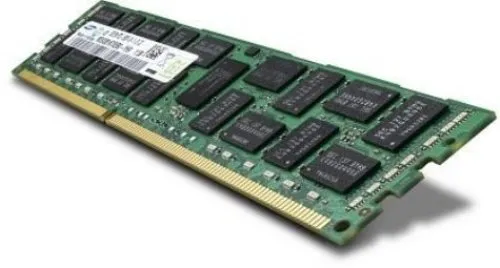
This Samsung 32GB DDR3-1333 RDIMM, with its registered ECC design and low 1.35V operating voltage, is purpose-built for data integrity in virtualized servers and memory-intensive database workloads. Its quad-rank x4 configuration maximizes capacity density per channel while the registered signal buffering ensures stable operation across fully populated multi-DIMM platforms.
1. 32GB capacity per module enables high-density server configurations, directly increasing the number of virtual machines a single physical host can support without sacrificing performance.
2. ECC protection transparently corrects single-bit memory errors, preserving data integrity for financial transactions and database operations that demand non-stop accuracy.
3. Registered signal buffering maintains clean command and address signals across heavily populated memory channels, ensuring stable operation when all DIMM slots are fully utilized.
4. Quad Rank x4 organization maximizes rank interleaving, keeping multiple memory banks simultaneously active to sustain throughput during concurrent data-streaming workloads.
5. 1333MHz clock speed delivers 10.6 GB/s of peak bandwidth per channel, providing the consistent data feed required by real-time analytics and high-traffic web services.
The Samsung M393B4G70DM0-YH9Q2 is a server-class DDR3 Registered DIMM, purpose-built for enterprise environments where reliability and scalability are non-negotiable. Its ECC technology silently detects and corrects single-bit memory errors, directly preventing data corruption in critical workloads. In a virtualization cluster hosting dozens of virtual machines, a single uncorrected bit flip in a hypervisor’s memory can crash entire guest fleets; ECC turns that catastrophic risk into a non-event, keeping your services continuously available. The registered architecture buffers command and address signals, stabilizing the memory bus even when all 24 sockets in a dual-socket server are fully populated with these 32GB modules—something unbuffered memory cannot guarantee at scale. With quad-rank x4 organization, it delivers dense capacity per channel, giving in-memory databases like Redis or SAP HANA the headroom to store massive datasets right next to the CPU for sub-millisecond response times. Operating at 1.35V instead of the standard 1.5V, this module also reduces power consumption and thermal load across a populated rack, lowering cooling costs and extending component lifespan without sacrificing the 1333MT/s throughput. For your virtualized infrastructure or real-time analytics platform, these four characteristics translate directly into sustained uptime, consistent latency, and lower total cost of ownership.
General Virtualization
Deploy four 32 GB quad‑rank RDIMMs (128 GB total) in a balanced configuration, using one module per memory channel on each CPU to avoid channel contention. This capacity comfortably supports 20–30 moderate VMs, and the 1.35 V low‑voltage operation helps control power density in dense server farms.
In-Memory Database
Maximise capacity by populating all available DIMM slots with these 32 GB modules, typically achieving 512 GB or more on a dual‑socket platform. Because quad‑rank DIMMs can force speed reductions when three modules share a channel, limit to two DIMMs per channel for the best balance between capacity and stable 1333 MHz operation. ECC guarantees data integrity for memory‑resident transactional stores.
High-Performance Computing (HPC)
Prioritise memory bandwidth by installing one 32 GB RDIMM per channel across all channels—this prevents the down‑clock penalty that multiple quad‑rank loads impose. While per‑node capacity stays moderate (often 128–256 GB), the consistent CAS 9 latency and registered signalling deliver reliable, low‑jitter memory access for tightly‑coupled parallel codes.
Server DDR3 RDIMM rigorously tested, compatible with Dell PowerEdge R720, R620, HPE DL380p Gen8, and Lenovo x3650 M4.
Q: Can I mix this M393B4G70DM0-YH9Q2 with other memory modules of different brands or speeds?
A: Mixing RDIMMs is not advised. Different ranks, speeds, or brands can cause instability. This quad-rank registered module must be paired with identical units for reliable server operation.
Q: Is this memory compatible with my Intel Xeon or AMD Opteron server platform?
A: It is compatible with platforms supporting DDR3-1333 registered DIMMs, such as Intel Xeon 5500/5600 or AMD Opteron 6100/6200 series. Always verify your motherboard’s qualified vendor list.
Q: What is the recommended DIMM population order for optimal performance?
A: Install identical quad-rank modules per channel, beginning with the slot farthest from the CPU. Follow your server manual precisely to maintain balanced memory interleaving and avoid performance loss.
Q: Does this module support overclocking or XMP profiles?
A: No. This is an enterprise registered ECC module operating strictly at JEDEC standard DDR3-1333 with CL9 timings. Overclocking and XMP are not supported.
Q: What warranty and typical failure rate can I expect?
A: This Samsung module includes a 1-year warranty. Under normal server conditions, the typical annualized failure rate (AFR) is very low, approximately 0.1–0.3%.