











 Secure payments
Standard refund policy
Trade Assurance
Secure payments
Standard refund policy
Trade Assurance
| Product Type | Memory Module |
|---|---|
| Memory Capacity | 32 GB |
| Memory Technology | DDR3 |
| Product Voltage | 1.35 V |
| RAM Speed | 1333 MHz |
| RAM Standard | DDR3-1333/PC3-10600 |
| Error Identifying | ECC |
| Signal Type | Registered |
| Column Access Strobe (CAS) | CL9 |
| Rank | Quad Rank x4 |
| Quantity of Pins | 240-pin |
| RAM Genre | RDIMM |
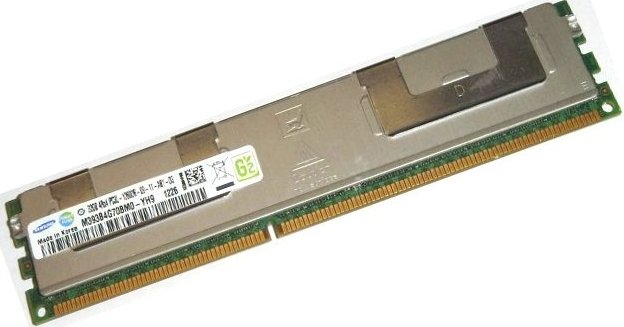
This is a server-grade DDR3-1333 Registered ECC RDIMM engineered for virtualization, in-memory databases, and enterprise workloads demanding uncompromised data integrity. Its quad-rank x4 configuration enables high-density 32GB capacity per module, while the registered signal type and ECC maintain robust signal stability and error correction across heavily populated multi-DIMM memory channels.
1. Registered DIMM architecture enhances signal integrity at high capacities, allowing server platforms to scale memory without sacrificing the rock-solid reliability required for always-on operations.
2. ECC error correction provides continuous single-bit error detection and repair, shielding financial transactions and database queries from silent data corruption in the datacenter.
3. Registered signal buffering isolates the memory controller from electrical loading, enabling densely populated server nodes to maintain stable command/address timing under sustained virtualization loads.
4. Quad Rank x4 organization saturates each memory channel with overlapped bank accesses, delivering the sustained bandwidth that hypervisors need when juggling dozens of active VMs.
5. A 32GB module density maximizes memory per slot in space-constrained server blades, directly translating to higher VM density and larger in-memory working sets for analytics.
The Samsung M393B4G70BM0-YH9 is a 32GB DDR3 RDIMM purpose-built for mission-critical server environments, where its four defining characteristics directly resolve the real pain points of data center operators. ECC error correction actively detects and repairs single-bit memory errors caused by cosmic radiation or electrical noise. In a virtualized cluster hosting dozens of VMs, a single uncorrected bit flip can corrupt the hypervisor and cascade into multi-tenant outages; ECC silences this risk, preserving 24/7 service continuity. The Registered signal buffer cleans and re-drives command and address lines, letting you fully populate all memory channels with these high-density quad rank modules without signal degradation. This stability is non-negotiable when you need terabytes of RAM for an in-memory database like SAP HANA. Operating at just 1.35V slashes power draw across a rack, directly reducing cooling expenses and extending hardware longevity. Finally, the quad rank x4 organization enables rank interleaving, boosting effective bandwidth during concurrent analytical queries. For your virtualized infrastructure or real-time analytics farm, this module translates into higher VM density, uncompromising data integrity, and a measurably lower total cost of ownership.
General Virtualization
For moderate-density virtualization, install six to eight of these 32GB RDIMMs across triple-channel memory controllers to achieve 192–256GB total capacity. This configuration balances cost and VM density, allowing roughly 3–5GB per virtual machine for standard workloads. Always populate identical DIMMs in matching channels to maintain ECC and registered memory stability.
In-Memory Database
Maximize capacity by fully populating all available slots on a dual-socket server, aiming for 384GB or higher using twelve modules. Quad-rank x4 DIMMs deliver deep rank interleaving, which improves throughput for large in-memory datasets like Redis or SAP HANA. Be aware that running at 1333 MT/s with quad-rank modules may limit maximum speed if slots are fully loaded, so verify platform support.
High-Performance Computing
Populate all memory channels symmetrically with one DIMM per channel to sustain balanced bandwidth under heavy floating-point loads. A typical compute node benefits from eight modules providing 256GB, sufficient for large simulation meshes. Registered ECC ensures data integrity during multi-day runs, while 1.35V operation reduces power draw per DIMM in dense cluster configurations.
Rigorously tested server memory compatible with Dell PowerEdge R720, HP DL380p Gen8, and similar servers.
Q: Can I mix this M393B4G70BM0-YH9 with other memory modules of different brands or speeds?
A: Mixing Registered ECC DIMMs with different specs is not recommended. It may cause signal integrity issues and force the system to the lowest common speed, undermining server reliability. Use identical Samsung modules.
Q: Is this memory compatible with my system?
A: This 32GB DDR3-1333 Registered ECC RDIMM fits servers with Intel Xeon E5/E7 or AMD Opteron 6300/8300 platforms. Verify your motherboard supports 1.35V quad-rank x4 modules and 32GB per slot.
Q: What is the recommended DIMM population order for optimal performance?
A: Follow your server manual's memory population guidelines. Typically, populate identical quad-rank DIMMs starting with the first slot of each channel (usually blue slots), balancing across available memory controllers.
Q: Does this module support overclocking or XMP profiles?
A: No. As a JEDEC-compliant server memory (DDR3-1333 CL9), it does not support XMP or overclocking. Running at 1.35V with standard timings ensures maximum data integrity for enterprise workloads.
Q: What warranty and typical failure rate can I expect?
A: This Samsung module carries a 1-year warranty. Enterprise DDR3 Registered memory typically has an annualized failure rate (AFR) below 1%, ensuring reliable 24/7 operation in properly cooled server environments.