











 Secure payments
Standard refund policy
Trade Assurance
Secure payments
Standard refund policy
Trade Assurance
| Model | M393B4G70DM0-YH93QM |
|---|---|
| Product Type | Memory Module |
| Compliance Standards | EU RoHS,FCC |
| Memory Capacity | 32 GB |
| Memory Technology | DDR3 |
| Product Voltage | 1.35V |
| RAM Speed | 1333MHz |
| RAM Standard | DDR3-1333/PC3-10600 |
| Error Identifying | ECC |
| Signal Type | Registered |
| Column Access Strobe (CAS) | CL9 |
| Rank | Quad Rank x4 |
| Quantity of Pins | 240-pin |
| RAM Genre | RDIMM |
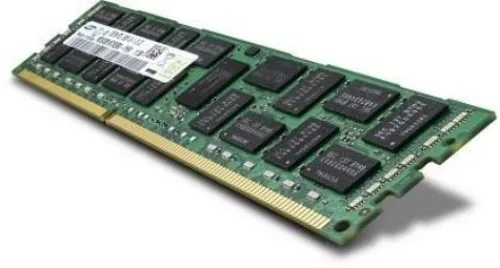
This 32GB DDR3-1333 RDIMM is purpose‑built for enterprise servers and is ideally suited for virtualization platforms and in‑memory databases that demand uncompromising data integrity. Its quad‑rank x4 configuration with ECC and registered signal buffering ensures stable operation under heavy loads while enabling higher memory density in mission‑critical deployments.
1. Registered signal buffering enables the memory bus to maintain signal integrity across fully populated server boards, ensuring rock-solid stability when every DIMM slot is occupied in large-scale virtualization hosts.
2. ECC protection corrects single-bit errors in real time, shielding in-memory financial transactions and database queries from silent data corruption that could cascade into costly outages.
3. Quad Rank x4 organization maximizes channel bandwidth utilization per DIMM, letting dense multi-VM deployments access more data in parallel without stalling under memory-intensive workloads.
4. The module’s high per-slot capacity allows enterprises to triple the memory footprint in existing servers without sacrificing expansion headroom, directly translating to higher virtual machine density per node.
5. Operating at low voltage slashes per-DIMM power draw across a fleet of always-on data center servers, yielding measurable cumulative savings in cooling and energy costs over the deployment lifecycle.
The M393B4G70DM0-YH93QM is a server-class registered DIMM, and its four defining characteristics translate directly into enterprise resilience where downtime is unacceptable. In a virtualized cluster hosting dozens of business-critical VMs, the integrated ECC engine actively corrects single-bit errors and detects multi-bit corruption. This is not a theoretical safeguard; it prevents silent data corruption in a hypervisor’s memory space that could crash every guest instance simultaneously, preserving transactional integrity in a production database. The registered signal architecture buffers command and address lines, stabilizing load on the memory controller. When you populate a dual-socket server with 24 of these 32 GB quad-rank modules, the buffers enable the platform to recognize the full 768 GB capacity without training failures, a non-negotiable advantage for in-memory databases like SAP HANA that demand massive, reliable footprints.
The 1.35 V low-voltage operation and quad-rank ×4 organization address two operational pain points directly. Reducing voltage from the legacy 1.5 V standard cuts power draw per DIMM noticeably; across a fully loaded server, this compounds into lower cooling overheads and a longer service life for embedded voltage regulators. The quad-rank density, meanwhile, delivers deeper interleaving and higher sustained bandwidth under concurrent access patterns. In a database environment where hundreds of users execute OLAP queries against a cached dataset, the extra rank interleaving smooths out latency spikes, keeping response times predictable. Together, these attributes turn a 32 GB DDR3-1333 CL9 module into a calculated choice for virtualized infrastructure that must blend capacity, energy efficiency, and uncompromised data integrity.
General Virtualization
Populate channels symmetrically to maximize memory bandwidth for multiple VMs. Install at least six 32 GB RDIMMs (192 GB total) across three channels per CPU, leaving room for scaling. The 1.35 V low-voltage operation reduces power and cooling costs in dense virtualized clusters.
In-Memory Database
Prioritize capacity and reliability over raw speed. Fill all available DIMM slots with these 32 GB quad-rank RDIMMs to reach 256 GB or more per node, ensuring the entire dataset fits in RAM. ECC and registered signaling safeguard data integrity under constant heavy writes.
High-Performance Computing
Balance capacity with channel configuration for memory-bound workloads. Use one 32 GB RDIMM per channel to achieve optimal interleaving, then scale to two DIMMs per channel if capacity demands grow. The CL9 latency and 1333 MT/s speed deliver predictable, consistent throughput for parallel tasks.
Rigorously validated for server compatibility: Dell PowerEdge R720, HP ProLiant DL380p Gen8, Lenovo System x3650 M4.
Q: Can I mix this M393B4G70DM0-YH93QM with other memory modules of different brands or speeds?
A: Mixing brands or speeds with this registered ECC module is not recommended. It may cause signal integrity issues and system instability. For guaranteed reliability, use identical part numbers in all populated slots.
Q: Is this memory compatible with my system?
A: This 32GB DDR3-1333 registered ECC RDIMM is designed for servers using Intel Xeon E5-2400/2600 series or AMD Opteron 6300/4300 platforms. Please verify your server's qualified vendor list to ensure compatibility.
Q: What is the recommended DIMM population order for optimal performance?
A: Populate identical DIMMs per channel, starting with the slot farthest from the CPU. Balance memory across all memory channels for optimal interleaving. Consult your server's manual for the precise population diagram.
Q: Does this module support overclocking or XMP profiles?
A: No. As an enterprise-class registered DDR3 module, it adheres strictly to JEDEC standard DDR3-1333 CL9 timings. It does not support XMP profiles or overclocking, prioritizing stability and data integrity.
Q: What warranty and typical failure rate can I expect?
A: This module includes a one-year warranty. Built with server-grade components, its annualized failure rate (AFR) is extremely low, typically below 0.5%, ensuring long-term mission-critical reliability.