











 Secure payments
Standard refund policy
Trade Assurance
Secure payments
Standard refund policy
Trade Assurance
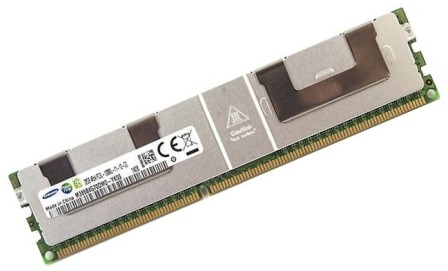
| Model | M386B4G70DM0-YK04Q |
|---|---|
| Product Type | Memory Module |
| Compliance Standards | CE,WEEE,RoHS |
| Memory Capacity | 32 GB |
| Memory Technology | DDR3 |
| Product Voltage | 1.35V |
| RAM Speed | 1600MHz |
| RAM Standard | DDR3-1600/PC3-12800 |
| Error Identifying | ECC |
| Signal Type | Registered |
| Column Access Strobe (CAS) | CL11 |
| Rank | Quad Rank x4 |
| Quantity of Pins | 240-pin |
| RAM Genre | RDIMM |
Designed for server platforms, this Samsung 32GB DDR3-1600 RDIMM leverages ECC and registered signal buffering to deliver robust data integrity and stability in memory-intensive deployments. Its quad-rank x4 configuration and 1.35V low-voltage operation make it an excellent choice for dense virtualization clusters and in-memory database workloads, where maximizing capacity per channel without sacrificing reliability is critical.
1. ECC protection automatically corrects single-bit errors, safeguarding transactional integrity in virtualized databases and preventing costly data corruption at scale.
2. Registered signaling strengthens command and address buses, enabling stable fully-populated server configurations critical for high-density virtualization hosts.
3. Quad Rank x4 organization fills every memory bank with dense chip placement, delivering the deep capacity that in-memory analytics and large-scale caching workloads demand.
4. Low operating voltage reduces overall server power draw and thermal strain, directly lowering energy costs in multi-node data center environments.
5. High-capacity module doubles the memory footprint per slot, allowing operators to maximize VM density and extend cluster utilization without sacrificing headroom.
The M386B4G70DM0-YK04Q is a 32GB DDR3 Registered ECC DIMM purpose-built for data-center reliability. Its four defining characteristics solve critical infrastructure challenges directly. The ECC engine continuously detects and corrects single-bit errors induced by cosmic radiation, preventing silent data corruption that would otherwise silently flip a financial transaction inside an in-memory database or crash a hypervisor during peak virtual-machine density. The registered buffer isolates the memory controller from excessive electrical loading, which means you can fully populate all 24 DIMM slots in a 2U server without signal degradation—essential when scaling a VMware cluster to host dozens of guests on a single node. The quad-rank x4 architecture pushes capacity to 32GB per stick while keeping the command bus manageable, delivering the massive RAM footprint needed to keep an entire Redis or SAP HANA dataset hot, even when multiple demanding VMs are competing for resources. Simultaneously, the 1.35V low-voltage operation dramatically cuts power consumption and cooling overhead across a fleet of servers, directly lowering your total cost of ownership. Whether you are consolidating mission-critical workloads or accelerating real-time analytics, this memory ensures your infrastructure never compromises on data integrity, density, or efficiency.
General Virtualization
Deploy these 32 GB Quad‑Rank RDIMMs to build dense, cost‑effective memory for host servers. In a dual‑socket system with three or four memory channels per CPU, populate one DIMM per channel (e.g., 6 or 8 modules) to enable channel interleaving while preserving the full DDR3‑1600 speed. Avoid placing a second Quad‑Rank DIMM on any channel, as the resulting rank load forces the memory controller to drop the frequency substantially, which reduces VM consolidation efficiency.
In‑Memory Database
Total capacity is more critical than peak frequency: fill all available DIMM slots with these modules to keep the entire working set in RAM. Even if the bank‑heavy Quad‑Rank loading imposes a speed downgrade to 1066 MT/s or 1333 MT/s, the performance gain from eliminating disk I/O outweighs the bandwidth reduction. Ensure all installed modules are identical to maintain consistent ECC protection and signal integrity.
High‑Performance Computing (HPC)
Sustained memory bandwidth is paramount, so install exactly one DIMM per memory channel to prevent any clock penalty. For a typical dual‑socket compute node with four channels per CPU, an 8‑module (256 GB) configuration runs reliably at 1600 MHz and the energy‑efficient 1.35 V. This balanced, low‑latency layout maximizes aggregate throughput for simulation and modeling codes while avoiding performance‑sapping rank contention.
Rigorously tested server memory. Works with Dell PowerEdge R720, HPE ProLiant DL380p Gen8, etc.
Q: Can I mix this M386B4G70DM0-YK04Q with other memory modules of different brands or speeds in my server?
A: For enterprise servers, mixing brands, speeds, or ranks often causes instability. We recommend using identical Samsung modules with the same part number to ensure fully validated, reliable operation and to prevent signal integrity issues.
Q: Is this registered DIMM compatible with my server platform, specifically Intel Xeon E5 or AMD systems?
A: This DDR3-1600 registered ECC module is compatible with servers supporting 240-pin RDIMM, such as Intel Xeon E5-2600 v1/v2 and AMD Opteron 6300 series. Please verify your board's qualified vendor list for this specific 32GB quad-rank part.
Q: What is the recommended DIMM population order for optimal performance with this memory?
A: Install identical modules starting from the farthest slot from the CPU in each memory channel. To avoid speed downgrades with quad-rank DIMMs, populate pairs symmetrically and consult your server’s manual for the specific slot numbering and population rules.
Q: Does this module support overclocking or XMP profiles?
A: No. As an enterprise-grade registered DIMM, it operates strictly at JEDEC standard DDR3-1600 CL11 timings. XMP and overclocking are not supported, as consistent stability and data integrity are prioritized for server environments.
Q: What warranty and typical failure rate can I expect with this Samsung memory module?
A: This module comes with a 1-year warranty. It delivers an extremely low typical annualized failure rate, usually under 0.5% AFR, due to rigorous Samsung enterprise testing and qualification for 24/7 mission-critical workloads.