











 Secure payments
Standard refund policy
Trade Assurance
Secure payments
Standard refund policy
Trade Assurance
| Model | M386B4G70DM0 |
|---|---|
| Product Type | Memory Module |
| Compliance Standards | EU RoHS,FCC |
| Memory Capacity | 32 GB |
| Memory Technology | DDR3 |
| Product Voltage | 1.35V |
| RAM Speed | 1600MHz |
| RAM Standard | DDR3-1600/PC3-12800 |
| Error Identifying | ECC |
| Signal Type | Registered |
| Column Access Strobe (CAS) | CL11 |
| Rank | Quad Rank |
| Quantity of Pins | 240-pin |
| RAM Genre | DIMM |
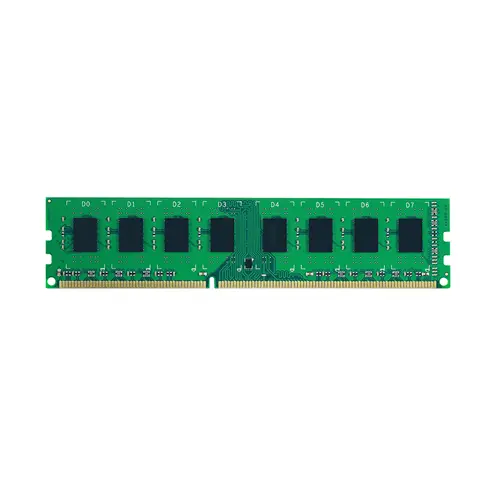
This Samsung M386B4G70DM0 is a server-class DDR3 Registered DIMM with ECC, optimized for virtualization and in-memory database workloads where data integrity is paramount. Its quad-rank configuration maximizes capacity per channel at 32 GB while the 1.35V low-voltage operation reduces power consumption, and the registered signal type ensures stable signal integrity in dense multi-DIMM server deployments.
1. Registered signal buffering stabilizes heavy memory loads across multiple DIMMs, preventing signal degradation in dense server racks that host business-critical databases.
2. ECC protection corrects single-bit errors and detects multi-bit faults in real time, preserving data integrity for financial transactions and long-running analytics jobs.
3. 32GB capacity per module maximizes virtualization density, enabling more VMs per server node without sacrificing memory headroom for enterprise applications.
4. Quad Rank organization keeps all bank groups active and data pipelines full, sustaining throughput under the concurrent request pressure of multi-tenant cloud workloads.
5. 1.35V low-voltage operation cuts thermal output and energy draw in always-on data centers, reducing cooling overhead while maintaining reliable 1600MHz frequency.
The M386B4G70DM0 is a 32GB DDR3-1600 Registered DIMM built specifically for server platforms, and its four defining characteristics directly address the critical pain points of enterprise data centers. First, ECC error correction constantly detects and corrects single-bit memory errors, which is non-negotiable in financial transaction databases or in-memory caching systems like Redis where a silent bit flip could corrupt a trade or session data. Second, the registered signal type buffers the command and address lines, allowing the memory controller to reliably drive quad-rank modules across large server boards. In a dense virtualization cluster running dozens of VMs per node, this translates to rock-steady stability even when all DIMM slots are populated. Third, the quad-rank organization packs 32GB onto a single module using high-density DRAM—crucial for maximizing capacity in dual-socket servers with limited slots, so you can provision massive memory to hungry hypervisors without sacrificing speed. Finally, the 1.35V low-voltage operation significantly reduces power consumption and thermal load across a fully populated rack, driving down both cooling costs and total cost of ownership in always-on environments. Together, these features make the module an ideal foundation for virtualized infrastructure and latency-sensitive in-memory applications where integrity, density, and efficiency must coexist.
Server Memory Capacity Planning – DDR3-1600 ECC Registered (32GB Module)
Based on the M386B4G70DM0 (32GB DDR3-1600 CL11 Quad-Rank ECC Registered DIMM), this module is strictly designed for server platforms requiring data integrity and large memory footprints. Below are capacity planning guidelines for three key workload scenarios.
General Virtualization
Virtualized hosts with moderate VM density benefit from balanced capacity and memory bandwidth. Populate at least four modules (128GB) per dual-socket server to allocate 4–8GB per light VM while leaving headroom for hypervisor overhead. Always install registered DIMMs in identical sets across memory channels to maintain symmetric NUMA configurations and avoid performance penalties.
In-Memory Database
In-memory databases like Redis or SAP HANA demand large, fully populated memory banks to keep entire datasets resident. Maximize capacity by populating all 24 DIMM slots on a typical quad-socket server with 32GB modules, reaching 768GB total. Leverage quad-rank modules to achieve higher capacity per channel, but confirm platform support and consider any frequency downshift to 1333MHz when all ranks are loaded.
High Performance Computing
HPC applications require high sustained bandwidth and low latency across hundreds of cores. Install six or twelve modules per dual-socket node (192–384GB) to populate all memory channels—six per CPU—ensuring balanced interleaving. Use 1600MHz speed to maximize throughput; quad-rank DIMMs may reduce dependency on 2DPC configurations while still delivering strong memory-level parallelism for MPI workloads.
Rigorously tested, works with Dell PowerEdge R720, R620, HP DL380p Gen8, and similar DDR3 Registered ECC servers.
Q: Can I mix this M386B4G70DM0 with other memory modules of different brands or speeds?
A: Mixing is not recommended. This 32GB quad-rank RDIMM requires specific timings and loading. Combining with dissimilar DIMMs may cause signal integrity issues and system instability on server platforms.
Q: Is this memory compatible with my system?
A: It is designed for servers supporting DDR3 Registered ECC memory, such as Intel Xeon E5-2600 v1/v2 or AMD Opteron 6300 series platforms. Verify your board’s quad-rank RDIMM support before purchase.
Q: What is the recommended DIMM population order for optimal performance?
A: Always follow your server vendor’s population guide. Typically, fill identical quad-rank DIMMs starting from the furthest slot per channel, one per channel first, to balance ranks and maximize memory bandwidth.
Q: Does this module support overclocking or XMP profiles?
A: No. This is a JEDEC-compliant DDR3-1600 Registered ECC module operating at standard 1.35V with CL11. Overclocking and XMP are not supported, as server memory prioritizes data integrity and stability.
Q: What warranty and typical failure rate can I expect?
A: This module carries a 1-year warranty. With rigorous EU RoHS/FCC compliant manufacturing, the typical annualized failure rate is exceptionally low, ensuring reliable 24/7 operation for enterprise workloads.