











 Secure payments
Standard refund policy
Trade Assurance
Secure payments
Standard refund policy
Trade Assurance
| Product Type | Memory Module |
|---|---|
| Memory Capacity | 32 GB |
| Memory Technology | DDR4 |
| Product Voltage | 1.2 V |
| RAM Speed | 2133 MHz |
| RAM Standard | DDR4-2133/PC4-17000 |
| Error Identifying | ECC |
| Signal Type | Registered |
| Column Access Strobe (CAS) | CL15 |
| Rank | Dual Rank x4 |
| Quantity of Pins | 288-pin |
| RAM Genre | RDIMM |
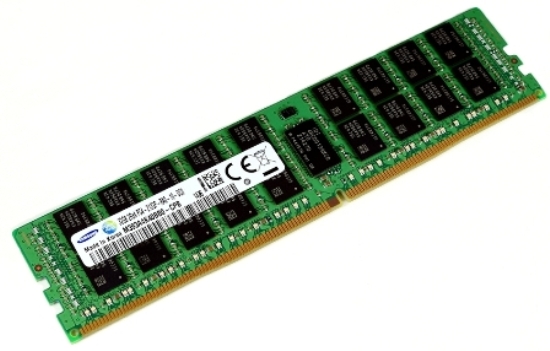
Ideal for virtualization hosts and in-memory databases, this 32GB DDR4-2133 RDIMM leverages registered signaling and ECC to ensure rock-solid data integrity in multi-slot server configurations. Its dual-rank x4 organization and CL15 latency strike an effective balance between capacity density and responsive access, making it a reliable workhorse for scale-out enterprise workloads.
1. ECC error correction detects and corrects single-bit memory faults in real time, protecting transactional databases and virtualization hosts from silent data corruption.
2. Registered signal buffering stabilizes command and address lanes across fully loaded memory channels, enabling dense server configurations without compromising uptime.
3. 32GB capacity per module allows higher memory density per server node, directly expanding the number of virtual machines or containers that can run concurrently.
4. Dual Rank x4 organization interleaves accesses across internal banks, sustaining peak bandwidth under parallel workloads like in-memory analytics and large-scale virtualization.
5. 1.2V low-voltage operation reduces overall server power draw and cooling overhead, translating to measurable OpEx savings in hyperscale data center deployments.
This Samsung RDIMM (M393A4K40BB0-CPB0) is purpose‑built for server environments, where its four defining attributes—32GB capacity, ECC error correction, registered signal buffering, and a dual‑rank x4 organization—directly resolve the most critical pain points of modern data centers. In a dense virtualization cluster hosting dozens of VMs per node, the 32GB density lets you allocate generous memory pools without swapping, while the register chip re‑drives address and command signals, preserving integrity across multiple DIMMs and eliminating the boot failures or random crashes that plague unregistered modules at scale. More importantly, ECC constantly corrects single‑bit errors induced by background radiation or electrical noise; without it, a flipped bit inside a VM’s kernel space could silently corrupt financial transactions or drop a production database. For in‑memory databases like Redis or SAP HANA, the dual‑rank x4 design interleaves internal banks to boost sustained bandwidth, delivering up to 17GB/s per channel at 2133MT/s. Together with a tight CL15 latency, that means real‑time analytics ingest millions of records with deterministic low‑lag access to hot datasets, so your query responses stay fast and your business logic remains absolutely trustworthy under relentless high‑load conditions.
General Virtualization
For general virtualization hosts, populate balanced memory channels to maximize bandwidth. With 32GB Registered DDR4-2133 modules, a common configuration is six or eight identical DIMMs per CPU to leverage triple or quad-channel architectures, providing 192GB or 256GB total capacity. This allows dense virtual machine consolidation without oversubscribing memory, while ECC ensures data integrity for multi-tenant workloads.
In-Memory Database
In-memory databases demand the highest capacity and reliability, so fully populate all memory channels with these 32GB RDIMMs for maximum density. A dual-socket server using 24 DIMMs achieves 768GB, enabling large datasets to reside entirely in RAM. The ECC and registered signaling guarantee stability under sustained heavy write loads, and dual-rank x4 construction helps maintain signal integrity at scale.
High-Performance Computing (HPC)
HPC clusters benefit from uniform memory configurations across nodes for predictable performance. Fill each memory channel with one 32GB Dual Rank x4 RDIMM to provide both capacity and the bandwidth needed for parallel simulation or modeling codes. Even at 2133MT/s, the dual-rank design enhances interleaving, and registered ECC eliminates silent data corruption during long compute runs.
Rigorously tested server memory. Compatible with Dell PowerEdge R730, HPE ProLiant DL380 Gen9, Lenovo ThinkSystem SR650, and more.
Q: Can I mix this M393A4K40BB0-CPB0 with other memory modules of different brands or speeds?
A: Mixing is not recommended for server environments. Even identical specs from different brands may cause instability. For RDIMMs, we advise using identical part numbers to ensure reliable synchronous operation and maintain data integrity.
Q: Is this memory compatible with my system?
A: This RDIMM is designed for Intel Xeon E5-2600 v3/v4 and select AMD EPYC platforms. Verify your server board supports DDR4-2133 ECC Registered memory. Consulting your hardware compatibility list is essential for guaranteed operation.
Q: What is the recommended DIMM population order for optimal performance?
A: Populate identical DIMMs per channel, starting with the slots farthest from the CPU. Typically, fill blue slots first. Follow your server manual's memory population guidelines to utilize all memory channels and achieve optimal interleaving.
Q: Does this module support overclocking or XMP profiles?
A: No. As an ECC Registered server memory module, it operates strictly at JEDEC standard speeds. Overclocking and XMP profiles are not supported, as stability and data integrity are prioritized over non-standard frequencies in server environments.
Q: What warranty and typical failure rate can I expect?
A: This module includes a one-year warranty. Enterprise-grade RDIMMs typically have an annualized failure rate under 0.5%. Proper cooling and handling ensure maximum reliability throughout its operational lifespan.