











 Secure payments
Standard refund policy
Trade Assurance
Secure payments
Standard refund policy
Trade Assurance
| Product Type | Memory Module |
|---|---|
| Memory Capacity | 32 GB |
| Memory Technology | DDR4 |
| Product Voltage | 1.2 V |
| RAM Speed | 2133 MHz |
| RAM Standard | DDR4-2133/PC4-17000 |
| Error Identifying | ECC |
| Signal Type | Registered |
| Column Access Strobe (CAS) | CL15 |
| Rank | Dual Rank x4 |
| Quantity of Pins | 288-pin |
| RAM Genre | RDIMM |
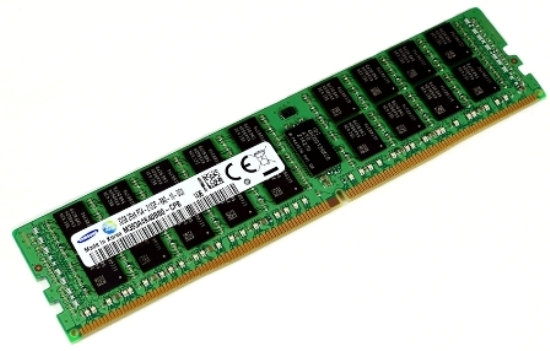
Designed for enterprise servers, this Samsung 32GB DDR4-2133 Registered ECC RDIMM (M393A4K40BB0-CPB4Q) ensures data integrity and system stability under heavy multi-threaded loads typical of virtualization, in-memory databases, and mission-critical applications. Its Dual Rank x4 organization combined with ECC error correction maximizes memory bandwidth and fault resilience, while the 1.2V low-power operation and CL15 latency provide an optimal balance of efficiency and responsiveness in dense rack and blade deployments.
1. ECC memory detects and corrects single-bit errors in real time, preserving data accuracy for financial databases and virtualized workloads that cannot tolerate silent corruption.
2. Registered buffer isolates the memory controller from excessive electrical loading, enabling fully populated server boards to operate reliably across all DIMM slots in dense rack deployments.
3. 32 GB capacity per module allows a single server to host many more virtual machines or containers, raising consolidation ratios without forcing expensive platform upgrades.
4. Dual Rank x4 organization interleaves access across internal banks, keeping the memory channel saturated and latency predictable during simultaneous queries from multiple hosted tenants.
5. DDR4-2133/PC4-17000 bandwidth provides a steady, balanced throughput that matches the needs of mid-range server processors, ensuring consistent response times under typical enterprise workloads.
Designed for mission-critical servers, the Samsung M393A4K40BB0-CPBQ4 is a 32GB DDR4-2133 registered DIMM that turns four essential engineering choices into real-world reliability. Its ECC technology continuously detects and corrects single-bit memory errors, which is not a theoretical safeguard but a daily necessity in virtualized clusters where a silent bit flip in one guest can cascade into corrupted transactional data or unplanned hypervisor faults. The registered signal buffer cleanly decouples the memory controller from the electrical load of high-density configurations, so a database server packed with multiple DIMMs per channel never suffers signal degradation that would otherwise force throttling or downtime during heavy OLAP queries. The dual‑rank x4 organization increases bank‑level parallelism, giving an in‑memory database like Redis or SAP HANA the ability to serve concurrent requests with measurably higher throughput, while the CL15 latency keeps response times tight under burst loads. And because all of this operates at a low 1.2 V, the module reduces the sustained power draw and thermal stress inside a 24/7 rack, directly lowering cooling costs without sacrificing the margin of stability that your financial batch processing or large‑scale virtualization depends on.
General Virtualization
For a typical hypervisor host running 10-15 light VMs, a balanced approach is four of these 32 GB RDIMMs (128 GB total) across a dual‑socket platform, ensuring ample memory for guest workloads and future growth. Keep population uniform across memory channels to sustain the registered‑ECC reliability and avoid bandwidth penalties.
In‑Memory Database
Latency‑sensitive engines like Redis or SAP HANA demand capacity without swapping. Deploy eight modules for 256 GB on a single socket with one DIMM per channel (1DPC), maximizing interleave and minimizing NUMA contention. If the dataset scales further, move to dual‑rank 64 GB RDIMMs later, but this 32 GB base offers a cost‑effective entry point.
High‑Performance Computing (HPC)
HPC applications often value memory bandwidth over raw capacity per node. Populate all eight channels with these 32 GB RDIMMs (256 GB total) at 2133 MT/s to saturate the memory interface, supporting data‑hungry simulation or modeling codes. Opt for dual‑rank x4 configuration as specified, which provides the best rank interleaving to hide refresh latencies and sustain high throughput under parallel job loads.
Strictly tested, compatible with Dell PowerEdge R740, HPE ProLiant DL380 Gen10, Lenovo ThinkSystem SR650.
Q: Can I mix this M393A4K40BB0-CPB4Q with other memory modules of different brands or speeds?
A: Mixing different brands or speeds is not recommended for RDIMM servers. It may cause stability issues and force all DIMMs to the lowest common speed, preventing optimal performance.
Q: Is this memory compatible with my Intel or AMD server platform?
A: This DDR4-2133 ECC Registered DIMM supports Intel Xeon E5-2600 v3/v4 and select AMD EPYC platforms. Verify your motherboard QVL for 32GB 2Rx4 RDIMM compatibility before purchasing.
Q: What is the recommended DIMM population order for optimal performance?
A: Populate identical DIMMs in sets corresponding to the memory channels, typically filling blue slots first. Follow the server board's population guide to balance channels and enable interleaving.
Q: Does this module support overclocking or XMP profiles?
A: No, this server-grade ECC RDIMM does not support overclocking or XMP. It runs strictly at JEDEC standard DDR4-2133 CL15 speeds to ensure enterprise reliability and data integrity.
Q: What warranty and typical failure rate can I expect?
A: This module includes a 1-year warranty. Enterprise RDIMMs like this Samsung part have very low AFR (typically under 1%) under normal server operating conditions, ensuring long-term reliability.