











 Secure payments
Standard refund policy
Trade Assurance
Secure payments
Standard refund policy
Trade Assurance
| Product Type | Memory Module |
|---|---|
| Memory Capacity | 32 GB |
| Memory Technology | DDR4 |
| Product Voltage | 1.2 V |
| RAM Speed | 2133 MHz |
| RAM Standard | DDR4-2133/PC4-17000 |
| Error Identifying | ECC |
| Signal Type | Registered |
| Column Access Strobe (CAS) | CL15 |
| Rank | Quad Rank x4 |
| Quantity of Pins | 288-pin |
| RAM Genre | RDIMM |
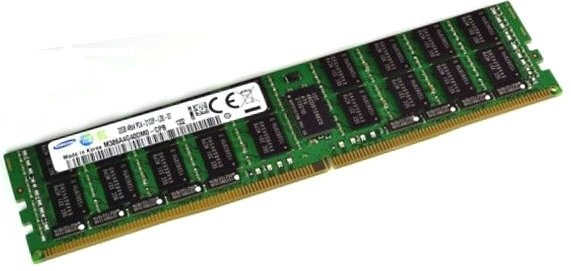
Designed for enterprise server platforms, this 32GB DDR4-2133 RDIMM with ECC and registered signal ensures data integrity and system stability in memory-intensive workloads such as virtualization and in-memory databases. Its quad-rank x4 configuration maximizes capacity per channel while maintaining reliable operation, making it an optimal choice for dense server deployments that demand high availability.
1. Error Correcting Code protection silently detects and corrects single-bit errors, safeguarding transactional integrity for databases and financial workloads around the clock.
2. Registered signal buffering stabilizes command and address buses on fully loaded server boards, preserving signal integrity across massive memory populations.
3. Quad Rank organization packs extreme density per module, enabling hypervisors to allocate abundant memory for heavy consolidation without sacrificing rank interleaving performance.
4. Generous module capacity supports dense node configurations, allowing data centers to run larger in-memory caches and more virtual machines per physical server.
5. Energy-efficient low-voltage operation cuts power draw and waste heat across rack-scale deployments, directly reducing cooling overhead and operational expenditure.
Engineered specifically for server environments, the M386A4G40DM0-CPB2Q is a DDR4-2133 Registered DIMM whose four defining characteristics directly address the pain points of modern data centers. First, the integrated ECC actively corrects single-bit errors in real time. When running an in-memory transactional database, a silent bit flip can corrupt financial records or crash the entire instance; ECC ensures data integrity at the silicon level, turning a potential multi-million-dollar liability into a verifiable result. Second, the Registered buffer isolates the memory controller from the electrical load of the Quad Rank x4 organization. This enables you to fully populate all channels with dense 32GB modules without signal distortion, a non-negotiable requirement for virtualization clusters hosting dozens of VMs where a single uncorrected anomaly would trigger cascading host failures. Third, the quad-rank architecture itself provides an unmatched 32GB per module, maximizing the memory footprint within limited DIMM slots to satisfy the immense appetite of hypervisors and large-scale containers. Finally, the 1.2V DDR4 design tangibly reduces power draw and thermal output across every installed module. For a fleet of servers running round-the-clock analytics or high-frequency trading operations, this translates into markedly lower cooling overhead and a more sustainable total cost of ownership. It means your critical workloads stay up, reports remain accurate, and density never sacrifices stability.
General Virtualization
For dense virtual machine hosting, populate a minimum of eight identical 32 GB RDIMMs per host to achieve 256 GB, leveraging quad‑rank x4 modules for increased bank‑level parallelism. Distribute modules evenly across all memory channels to sustain bandwidth under mixed‑workload pressure, and leave at least two channels empty for future scale‑out.
In‑Memory Database
Maximize capacity per socket by installing one 32 GB RDIMM in every available DIMM slot, as registered ECC and quad‑rank construction provide the reliability and latency tolerance essential for large in‑memory datasets. Operate at the platform’s rated 2133 MT/s to keep latency predictable, and avoid mixing speeds that could force a downclock under heavy load.
High‑Performance Computing
Fill all memory channels with identical 32 GB registered ECC modules to deliver balanced throughput for memory‑bound HPC workloads. The CL15 latency and 1.2 V operation help keep power and cooling within cluster‑node budgets, while ECC guards against silent data corruption during long‑running simulations.
Rigorously tested RDIMM. Compatible with Dell PowerEdge R740/R640, HPE ProLiant DL380 Gen10, Lenovo ThinkSystem SR650.
Q: Can I mix this M386A4G40DM0-CPB2Q with other memory modules of different brands or speeds?
A: Mixing this registered ECC module with modules of different brands, speeds, or ranks is strongly discouraged. It can cause system instability or boot failures. Use identical modules exclusively in server environments for guaranteed reliability.
Q: Is this memory compatible with my system?
A: This module is compatible with servers supporting DDR4 Registered ECC memory, such as Intel Xeon E5-2600 v3/v4 or select AMD EPYC platforms. Please check your motherboard’s qualified vendor list for this specific 32GB Quad Rank part number.
Q: What is the recommended DIMM population order for optimal performance?
A: For Quad Rank RDIMMs, populate the first slot of each memory channel (typically DIMM_A1, B1, C1, D1) before adding secondary slots. Follow your server’s population guide to balance channels and maximize throughput.
Q: Does this module support overclocking or XMP profiles?
A: No. This is a server-class registered ECC module that operates strictly at JEDEC standard DDR4-2133 speeds. It does not support overclocking or XMP profiles, as data integrity and 24/7 stability are paramount.
Q: What warranty and typical failure rate can I expect?
A: This module includes a 1-year warranty. Enterprise-grade RDIMMs like this typically have an annualized failure rate well below 0.1%, reflecting rigorous testing for mission-critical server deployments.