











 Secure payments
Standard refund policy
Trade Assurance
Secure payments
Standard refund policy
Trade Assurance
| Product Type | Memory Module |
|---|---|
| Memory Capacity | 32 GB |
| Memory Technology | DDR4 |
| Product Voltage | 1.2V |
| RAM Standard | DDR4-2400/PC4-19200 |
| Error Identifying | ECC |
| Signal Type | Registered |
| Column Access Strobe (CAS) | CL17 |
| Rank | Dual Rank |
| Quantity of Pins | 288-pin |
| RAM Genre | RDIMM |
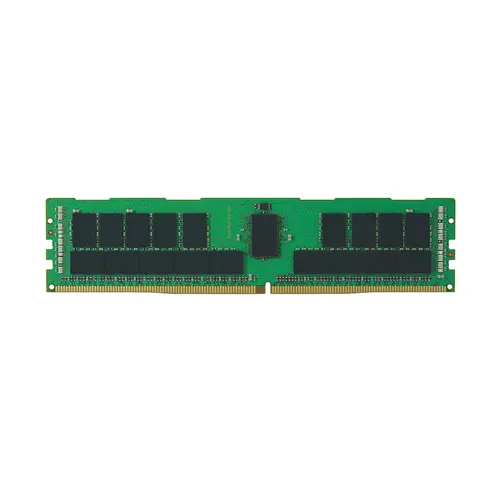
The M393A4K40BB1 is a server-class DDR4-2400 Registered ECC DIMM, engineered for virtualization, in-memory databases, and data-integrity-critical workloads, where its dual-rank configuration boosts memory bandwidth and ECC guards against silent data corruption. Operating at 1.2V with CL17 latency and registered signal buffering for improved stability in fully populated servers, it reliably delivers the capacity and error resilience required by demanding enterprise deployments.
1. ECC protection silently corrects single-bit errors in real-time, safeguarding transactional databases and preventing costly data corruption in mission-critical server environments.
2. Registered signal buffering stabilizes the command and address buses, enabling fully populated memory channels that sustain performance under extreme virtualization density.
3. A 32GB module density allows deeper memory footprints per server node, supporting larger in-memory datasets and more simultaneous virtual machines without sacrificing speed.
4. Dual Rank interleaving maximizes channel utilization by overlapping access cycles, which directly improves sustained bandwidth for analytics and high-concurrency workloads.
5. The DDR4-2400 speed grade delivers a consistent 19.2 GB/s of throughput per channel, balancing ample data pipelines with the strict power and thermal budgets of rack-scale deployments.
The Samsung M393A4K40BB1 is a server-class 32GB DDR4-2400 Registered ECC RDIMM, and its four defining characteristics directly address the critical pain points of modern data centers. Consider a large-scale virtualization cluster running dozens of VMs on a single hypervisor. The Registered signal type buffers the command and address lines, dramatically reducing electrical loading on the host memory controller and allowing you to populate all memory channels with high-capacity modules like this one without sacrificing stability. This reliable density is what makes dense VM consolidation possible. Simultaneously, the ECC technology continuously corrects single-bit errors and detects multi-bit corruptions, a non-negotiable safeguard when a flipped bit in a financial database or a customer record during an in-memory analytics query could mean revenue loss or compliance violations. The dual-rank organization further elevates performance through rank interleaving; the memory controller can issue concurrent accesses to alternating ranks, significantly boosting sustained bandwidth for latency-sensitive workloads such as Redis or SAP HANA. All of this is achieved at a cool 1.2V, lowering thermal energy per DIMM and reducing the total cost of ownership across a fleet of servers. For an IT infrastructure manager, this module translates into uncompromised data integrity, maximum server uptime, and the headroom to scale critical enterprise applications securely.
General Virtualization
For a typical dual-socket hypervisor host, populate at least 8 of these 32 GB RDIMMs (256 GB total) evenly across memory channels to maximize NUMA-aware scheduling. Distribute the dual-rank modules one per channel to maintain balanced interleaving and ensure consistent VM performance under consolidation.
In-Memory Database
In-memory platforms like SAP HANA or Redis demand maximum capacity with near-uniform latency. Configure a fully populated 16-DIMM layout (512 GB) using two of these modules per channel, respecting platform-specific speed derating limits. The ECC and registered signaling safeguard data integrity at sustained high throughput, critical for real-time analytics.
High-Performance Computing
HPC workloads benefit from the highest sustainable memory bandwidth. Install 6 or 12 identical DIMMs per socket in a symmetrical pattern, leveraging dual-rank chips for rank interleaving without exceeding the memory controller’s load limit. This 32 GB DDR4-2400 RDIMM supplies ample per-node capacity for simulation meshes while keeping CAS 17 latency predictable under MPI-heavy parallel jobs.
Validated server memory. Compatible with Dell PowerEdge R760, HPE ProLiant DL380 Gen10, Lenovo ThinkSystem SR650.
Q: Can I mix this M393A4K40BB1 with other memory modules of different brands or speeds?
A: Mixing registered DIMMs is not recommended. Different brands, speeds, or ranks may cause instability. For reliable server operation, always use identical modules with the same part number.
Q: Is this memory compatible with my system?
A: It’s compatible with servers using Intel Xeon E5-2600 v4 or AMD EPYC platforms supporting DDR4-2400 RDIMMs. Verify your board supports registered ECC memory before ordering.
Q: What is the recommended DIMM population order for optimal performance?
A: Populate identical dual-rank DIMMs per channel starting with the farthest slot from the CPU. Follow your server motherboard’s memory population guide for balanced configurations and maximum bandwidth.
Q: Does this module support overclocking or XMP profiles?
A: No. Server RDIMMs operate at standard JEDEC speeds for stability. Overclocking and XMP are not supported; this module runs strictly at DDR4-2400 with CL17 timings.
Q: What warranty and typical failure rate can I expect?
A: It includes a 1-year warranty. Enterprise-class registered DIMMs typically exhibit very low failure rates. We recommend periodic ECC logging checks to ensure reliability in production environments.