











 Secure payments
Standard refund policy
Trade Assurance
Secure payments
Standard refund policy
Trade Assurance
| Product Type | Memory Module |
|---|---|
| Memory Capacity | 32 GB |
| Memory Technology | DDR4 |
| Product Voltage | 1.2 V |
| RAM Speed | 2400 MHz |
| RAM Standard | DDR4-2400/PC4-19200 |
| Error Identifying | ECC |
| Signal Type | Registered |
| Column Access Strobe (CAS) | CL17 |
| Rank | Dual Rank x4 |
| Quantity of Pins | 288-pin |
| RAM Genre | RDIMM |
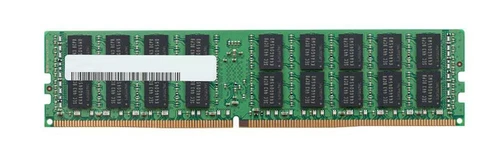
Designed as a registered ECC DDR4 module, this 32 GB RDIMM is purpose-built for enterprise server environments demanding uncompromising data integrity. Its dual-rank x4 organization and CL17 latency deliver balanced throughput ideal for memory-intensive virtualization and in-memory database workloads, while the registered signal architecture ensures stable operation across densely populated 288-pin platforms.
1. ECC error correction silently detects and fixes single-bit memory faults, preserving transactional integrity and uptime in mission-critical enterprise servers.
2. Registered buffering fortifies signal stability across high-density DIMM populations, making large-scale virtualization and memory scaling feasible.
3. Dual Rank x4 organization sustains channel saturation through interleaving, delivering consistent low-latency throughput for heavily consolidated virtual machines.
4. Generous per-module capacity raises the total memory ceiling of server nodes, enabling dense database collocation and broader container orchestration.
5. The rated transfer speed supplies ample main-memory bandwidth to feed contemporary multi-core server CPUs, preventing data-starve in real-time analytics workloads.
The Samsung M393A4K40CB1-CRC0Y is engineered as a registered server DIMM, and its four defining characteristics translate directly into mission-critical reliability for data center workloads. First, the ECC technology continuously detects and corrects single-bit memory errors caused by cosmic radiation or electrical noise. In a virtualization cluster hosting dozens of VMs, an undetected bit flip could silently corrupt a financial transaction or hypervisor state; ECC eliminates that existential risk. Second, the registered signal type buffers command and address lines, allowing a single server board to support multiple high-capacity modules without signal degradation. When you load a four-socket box with 32 GB RDIMMs for a large in-memory database like SAP HANA, the register ensures clean signaling under heavy rank counts. Third, the dual-rank x4 organization boosts bandwidth through rank interleaving, enabling the memory controller to pipeline reads and writes across ranks—this directly accelerates in-memory analytics queries where every nanosecond of data access counts. Finally, operating at a cool 1.2 V, this DDR4 module reduces thermal load inside dense rackmount servers, lowering both cooling costs and long-term power bills while preserving stability across always-on platforms.
General Virtualization
For general virtualization hosts, populate memory channels symmetrically to maximize memory bandwidth. A balanced configuration using six or eight identical 32GB RDIMMs per socket enables smooth consolidation of dozens of moderate VMs, while leaving DIMM slots available for future growth. Avoid mixing ranks or capacities across channels to maintain predictable NUMA performance.
In-Memory Database
In-memory databases demand low latency and high capacity without swapping. Deploy this 32GB dual-rank x4 RDIMM across all available channels—aiming for at least 256GB per socket—to keep entire datasets resident in RAM. The ECC and registered design ensure data integrity, which is critical when journaling or replicating transactional workloads.
High-Performance Computing (HPC)
HPC applications thrive on bandwidth-sensitive, large-footprint memory configurations. Populate one DIMM per channel using these registered 32GB modules to balance capacity and the peak 2400 MT/s speed. For CFD or molecular dynamics codes that scale with memory bandwidth, prioritize fully populating memory controllers before adding extra ranks, as dual-rank x4 modules already provide an optimal rank interleaving benefit without exceeding electrical loading limits.
Rigorously tested server memory: compatible with Dell PowerEdge R740, HPE ProLiant DL380 Gen10, Lenovo ThinkSystem SR650.
Q: Can I mix this M393A4K40CB1-CRC0Y with other memory modules of different brands or speeds?
A: Mixing modules is not recommended. For stable server operation, use identical RDIMMs with matching rank, speed, and timings. Mismatched DIMMs may cause POST failures or degraded performance.
Q: Is this memory compatible with my system?
A: This 32GB DDR4-2400 ECC Registered RDIMM is compatible with servers using Intel Xeon E5-2600 v3/v4 or AMD EPYC 7000 series platforms. Always verify your motherboard's QVL list and support for dual-rank x4 RDIMMs.
Q: What is the recommended DIMM population order for optimal performance?
A: Populate identical DIMMs symmetrically across memory channels first. For dual-socket servers, install one DIMM per channel, balancing capacity equally between sockets, then add further modules in matched pairs per channel.
Q: Does this module support overclocking or XMP profiles?
A: No, this is a JEDEC-compliant server memory module. It runs at fixed 2400 MT/s with CL17 timings and does not support XMP or overclocking. Reliability and stability take priority over tuning.
Q: What warranty and typical failure rate can I expect?
A: This module carries a 1-year warranty. Under normal server operating conditions with adequate cooling, the annualized failure rate (AFR) is typically very low, around 0.2–0.5%, ensuring enterprise-class reliability.