











 Secure payments
Standard refund policy
Trade Assurance
Secure payments
Standard refund policy
Trade Assurance
| Product Type | Memory Module |
|---|---|
| Compliance Standards | |
| Memory Capacity | 32 GB |
| Memory Technology | DDR4 |
| Product Voltage | 1.2 V |
| RAM Speed | 2400 MHz |
| RAM Standard | DDR4-2400/PC4-19200 |
| Error Identifying | ECC |
| Signal Type | Registered |
| Column Access Strobe (CAS) | CL17 |
| Rank | Quad Rank x4 |
| Quantity of Pins | 288-pin |
| RAM Genre | RDIMM |
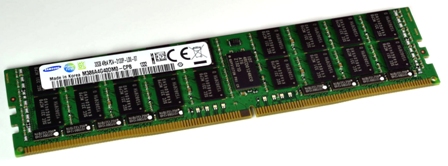
This 32GB DDR4-2400 RDIMM, built with a Quad Rank x4 organization, maximizes server memory density while leveraging interleaving for enhanced throughput in virtualized and in-memory database workloads. Its registered signal design and integrated ECC deliver robust data integrity and reliable system stability under the demanding 24/7 operations typical of enterprise server platforms.
1. Each module’s 32GB capacity enables dense memory configurations that maximize virtual machine density and keep large in-memory datasets instantly accessible under heavy consolidation.
2. ECC protection silently corrects single-bit errors, eliminating the risk of data corruption in transactional databases and mission-critical analytics that cannot tolerate downtime.
3. Registered buffering stabilizes high-capacity memory subsystems by managing signal loads, allowing operators to fully populate channels without compromising reliability at scale.
4. Quad Rank x4 organization packs more DRAM packages per stick, delivering the channel depth needed to sustain bandwidth-demanding enterprise applications without sacrificing slot economy.
5. DDR4-2400 speed provides a balanced throughput that saturates server memory bandwidth efficiently while keeping power ceilings predictable in dense rack environments.
The M386A4G40DM1-CRC4Q is a 32GB DDR4-2400 RDIMM engineered for mission-critical servers, where ECC, registered buffering, quad-rank x4 design, and low 1.2V power define operational excellence. ECC error correction silently remedies single-bit flips that can corrupt financial transactions or bring down virtual machines in a dense VMware cluster—protecting your data integrity at the most fundamental level. Registered buffering decouples the memory bus electrical load, so you can populate all 24 slots of a dual-socket platform with stable signals, scaling memory to support large virtualized environments and in-memory databases like SAP HANA. The quad-rank x4 configuration interleaves four ranks on a single module, boosting bandwidth for concurrent VM access while offering a generous 32GB per DIMM. Finally, 1.2V operation reduces power consumption by 20-30% versus older DDR3 or 1.35V modules, cutting cooling OPEX in dense data centers. For IT managers, this translates to fewer errors, higher consolidation ratios, and lower TCO.
General Virtualization
For a virtualization host, populate all available memory channels symmetrically with identical 32GB RDIMMs to maximize bandwidth and leave no channel underutilized. Start with a minimum of eight modules (256GB) for moderate consolidation and scale to the platform's maximum supported capacity—often 512GB or more—to ensure headroom for VM growth without swapping to disk.
In-Memory Database
Aggregate as much capacity as the server board allows, fully populating every DIMM slot with these 32GB Quad-Rank x4 RDIMMs. In-memory datasets demand near-zero latency, so prioritize total capacity over pure frequency: a fully loaded 24-slot system can deliver 768GB, keeping entire databases resident in RAM. Pair with a processor that supports high-capacity Registered ECC memory and be mindful of possible speed downgrades when all channels are loaded with quad-rank DIMMs.
High-Performance Computing (HPC)
Configure one DIMM per channel across all available memory channels to saturate memory bandwidth—the primary bottleneck in many HPC workloads. Using these 32GB Registered ECC modules in a balanced 8‑ or 12‑DIMM arrangement yields a strong combination of capacity and sustained throughput. Because Quad-Rank x4 modules can limit maximum frequency, trust the ECC and registered signaling to maintain stability during long-running parallel jobs, and avoid mixing ranks or capacities that would break uniform channel loading.
Rigorously tested server memory, compatible with Dell PowerEdge R760, HPE ProLiant DL380 Gen10, and Lenovo ThinkSystem SR650.
Q: Can I mix this M386A4G40DM1-CRC4Q with other memory modules of different brands or speeds?
A: Mixing is not recommended for servers. Mismatched modules may cause instability, forced speed downgrades, or ECC errors. For guaranteed reliability, deploy identical Samsung RDIMMs with matching rank, speed, and CL17 settings.
Q: Is this memory compatible with my Intel or AMD server platform?
A: It is compatible with servers supporting DDR4-2400 ECC Registered DIMMs. Verify your motherboard’s QVL for 32GB Quad Rank x4 RDIMMs at 1.2V, and ensure the CPU (e.g., Intel Xeon Scalable, AMD EPYC) supports this configuration.
Q: What is the recommended DIMM population order for optimal performance?
A: Follow your server manual’s memory channel balancing. Typically, populate identical RDIMMs in corresponding slots per channel (e.g., A1, B1 first) to enable interleaving. Quad Rank modules count as four ranks; mixing may limit speed to 1600 MT/s.
Q: Does this module support overclocking or XMP profiles?
A: No. This is a server-class RDIMM adhering strictly to JEDEC DDR4-2400/PC4-19200 standards. It prioritizes ECC stability and does not offer overclocking or XMP. Any attempt to exceed nominal speed will compromise data integrity.
Q: What warranty and typical failure rate can I expect?
A: This module includes a one-year warranty. As an enterprise-grade Samsung RDIMM, its designed MTBF ensures extremely low failure rates under specified conditions. Proper thermal management and unbent pinholes further minimize field issues.