











 Secure payments
Standard refund policy
Trade Assurance
Secure payments
Standard refund policy
Trade Assurance
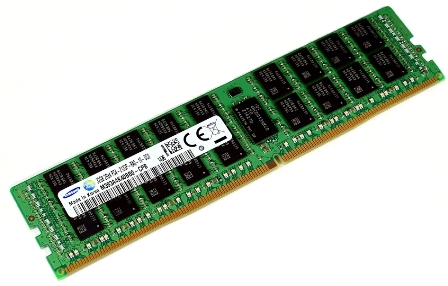
| Model | M386A4G40EM2-CRC4Q |
|---|---|
| Product Type | Memory Module |
| Compliance Standards | EU RoHS,FCC |
| Memory Capacity | 32 GB |
| Memory Technology | DDR4 |
| Product Voltage | 1.2V |
| RAM Speed | 2400MHz |
| RAM Standard | DDR4-2400/PC4-19200 |
| Error Identifying | ECC |
| Signal Type | Registered |
| Column Access Strobe (CAS) | CL17 |
| Rank | Quad Rank x4 |
| Quantity of Pins | 288-pin |
| RAM Genre | RDIMM |
This 32GB registered ECC DDR4-2400 RDIMM is engineered specifically for enterprise servers and virtualization platforms running memory-intensive workloads such as in-memory databases and large-scale virtual machine deployments. Its quad-rank x4 configuration delivers high per-channel density, while the registered signal path and ECC correction ensure reliable data integrity and stable operation under heavy memory loads.
1. A dense 32GB capacity per module lets IT teams pack more memory into limited server slots, boosting virtual machine density and keeping more in-memory databases ready without touching slower storage.
2. ECC correction silently fixes single-bit errors in real time, shielding mission-critical workloads from data corruption and unexpected downtime in financial or healthcare systems.
3. Registered buffering reclocks and re-drives signals, stabilizing heavy multi-DIMM configurations so that fully populated servers never suffer signal degradation under constant access loads.
4. Quad Rank x4 bank interleaving spreads requests across numerous internal banks, sustaining high bandwidth even as core counts rise, which keeps latency-sensitive enterprise applications responsive.
5. The 2400MT/s transfer rate provides a reliable throughput foundation for memory-bound analytics and virtualized environments, balancing performance with the tight thermal and power envelopes of dense data-center racks.
The M386A4G40EM2-CRC4Q is a 32GB DDR4-2400 Registered DIMM built explicitly for enterprise servers, where uptime and data fidelity are non-negotiable. Its four cornerstone attributes — ECC error correction, registered signal buffering, quad-rank architecture, and dense 32GB capacity — directly determine operational resilience. ECC instantly corrects single-bit flips triggered by cosmic radiation or electrical noise; in a virtualized cluster hosting dozens of tenants, one uncorrected error could silently corrupt a database page or kernel memory, crashing multiple VMs without warning. The registered clock driver stabilizes command and address signals across fully loaded memory channels, allowing you to populate all 16 or 24 slots without signal integrity loss, which is vital when consolidating massive virtualization workloads on a dual-socket host. The quad-rank x4 design leverages deeper bank interleaving to sustain higher bandwidth under concurrent access, a clear advantage for in-memory analytics platforms like SAP HANA where query throughput hinges on minimizing bank conflicts. Simultaneously, the 32GB module density enables 512GB or more per server, collapsing memory-hungry workloads such as real-time financial transaction processing onto fewer boxes. For IT operators, this translates into hardened uptime, predictable low-latency performance under virtualized chaos, and a leaner data center footprint.
Capacity Planning for 32GB DDR4-2400 ECC RDIMM
The M386A4G40EM2-CRC4Q is a 32GB registered DDR4-2400 ECC memory module designed for server platforms. Its Error-Correcting Code and registered buffer ensure data integrity and signal stability in multi-DIMM configurations, making it ideal for reliability-critical workloads. Plan capacity around channel and rank balance to maximize memory bandwidth.
General Virtualization
Populate all memory channels symmetrically with identical 32GB RDIMMs. For a dual-socket server with 8 channels per CPU, eight modules per socket provide 256GB per node, comfortably hosting 30–40 moderate VMs. Avoid mixing quad-rank DIMMs in the same channel to maintain 2400 MT/s speed; stick to one DIMM per channel for optimal latency.
In-Memory Database
Prioritize total capacity and low latency. Use the maximum number of supported DIMMs per channel (typically two) with these 32GB quad-rank modules, but note that speed may step down to 2133 MT/s. Plan for 512GB–1TB per node by populating all slots, ensuring the dataset fits entirely in RAM to eliminate disk I/O bottlenecks. Consider 2-socket configurations to double memory bandwidth.
High-Performance Computing
Balance memory bandwidth, capacity, and rank interleaving. Configure one DIMM per channel with these quad-rank modules to maintain full 2400 MHz speed while leveraging rank interleaving for improved throughput. For memory-bandwidth-bound HPC jobs, 128–256GB per socket (4–8 identical 32GB DIMMs) provides a sweet spot. Align population order to enable symmetrical rank balancing across CPU memory controllers.
Rigorously tested server memory, compatible with Dell PowerEdge R740, HPE ProLiant DL380 Gen10, Lenovo ThinkSystem SR650.
Q: Can I mix this M386A4G40EM2-CRC4Q with other memory modules of different brands or speeds?
A: Mixing heterogeneous modules in a server environment is not recommended. Registered DIMMs require identical ranks, timings, and ECC parity. Mismatched speeds will downclock to the slowest common denominator, potentially destabilizing your workload.
Q: Is this memory compatible with my system?
A: This DDR4-2400 ECC Registered DIMM is validated for Intel Xeon E5-2600 v3/v4 and scalable Xeon platforms. Verify your server board supports 288-pin RDIMMs and quad-rank x4 configurations, such as HPE ProLiant Gen9/Gen10 or Dell PowerEdge 13G/14G.
Q: What is the recommended DIMM population order for optimal performance?
A: Populate identical DIMMs per channel starting with the first white slot farthest from the CPU. Balance capacity across memory controllers and follow the platform’s user guide for balanced or memory‑mirroring modes to maintain interleaving and full bandwidth.
Q: Does this module support overclocking or XMP profiles?
A: No. Enterprise RDIMMs with ECC operate exclusively at JEDEC-standard DDR4-2400 (PC4-19200) CL17. Overclocking and XMP are disabled to guarantee 24/7 data integrity. The module ignores any XMP‑related BIOS adjustments.
Q: What warranty and typical failure rate can I expect?
A: This module includes a 1-year warranty. Manufactured under rigorous Samsung JEDEC qualification, it exhibits an extremely low annualized failure rate (AFR) typically below 0.5% in temperature‑controlled datacenters, ensuring high reliability for mission‑critical applications.