











 Secure payments
Standard refund policy
Trade Assurance
Secure payments
Standard refund policy
Trade Assurance
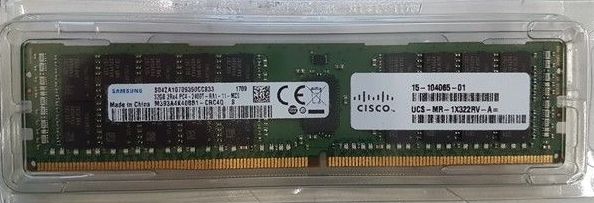
| Product Type | Memory Module |
|---|---|
| Memory Capacity | 32 GB |
| Memory Technology | DDR4 |
| Product Voltage | 1.2V |
| RAM Speed | 2400MHz |
| RAM Standard | DDR4-2400/PC4-19200 |
| Error Identifying | ECC |
| Signal Type | Registered |
| Column Access Strobe (CAS) | CL17 |
| Rank | Dual Rank x4 |
| Quantity of Pins | 288-pin |
| RAM Genre | RDIMM |
This 32GB DDR4-2400 Registered ECC module is engineered for enterprise server platforms, delivering reliable performance in virtualized environments, in-memory databases, and data-integrity-critical workloads. Its dual-rank x4 organization boosts effective bandwidth through rank interleaving, while the combination of registered signal buffering and ECC error correction ensures robust signal integrity and automatic single-bit error remediation under sustained heavy loads.
1. Registered signal type buffers the command and address lines, preserving signal integrity across fully loaded server memory channels and maximizing uptime in dense rack configurations.
2. ECC protection detects and corrects single-bit errors in real time, shielding large-scale data processing from silent corruption that could compromise transactional accuracy.
3. Dual rank x4 organization leverages rank interleaving to keep server memory buses saturated, which directly improves throughput for concurrent virtual machines and in-memory databases.
4. High module capacity increases memory headroom per slot, enabling higher VM density and larger dataset caching without resorting to costly chassis expansion.
5. The DDR4-2400 speed grade delivers a strong balance of bandwidth and power efficiency, accelerating analytical queries while maintaining the thermal envelope required for 24/7 datacenter operation.
Based on the RDIMM type and ECC Registered signal, the M393A4K40BB1-CRC0Y is clearly a server-grade memory module, purpose-built for data centers and enterprise workloads where downtime is unacceptable. Its 32GB capacity at 2400MHz, combined with dual-rank x4 organization and a Registered architecture, directly addresses the critical pain points of modern virtualized infrastructure and in-memory databases.
Consider a dense virtualization cluster hosting dozens of VMs. The Registered design buffers command and address signals, stabilizing signal integrity when all 288 pins populate every slot across 8 or 16 DIMM channels. Without this, electrical loading would cause memory errors and random crashes at scale. Simultaneously, the ECC function continuously detects and corrects single-bit upsets caused by cosmic radiation—a silent data corruption risk that, in an SAP HANA or Redis cluster, could quietly poison transactional integrity over days before manifesting into catastrophic query failures. The dual-rank x4 layout further boosts bandwidth by interleaving accesses across internal banks, letting your hypervisor sustain higher consolidation ratios without latency spikes. For a financial trading database running entirely in memory, this means consistent sub-millisecond response times under concurrent load, and absolute confidence that a flipped bit will not escalate into a multimillion-dollar reconciliation nightmare. This memory transforms raw performance into reliable business continuity.
General Virtualization
For virtualized environments, balanced capacity and consistent memory access are key. Populate all memory channels symmetrically using these 32GB Registered DDR4 RDIMMs — typically one module per channel on a dual-socket server — to enable full interleaving and predictable performance. A configuration of 8 identical modules per host (256 GB) provides a solid foundation for moderate VM density, scaling to 512 GB with a second DIMM per channel as workloads grow.
In-Memory Database
In-memory databases demand maximum capacity and hardware resilience. Fully leverage the ECC and Registered characteristics by filling all DIMM slots with these 32 GB modules to reach the platform’s ceiling, often 1.5 TB or more. Although the 2400 MHz speed represents a moderate clock, the dual-rank x4 organization benefits latency-sensitive operations, making the large footprint more critical than peak frequency for holding entire datasets in RAM.
High-Performance Computing (HPC)
HPC clusters rely on high sustained bandwidth and node-level uniformity. Equip each server with one of these dual-rank 32 GB DDR4 RDIMMs per memory channel to maximize channel interleaving without incurring speed drops from fully loaded buses. Across a cluster, standardizing on this identical module configuration ensures run-to-run performance consistency and simplifies capacity upgrades, balancing cost and throughput for parallelized computational jobs.
Rigorously tested server memory, compatible with Dell PowerEdge R640/R740, HPE ProLiant DL380 Gen10, Lenovo SR650, and more.
Q: Can I mix this M393A4K40BB1-CRC0Y with other memory modules of different brands or speeds?
A: Mixing different brands or speeds is not recommended for RDIMMs in server environments. Use identical modules like the M393A4K40BB1-CRC0Y to guarantee signal integrity and system stability under all workloads.
Q: Is this memory compatible with my system, such as Intel Xeon or AMD EPYC platforms?
A: This 32GB DDR4-2400 ECC Registered DIMM is compatible with servers using Intel Xeon E5-2600 v4/v3 or AMD EPYC 7001 series processors that support 288-pin RDIMMs and 1.2V operation.
Q: What is the recommended DIMM population order for optimal performance?
A: Follow your server board manual to populate identical DIMMs per channel. Typically, install dual-rank modules like this one in the farthest white slots first, balancing capacity across all memory channels.
Q: Does this module support overclocking or XMP profiles?
A: No. As an enterprise RDIMM, it adheres strictly to JEDEC DDR4-2400 specifications for stability. Overclocking and XMP profiles are not supported to ensure 24/7 data integrity in mission-critical systems.
Q: What warranty and typical failure rate can I expect?
A: This module includes a one-year warranty. Enterprise-grade components like this Samsung RDIMM typically exhibit an annualized failure rate (AFR) below 0.2%, ensuring long-term reliability in properly cooled environments.