











 Secure payments
Standard refund policy
Trade Assurance
Secure payments
Standard refund policy
Trade Assurance
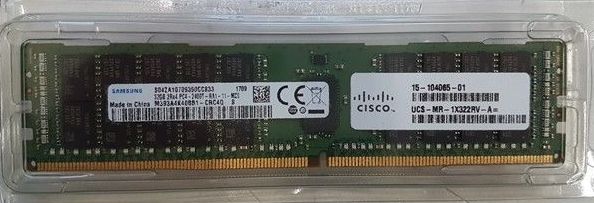
| Product Type | Memory Module |
|---|---|
| Memory Capacity | 32 GB |
| Memory Technology | DDR4 |
| Product Voltage | 1.2 V |
| RAM Speed | 2400 MHz |
| RAM Standard | DDR4-2400/PC4-19200 |
| Error Identifying | ECC |
| Signal Type | Registered |
| Column Access Strobe (CAS) | CL17 |
| Rank | Dual Rank x4 |
| Quantity of Pins | 288-pin |
| RAM Genre | RDIMM |
This 32GB DDR4-2400 RDIMM, with its Registered ECC architecture and Dual Rank x4 configuration, ensures maximum data integrity and signal stability for mission-critical server workloads like virtualization and in-memory databases. The 1.2V low-power operation and CL17 latency deliver an optimal balance of energy efficiency and reliable throughput in dense multi-DIMM deployments, preventing data corruption in 24/7 environments.
1. Registered signal type isolates the memory controller from electrical loading, enabling massive server memory scaling and rock-solid stability under 24/7 operation.
2. ECC error correction eliminates silent data corruption, a non-negotiable requirement for financial transactions and scientific computations where accuracy is paramount.
3. Dual Rank x4 organization leverages rank interleaving to fully saturate the memory bus, delivering consistent low-latency bandwidth critical for heavily consolidated virtual machines.
4. 32GB module density maximizes compute-node memory footprints, empowering hypervisors to host more virtual machines per socket without compromising performance.
5. DDR4-2400 speed paired with CL17 timing offers a proven balance of throughput and latency, optimizing response times for enterprise databases and in-memory analytics.
In the data center, the M393A4K40BB1-CRC4Q RDIMM is far more than a list of specifications—it is a safeguard for your infrastructure. Its ECC technology directly counters silent data corruption caused by cosmic ray-induced bit flips, a real risk that can silently corrupt financial transactions or patient records in memory-intensive databases like SAP HANA. Meanwhile, the registered signal buffer stabilizes high-capacity configurations, enabling you to pack 32 GB modules into dense virtualization clusters without sacrificing signal integrity; this means higher VM density per server and fewer nodes to manage. The dual-rank x4 organization further accelerates in-memory caching platforms such as Redis by leveraging rank interleaving to saturate bandwidth and reduce access latency under heavy concurrent queries. Finally, operating at just 1.2 V, this DDR4 module lowers thermal stress and electricity costs across a fleet of servers, directly extending component lifespan and reducing your total cost of ownership in 24/7 deployments.
General Virtualization
For a typical hypervisor hosting multiple VMs, populate at least six to eight identical 32GB RDIMMs across balanced memory channels to achieve 192–256GB total capacity. This ECC Registered memory ensures data integrity for diverse workloads and allows smooth live migration, while leaving DIMM slots free for future scaling without replacing existing modules.
In-Memory Database
Latency-sensitive in-memory databases like Redis or SAP HANA benefit from multiple RDIMMs configured for maximum bandwidth. Install eight 32GB modules (256GB) evenly across all memory channels to saturate the memory controller, and leverage Dual Rank x4 organization for improved bank-level parallelism, which boosts transaction throughput under heavy concurrent access.
High-Performance Computing
HPC clusters running simulation or modeling codes require high capacity per node along with rock‑solid error correction. Fully populate the server’s DIMM slots with 32GB RDIMMs—commonly 16 modules for 512GB per node—operating at DDR4-2400. The Registered ECC design prevents silent data corruption during week‑long compute runs, while the uniform DIMM population maintains consistent memory latency across all cores.
Rigorously tested server memory, compatible with Dell PowerEdge R740, HPE ProLiant DL380 Gen10, Lenovo ThinkSystem SR650, and more.
Q: Can I mix this M393A4K40BB1-CRC4Q with other memory modules of different brands or speeds?
A: Mixing is strongly discouraged. Registered ECC modules require identical rank, latency, and speed to ensure signal integrity. Mismatched specs may cause POST failures or silent data corruption in server environments.
Q: Is this memory compatible with my system?
A: This DDR4-2400 RDIMM is designed for Intel Xeon Scalable (Purley) and AMD EPYC 7001/7002 platforms. Please verify your server board’s qualified vendor list for M393A4K40BB1-CRC4Q to confirm BIOS-level support.
Q: What is the recommended DIMM population order for optimal performance?
A: Populate identical modules per channel starting with the farthest slot from the CPU. For dual-socket systems, balance memory across both processors. Refer to your server’s manual for precise channel numbering to maximize throughput.
Q: Does this module support overclocking or XMP profiles?
A: No. As a JEDEC-compliant registered ECC module, it runs at fixed 2400 MT/s with CL17. It does not support XMP or overclocking, which could compromise data integrity and system stability in server workloads.
Q: What warranty and typical failure rate can I expect?
A: This module includes a one-year warranty. Enterprise-grade RDIMMs like the M393A4K40BB1-CRC4Q exhibit an annualized failure rate below 0.5% under proper thermal and operating conditions, ensuring high reliability.