











 Secure payments
Standard refund policy
Trade Assurance
Secure payments
Standard refund policy
Trade Assurance
| Product Type | Memory Module |
|---|---|
| Memory Capacity | 32 GB |
| Memory Technology | DDR4 |
| Product Voltage | 1.2 V |
| RAM Speed | 2400 MHz |
| RAM Standard | DDR4-2400/PC4-19200 |
| Error Identifying | ECC |
| Signal Type | Registered |
| Column Access Strobe (CAS) | CL17 |
| Rank | Dual Rank x4 |
| Quantity of Pins | 288-pin |
| RAM Genre | RDIMM |
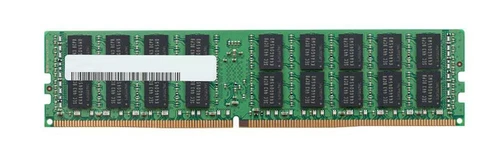
This 32GB DDR4-2400 Registered ECC memory module is engineered for enterprise-class servers and workstations tasked with virtualized environments, in-memory databases, and other data-integrity-critical workloads. Its dual-rank x4 architecture combined with Registered (buffered) signaling and ECC error correction ensures stable signal integrity across high-density memory configurations while actively detecting and correcting single-bit errors to maintain uninterrupted operation.
1. Registered buffer technology scales memory to high capacities across numerous DIMM slots while preserving signal integrity, essential for running large-scale virtualization hosts without data access errors.
2. ECC protection continuously detects and corrects single-bit memory faults, delivering the end-to-end data resilience required by transactional databases and financial processing.
3. Dual Rank x4 organization interleaves data across internal banks to sustain near-peak throughput, directly benefiting latency-sensitive analytics and in-memory caching.
4. High-density module capacity allows servers to accommodate more active virtual machines per node, lowering infrastructure cost by consolidating workloads onto fewer physical boxes.
5. Efficient base frequency ensures stable memory performance under 24/7 operation, matching the power and thermal budgets typical of dense rack deployments.
The Samsung M393A4K40CB1-CRC4Q is a 32GB DDR4-2400 Registered DIMM, purpose-built for enterprise servers where every bit of data integrity and uptime counts. Its four defining characteristics translate directly into hardened reliability for mission-critical workloads. First, ECC error correction continuously detects and corrects single-bit memory errors, silently preventing cosmic-ray-induced data corruption that could crash a virtual machine or poison a financial transaction. In a dense virtualization cluster hosting dozens of tenants, that safeguard means you avoid unexplained hypervisor failures and preserve multi-tenant isolation. Second, the registered signal buffer stabilizes command and address lines as you scale—without it, populating all 24 DIMM slots on a dual-socket server would cause signal degradation and intermittent faults; with RDIMM, your memory bus remains crisp even under full load, essential when running memory-hungry in-memory databases like SAP HANA where a single uncorrected error can scrap an entire analytics query. Third, the dual-rank x4 organization interleaves two internal rank groups per module, boosting bandwidth through parallel bank accesses. This lets a virtualized SQL Server instance sustain higher transaction throughput under concurrent users without stalling on row-activation latency. Finally, the low 1.2V JEDEC voltage and CL17 latency keep thermals in check across a 2U rack server, so cooling overhead stays predictable while your Redis clusters serve sub-millisecond lookups. Simply put, this module turns raw specs into a foundation for always-available services.
General Virtualization
This Samsung 32GB DDR4-2400 RDIMM is built for dense server virtualization. Deploy six to eight of these dual-rank modules across the memory channels of a typical dual-socket Xeon platform to achieve 192–256 GB, comfortably supporting 40–50 average virtual machines. The registered ECC design ensures stability under the constant memory pressure of mixed-workload hypervisors.
In-Memory Database
For in-memory databases like Redis or SAP HANA, low latency and data integrity are paramount. Populate all memory channels with identical sticks — a 12-module configuration providing 384 GB — to leverage the 1.2V energy efficiency and x4 DRAM width for superior error correction. The CL17 CAS latency at 2400 MT/s delivers a balanced profile for large dataset caching without unexpected power spikes.
High-Performance Computing (HPC)
HPC clusters demand maximum memory bandwidth per node. Install one DIMM per channel (1DPC) using these dual-rank RDIMMs to achieve optimal signal integrity and speed, often sacrificing total capacity for clock stability. A common build employs eight modules for 256 GB per node, providing the sustained throughput needed for MPI-based simulations and finite element analysis while maintaining registered ECC precision.
Validated for Dell PowerEdge R740, HPE ProLiant DL380 Gen10, Lenovo ThinkSystem SR650, fully compatible DDR4-2400 ECC RDIMM.
Q: Can I mix this M393A4K40CB1-CRC4Q with other memory modules of different brands or speeds?
A: Mixing RDIMMs of different brands, speeds, or ranks is not advised. Inconsistent register timings and ECC handling can cause boot failures or silent data corruption in server environments. Use identical modules for guaranteed stability.
Q: Is this memory compatible with my system? (Server platforms: Intel Xeon / AMD EPYC)
A: This DDR4-2400 ECC Registered RDIMM is validated for Intel Xeon E5-2600 v3/v4 platforms and select AMD EPYC 7001 series. Please verify your server board's qualified vendor list for M393A4K40CB1-CRC4Q to ensure full RDIMM support.
Q: What is the recommended DIMM population order for optimal performance?
A: Follow the server motherboard manual: populate the furthest white or blue slot from each CPU per channel first. For dual-socket systems, balance identical RDIMMs evenly across memory channels to maintain symmetric access and maximize throughput.
Q: Does this module support overclocking or XMP profiles?
A: No. This server-grade ECC Registered DIMM runs strictly at JEDEC DDR4-2400 CL17. Overclocking and XMP are disabled to preserve error correction and data integrity. The fixed profile ensures reliable operation under sustained enterprise workloads.
Q: What warranty and typical failure rate can I expect?
A: This Samsung module includes a 1-year warranty. Engineered for 24/7 operation, enterprise RDIMMs like this typically exhibit an annualized failure rate (AFR) below 0.5% under specified conditions, backed by rigorous burn-in testing and quality controls.