











 Secure payments
Standard refund policy
Trade Assurance
Secure payments
Standard refund policy
Trade Assurance
| Product Type | Memory Module |
|---|---|
| Memory Capacity | 32 GB |
| Memory Technology | DDR4 |
| Product Voltage | 1.2 V |
| RAM Speed | 2400 MHz |
| RAM Standard | DDR4-2400/PC4-19200 |
| Error Identifying | ECC |
| Signal Type | Registered |
| Column Access Strobe (CAS) | CL17 |
| Rank | Dual Rank x4 |
| Quantity of Pins | 288-pin |
| RAM Genre | VLP RDIMM |
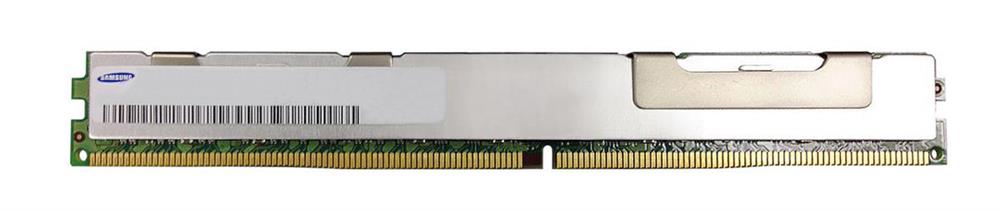
This VLP RDIMM is a server-grade module engineered for dense virtualization and in-memory database workloads, where its Registered signal type and ECC ensure robust signal integrity and end-to-end data protection. The dual-rank x4 organization with CL17 latency maximizes memory bandwidth in population-heavy 1U/2U platforms while the very low-profile form factor solves clearance constraints in compact server chassis.
1. Registered signal buffering stabilizes high-capacity memory configurations, ensuring reliable operation in multi-socket servers under full load.
2. ECC error correction detects and fixes single-bit memory faults, preserving data integrity for mission-critical databases and financial transactions.
3. The Very Low Profile design allows dense memory installation in 1U and blade servers, maximizing compute power within tight thermal envelopes.
4. Dual rank x4 organization interleaves memory accesses across ranks, boosting effective bandwidth for virtualized workloads and in-memory analytics.
5. A 32GB capacity per module raises memory density per server, enabling more virtual machines and containers without sacrificing performance.
The Samsung M392A4K40BM0-CRC0Y is a server-grade VLP RDIMM, and its design speaks directly to the pain points of modern data centers. When you are running a dense virtualization cluster hosting dozens of VMs, every bit matters. The ECC technology instantly corrects single-bit memory errors caused by background radiation, preventing silent data corruption that could crash a critical database or require a full node reboot. At the same time, the Registered signal buffer takes the electrical load off the CPU’s memory controller, so you can populate all 24 DIMM slots on a 2-socket board with 32GB modules without sacrificing stability — a lifesaver in memory-hungry environments like SAP HANA or large-scale Redis clusters where total RAM capacity directly determines performance.
The dual-rank x4 organization increases bank-level parallelism, delivering measurably higher sustained bandwidth for in-memory analytics compared to single-rank alternatives. Moreover, its Very Low Profile form is mission-critical for 1U rack servers and blade enclosures with severe space constraints; the reduced height improves front-to-back airflow, lowering operational temperatures and allowing denser CPU and GPU configurations without thermal throttling. This module transforms a routine memory upgrade into a strategic investment in uptime, density, and cooling efficiency, directly reducing TCO for any scale-out deployment.
Server Memory Identified
This 32GB DDR4-2400 ECC Registered VLP RDIMM (dual-rank x4, 1.2V, 288-pin) is purpose‑built for enterprise servers. Below is capacity planning guidance for typical server workloads.
General Virtualization
Deploy six to eight modules per host (192–256 GB) to comfortably run 20–30 moderate VMs, balancing density and cost. Populate all memory channels with one DIMM per channel (1DPC) for best 2400 MT/s speed; if greater capacity is vital, move to two DIMMs per channel but expect a slight frequency drop. Leave at least two slots open for future expansion.
In-Memory Database
Maximize capacity and interleaving by fully populating all channels with these 32GB dual-rank RDIMMs—12 or 16 modules (384–512 GB) are common for Redis, Memcached, or SAP HANA instances. The dual‑rank x4 organization boosts bank‑level parallelism, reducing latency under heavy random access. Keep memory speed stable by staying at 1DPC where possible, but prioritize capacity if the dataset demands it.
High-Performance Computing
Use one module per channel (typically eight 32GB RDIMMs for 256 GB) to sustain the 2400 MT/s clock without throttling. The dual‑rank design already delivers strong bandwidth; avoid mixing different ranks or capacities. For highly threaded MPI or OpenMP codes, ensure uniform population across all CPU sockets to maintain NUMA balance and consistent access latency.
Rigorously tested, compatible with Dell PowerEdge R760, HPE ProLiant DL380 Gen10, Lenovo ThinkSystem SR650.
Q: Can I mix this M392A4K40BM0-CRC0Y with other memory modules of different brands or speeds?
A: Mixing different brands or speeds is not recommended for servers. It may cause instability. For registered ECC memory, populate with identical modules to ensure reliable operation and maintain data integrity.
Q: Is this memory compatible with my system?
A: This 32GB DDR4-2400 ECC Registered VLP RDIMM is designed for servers with Intel Xeon E5-2600 v4 or AMD EPYC platforms supporting DDR4 Registered DIMMs. Verify your motherboard's QVL for compatibility.
Q: What is the recommended DIMM population order for optimal performance?
A: For dual-socket servers, populate memory channels per your system manual, typically starting with slot A1, B1, then C1, D1. For dual rank x4 modules, ensure balanced channel loading for best performance.
Q: Does this module support overclocking or XMP profiles?
A: No, this ECC Registered server memory does not support overclocking or XMP. It operates at JEDEC standard DDR4-2400 for maximum stability and data integrity in mission-critical environments.
Q: What warranty and typical failure rate can I expect?
A: This module comes with a 1-year warranty. ECC server memory typically has very low failure rates due to rigorous testing. Expect a mean time between failures (MTBF) exceeding millions of hours.