











 Secure payments
Standard refund policy
Trade Assurance
Secure payments
Standard refund policy
Trade Assurance
| Product Type | Memory Module |
|---|---|
| Memory Capacity | 32 GB |
| Memory Technology | DDR4 |
| Product Voltage | 1.2 V |
| RAM Speed | 2400 MHz |
| RAM Standard | DDR4-2400/PC4-19200 |
| Error Identifying | ECC |
| Signal Type | Registered |
| Column Access Strobe (CAS) | CL17 |
| Rank | Dual Rank x4 |
| Quantity of Pins | 288-pin |
| RAM Genre | RDIMM |
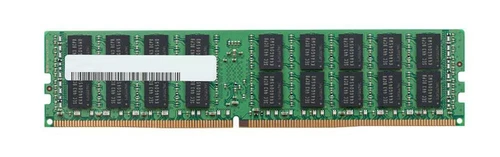
This 32GB DDR4-2400 Registered ECC RDIMM is purpose-built for enterprise servers and virtualization hosts, delivering the data integrity and reliability required for memory-intensive workloads such as in-memory databases and consolidated virtual machine environments. Its dual-rank x4 configuration and registered signaling strengthen signal integrity and memory channel efficiency under high-load conditions, while ECC actively corrects single-bit errors to prevent silent data corruption.
1. Registered signal buffering ensures stable operation across fully populated server memory channels, reducing electrical load on the memory controller for maximum platform reliability.
2. ECC protection corrects single-bit errors and detects multi-bit faults, preserving data integrity in mission-critical databases and preventing silent corruption.
3. Dual Rank x4 organization interleaves memory accesses to sustain high bandwidth utilization, which directly improves virtual machine response times under heavy consolidation.
4. Generous capacity per module allows hyperscale deployments to reach higher memory density per server node, expanding the number of containers and VMs without sacrificing performance.
5. 2400 MT/s transfer rate with CL17 latency delivers a balanced profile of steady throughput and predictable access times, ideal for transactional workloads that require consistent quality of service.
The Samsung M393A4K40CB1-CRC0Q is a 32GB DDR4-2400 Registered DIMM engineered specifically for server environments, and its four defining characteristics translate directly into reliability and performance where downtime is not an option. The ECC technology continuously detects and corrects single-bit memory errors, a critical defense against silent data corruption that, in a virtualized cluster, prevents a flipped bit from crashing multiple guest systems or propagating into storage snapshots. The Registered signal buffer stabilizes heavy memory configurations by reducing the electrical load on the CPU’s memory controller, meaning a fully populated bank of 24 DIMMs runs 24/7 without signal degradation—this is the difference between confident scaling and intermittent failures in a database server. Operating at a low 1.2V and configured as Dual Rank x4, the module delivers superior energy efficiency while the dual-rank interleaving boosts bandwidth through parallel access; for an in-memory database like Redis or SAP HANA, this layout reduces latency under concurrent query loads, ensuring that massive datasets are served with minimal CPU stall cycles. In practice, these attributes allow IT architects to consolidate more virtual machines per node and run OLTP workloads with absolute data integrity, making this RDIMM a foundation for mission-critical infrastructure rather than a commodity component.
Based on the specifications — DDR4-2400, Registered ECC, Dual Rank x4, 288-pin RDIMM — this is clearly a server memory module designed for stability and data integrity. Below is capacity planning guidance for typical workload scenarios.
General Virtualization
For general hypervisor hosts running mixed VMs, populate dual processors with at least 8–12 identical 32 GB RDIMMs per server to balance memory channels and leave expansion room. Configure in symmetric DIMM population across all memory channels to maintain NUMA balance and full memory bandwidth.
In-Memory Database
In-memory databases like Redis or SAP HANA demand both capacity and reliability. Use multiple 32 GB RDIMMs to reach 256–512 GB per socket, ensuring all channels are filled identically. The ECC and registered architecture help prevent data corruption during sustained high-throughput access.
High-Performance Computing (HPC)
HPC clusters benefit from dense, balanced configurations memory per core ratio is critical. Deploy six to eight 32 GB RDIMMs per CPU to achieve 192–256 GB while populating all channels, maximizing interleaving and bandwidth for compute-intensive parallel workloads.
Rigorously tested server memory compatible with Dell PowerEdge R740, HPE ProLiant DL380 Gen10, Lenovo ThinkSystem SR650.
Q: Can I mix this M393A4K40CB1-CRC0Q with other memory modules of different brands or speeds?
A: Mixing this registered ECC module with different brands or speeds is not recommended. Disparities can cause stability issues or downclocking. For server reliability, use identical modules validated for your platform.
Q: Is this memory compatible with my system?
A: This DDR4-2400 RDIMM targets servers based on Intel Xeon E5-2600 v3/v4 or AMD EPYC 7001 platforms. Verify your motherboard’s qualified vendor list (QVL) for guaranteed compatibility with this 32GB registered ECC module.
Q: What is the recommended DIMM population order for optimal performance?
A: Populate identically across memory channels for balanced performance. Follow your server manual's slot numbering, typically filling blue slots first. Symmetrical Dual Rank x4 installation ensures maximum throughput and minimizes latency.
Q: Does this module support overclocking or XMP profiles?
A: No. This is a JEDEC-compliant registered server DIMM with ECC. It runs at fixed DDR4-2400 CL17 timings and does not support overclocking or XMP, prioritizing enterprise data integrity and stability.
Q: What warranty and typical failure rate can I expect?
A: It includes a 1-year warranty. The typical Annualized Failure Rate (AFR) is below 0.5% under specified conditions, reflecting rigorous factory testing for 24/7 server operation and long-term reliability.