











 Secure payments
Standard refund policy
Trade Assurance
Secure payments
Standard refund policy
Trade Assurance
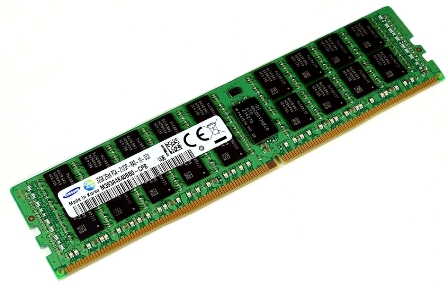
| Product Type | Memory Module |
|---|---|
| Memory Capacity | 32 GB |
| Memory Technology | DDR4 |
| Product Voltage | 1.2V |
| RAM Speed | 2400MHz |
| RAM Standard | DDR4-2400/PC4-19200 |
| Error Identifying | ECC |
| Signal Type | Registered |
| Column Access Strobe (CAS) | CL17 |
| Rank | Quad Rank x4 |
| Quantity of Pins | 288-pin |
| RAM Genre | RDIMM |
Designed as a server-grade DDR4-2400 Registered DIMM with ECC, this 32GB module is optimal for virtualization clusters and in-memory databases where data integrity under sustained load is critical. Its quad-rank x4 organization and registered signaling maximize per-channel capacity and signal stability, enabling dense, mission-critical server deployments without sacrificing reliability.
1. ECC protection detects and corrects single-bit errors on the fly, safeguarding transactional data integrity for mission-critical database and financial workloads.
2. Registered signal buffering stabilizes high-density memory channels, enabling seamless scaling to massive capacities without sacrificing enterprise server uptime.
3. The 32-gigabyte capacity per module maximizes virtual machine density per rack unit, reducing server sprawl and optimizing software license costs.
4. Quad Rank x4 organization packs more bank groups into a single DIMM, maintaining elevated bandwidth utilization even under the heavy concurrency of in-memory analytics.
5. A 2400 MHz transfer rate strikes a deliberate balance between throughput and power efficiency, ideal for sustained operation in thermally constrained data center deployments.
Built from the ground up for enterprise servers, the M386A4G40EM2-CRC5Y is a 32GB DDR4-2400 Registered DIMM where its four core attributes directly translate into uncompromised data center reliability. The first is ECC error correction, which proactively detects and corrects single-bit memory errors caused by cosmic radiation or electrical noise. In a virtualization cluster hosting dozens of VMs, an uncorrected bit flip can silently corrupt a financial transaction or crash a hypervisor; ECC prevents this at the hardware level, safeguarding business continuity. The second is the Registered (buffered) signal architecture. When you populate a server with six or more modules to run a large in-memory database like SAP HANA, the register chip stabilizes command and address signals across all DRAM chips. Without it, electrical loading would cause signal degradation and sporadic instability under heavy load. The third is the quad-rank x4 organization, which packs more DRAM banks onto the module. This increases bank-level parallelism, reducing access conflicts when multiple database queries or virtual machines contend for memory simultaneously—translating to consistently lower latency under mixed workloads. Finally, the 1.2V low-voltage DDR4 design cuts power consumption per DIMM, which cumulatively reduces cooling overhead across a fully populated rack. In practice, this means a virtualized cluster runs denser, stays cooler, and processes critical workloads with zero tolerance for silent data corruption.
General Virtualization
Deploy four 32GB RDIMMs across all memory channels for a balanced 128GB configuration, supporting dozens of lightweight VMs without overcommitting. This quad-rank module’s registered architecture allows stable operation even with mixed workloads, but populate identical DIMMs per channel to avoid performance penalties.
In-Memory Database
Maximize capacity with 12 or 16 modules in a dual-socket server, yielding 384GB to 512GB to keep entire datasets in RAM. Although 2400MT/s is moderate, the ECC and registered buffer ensure data integrity under constant write pressure. Distribute quad-rank DIMMs evenly across memory controllers to sustain high bandwidth.
High-Performance Computing (HPC)
Employ full channel population with two DIMMs per channel using 16 modules to reach 512GB, enabling large working sets for simulation or rendering. Quad-rank loading may drop speed to 1866MT/s in top-fill scenarios, so verify node BIOS limits. Combine with a CPU supporting many cores to leverage the accessible capacity without bottlenecking memory throughput.
Rigorously tested, compatible with Dell PowerEdge R740, HPE ProLiant DL380 Gen10, Lenovo ThinkSystem SR650, and more.
Q: Can I mix this M386A4G40EM2-CRC5Y with other memory modules of different brands or speeds?
A: Mixing registered DIMMs with different brands or speeds is not recommended, as it often causes POST failures or instability. For reliable server operation, always populate identical Samsung modules with matching ranks and CAS latency.
Q: Is this memory compatible with my Intel Xeon Scalable or AMD EPYC server platform?
A: This DDR4-2400 RDIMM operates at 1.2V with ECC and is compatible with systems using Intel Xeon E5-2600 v3/v4 or first-generation Xeon Scalable processors. Verify your motherboard’s QVL for quad-rank x4 support.
Q: What is the recommended DIMM population order for optimal performance?
A: For quad-rank x4 RDIMMs on a dual-socket server, populate identical modules per channel, starting with the farthest slots from the CPU. Balance memory across all memory controllers to maintain interleaved performance.
Q: Does this module support overclocking or XMP profiles?
A: No. This is an enterprise registered ECC module designed for stability at JEDEC standard DDR4-2400 CL17 timings. It does not support XMP or overclocking, preserving data integrity in mission-critical environments.
Q: What warranty and typical failure rate can I expect?
A: This Samsung original module includes a 1-year warranty. Registered ECC memory exhibits very low annualized failure rates under normal server operating conditions, typically less than 0.03% AFR when properly cooled.