











 Secure payments
Standard refund policy
Trade Assurance
Secure payments
Standard refund policy
Trade Assurance
| Product Type | Memory Module |
|---|---|
| Memory Capacity | 32 GB |
| Memory Technology | DDR4 |
| Product Voltage | 1.2 V |
| RAM Speed | 2400 MHz |
| RAM Standard | DDR4-2400/PC4-19200 |
| Error Identifying | ECC |
| Signal Type | Registered |
| Column Access Strobe (CAS) | CL17 |
| Rank | Dual Rank x4 |
| Quantity of Pins | 288-pin |
| RAM Genre | VLP RDIMM |
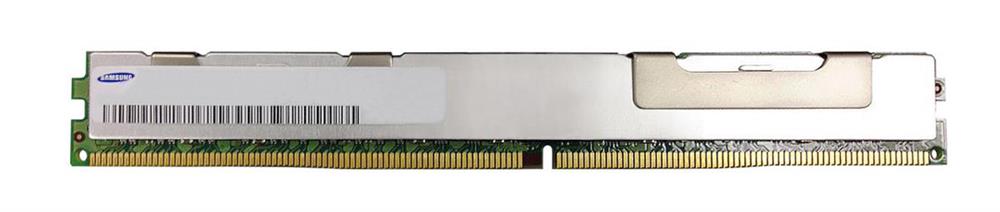
This 32GB DDR4-2400 VLP RDIMM with ECC and registered signaling targets dense virtualization and in-memory database deployments in space-constrained 1U servers, leveraging its dual-rank x4 organization for enhanced memory interleaving bandwidth. Hardware error correction combined with the registered command/address bus guarantees end-to-end data integrity and stable operation under heavy, fully populated memory channel loads.
1. Registered signal type buffers command and address lines, enabling the deployment of high-density memory configurations without compromising signal integrity in data center servers.
2. ECC error correction detects and corrects single-bit memory errors, preventing silent data corruption in critical enterprise applications and virtualization platforms.
3. Dual Rank x4 organization boosts memory bandwidth via interleaving, sustaining heavy virtual machine workloads and accelerating in-memory database operations.
4. VLP (Very Low Profile) form factor fits into compact 1U server chassis, optimizing thermal airflow and allowing denser node packaging in hyperscale data centers.
5. A 32GB capacity per module maximizes the memory footprint per CPU socket, providing ample headroom for large-scale virtualization and memory-hungry enterprise software suites.
When deploying dense server environments like virtualization clusters or in-memory databases, every component choice ripples through reliability and performance. The Samsung M392A4K40BM0-CRC0Q, a DDR4-2400 VLP RDIMM, is purpose-built for these exacting workloads, and four distinct characteristics define its value.
First, its Error Correcting Code (ECC) constantly scrubs single-bit errors—a crucial shield against silent data corruption that could crash a hypervisor hosting dozens of virtual machines or poison a financial transaction in Redis. Second, the Registered (RDIMM) signal buffer stabilizes the command bus when populating all 24 DIMM slots of a dual-socket server, letting you safely scale to hundreds of gigabytes for large database caches without signal integrity compromises that cause boot failures. Third, the Very Low Profile (VLP) form factor actively solves a physical pain point: in 1U rack servers or blade nodes, standard-height modules obstruct critical airflow across CPUs, but this module’s reduced height drops into tight spaces, keeping thermal headroom safe and fans from screaming under constant high load. Finally, its dual-rank x4 organization enables rank interleaving, meaning the memory controller can pipeline concurrent read and write operations across ranks. For a virtualized SQL Server or an in-memory analytics platform, this parallelism directly translates to lower latency and higher sustained throughput when multiple tenants hammer the memory bus simultaneously. This is not just a stick of RAM; it is a strategic layer of stability, density, and cooling assurance that keeps your services running without compromise.
This memory module is a server-class DDR4-2400 VLP RDIMM with ECC and registered signaling, designed for dense, rack-optimized systems. The following capacity-planning guidance covers its best-fit scenarios.
General Virtualization
Populate at least one 32GB DIMM per memory channel to balance density and throughput. In a dual-socket server with eight channels per CPU, installing sixteen modules yields 512GB, supporting high VM consolidation ratios. The very-low-profile form factor maintains airflow in 1U and 2U chassis.
In-Memory Database
Maximize capacity by fully populating all channels with these dual-rank x4 modules to feed large datasets (e.g., Redis, SAP HANA). Configure identical DIMMs across CPU sockets to preserve NUMA locality. Two-socket nodes equipped with 32GB RDIMMs can easily reach 1TB, and the VLP design eases cooling in dense appliances.
High Performance Computing
For bandwidth-sensitive workloads, install one DIMM per channel to exploit balanced memory interleaving and full DDR4-2400 speed. These dual-rank RDIMMs offer a sweet spot between capacity and sustained throughput. Uniform population across all channels prevents NUMA bottlenecks and ensures repeatable run times.
Rigorously tested, compatible with Dell PowerEdge R740, HPE DL380 Gen10, Lenovo SR650, and similar servers.
Q: Can I mix this M392A4K40BM0-CRC0Q with other memory modules of different brands or speeds?
A: Mixing is not recommended. Registered ECC memory demands matched ranks, timings, and speeds for stable server operation. Mismatched modules may cause POST failures or silent data corruption, jeopardizing system integrity.
Q: Is this memory compatible with my system? I am using an Intel Xeon Scalable platform.
A: This DDR4-2400 RDIMM is validated for Intel Xeon E5-2600 v4 and select Xeon Scalable platforms. Verify your motherboard supports 2400 MT/s Registered ECC and has 288-pin DIMM slots. Check the manufacturer's qualified vendor list (QVL) for precise compatibility.
Q: What is the recommended DIMM population order for optimal performance?
A: Populate identical DIMMs in balanced sets per memory channel, typically starting with the slots furthest from the CPU. Follow your server’s manual, usually filling blue then black slots to enable multi-channel interleaving and maximize bandwidth.
Q: Does this module support overclocking or XMP profiles?
A: No. This is a JEDEC-compliant Registered ECC module operating at its native 2400 MT/s with CL17. Server platforms prioritize stability and data integrity over overclocking. XMP is not supported; the module runs at standard JEDEC timings.
Q: What warranty and typical failure rate can I expect?
A: This module carries a one-year warranty. Enterprise-grade DDR4 RDIMMs exhibit an annualized failure rate (AFR) below 0.5% under normal operating conditions. ECC corrects most single-bit errors, maintaining high data reliability throughout its lifespan.