











 Secure payments
Standard refund policy
Trade Assurance
Secure payments
Standard refund policy
Trade Assurance
| Product Type | Memory Module |
|---|---|
| Memory Capacity | 32 GB |
| Memory Technology | DDR4 |
| Product Voltage | 1.2V |
| RAM Speed | 2666MHz |
| RAM Standard | DDR4-2666/PC4-21300 |
| Error Identifying | ECC |
| Signal Type | Registered |
| Column Access Strobe (CAS) | CL19 |
| Rank | Dual Rank x4 |
| Quantity of Pins | 288-pin |
| RAM Genre | RDIMM |
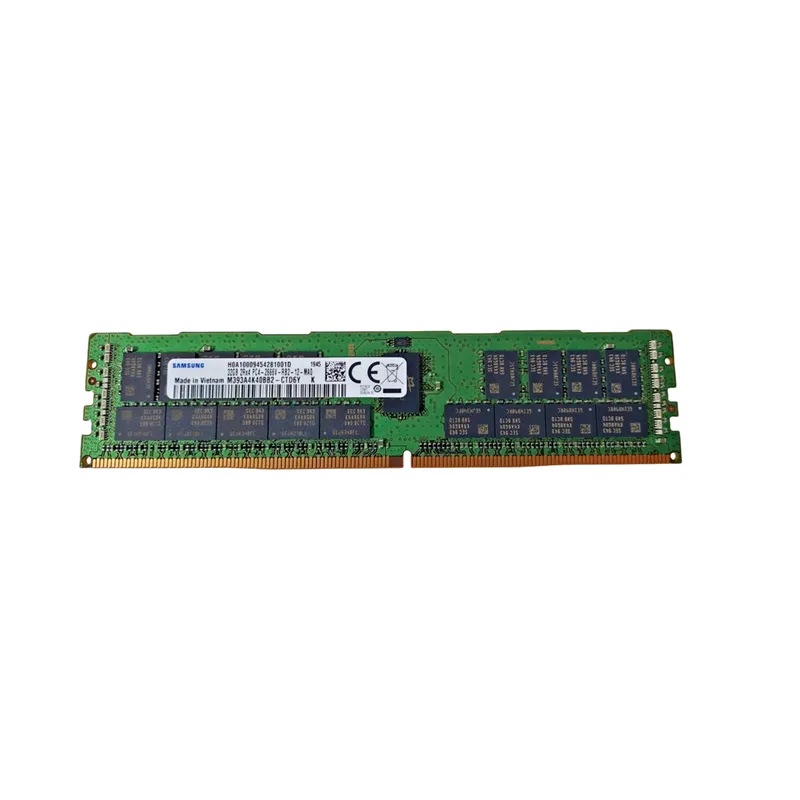
This RDIMM is engineered for enterprise servers and workstations, where its DDR4-2666 speed, ECC error correction, and registered signal buffering ensure uncompromised data integrity and rock-solid stability under heavy, sustained loads. The dual-rank x4 organization maximizes memory interleaving for superior throughput in virtualized environments and in-memory database applications, making it the ideal choice for mission-critical deployments that demand high capacity and reliability.
1. ECC protection silently corrects single-bit errors, preserving the integrity of financial transactions and virtualized databases against undetected data corruption.
2. Registered clock drivers buffer command and address signals, enabling densely packed memory configurations that scale effortlessly under heavy enterprise workloads.
3. Generous per-module capacity allows more virtual machines to reside on a single physical host, directly boosting consolidation density and cost efficiency.
4. Dual rank x4 organization interleaves accesses across internal banks, keeping memory channels saturated to sustain throughput for concurrent analytics and large in-memory caches.
5. High-speed DDR4 clocking supplies the bandwidth headroom modern multi-core server processors demand, preventing memory bottlenecks during peak data-center traffic.
When deploying dense virtualization clusters or running in-memory databases like SAP HANA, reliability isn't optional — it's foundational. The M393A4K40BB2-CTD6Y is a 32GB DDR4-2666 RDIMM engineered precisely for these enterprise workloads, and its four defining characteristics translate directly into tangible operational resilience.
First, ECC error correction actively detects and corrects single-bit memory errors. In a virtualized host running dozens of VMs, a silent bit-flip in customer data or hypervisor code can cascade into application failure or data corruption; ECC eliminates that risk at the hardware level. Second, the registered buffer stabilizes signal integrity across the memory channel. This means you can populate all DIMM slots without compromise, scaling to the high memory densities that virtualization and large dataset processing demand. Third, the dual-rank x4 organization interleaves access across internal banks, delivering measurably higher sustained bandwidth under concurrent workloads — a critical advantage when a real-time pricing engine queries a gigabyte-sized in-memory dataset. Finally, operating at a low 1.2V, this module helps keep thermal profiles in check across fully loaded 24-slot servers, reducing cooling costs and improving long-term reliability in always-on environments. For the database administrator or infrastructure architect, it’s not just a spec sheet — it’s guaranteed uptime and predictable performance under load.
Capacity Planning Guide for DDR4-2666 32GB RDIMM
This registered ECC memory module is designed for server platforms, ensuring data integrity in mission-critical environments. The following recommendations assume a dual-socket system with 16 DIMM slots per node, leveraging 32GB dual-rank x4 RDIMMs for balanced capacity and bandwidth.
General Virtualization
Populate six to eight modules per host (192–256 GB) to support 20–30 moderate VMs. Distribute modules evenly across memory channels for optimal throughput, and keep two DIMM slots available for future scaling without replacing existing sticks.
In-Memory Database
Maximize capacity and channel utilization with at least twelve modules (384 GB) to hold large datasets entirely in RAM. Configure one DIMM per channel to maintain full 2666 MT/s speed, avoiding the performance penalty of three DPC configurations.
High Performance Computing
Install eight modules (256 GB) in a balanced eight-channel population to feed compute cores efficiently. Combine with identical kits across nodes to guarantee uniform performance in clustered jobs, and choose CL19 latency for predictable, stable execution under sustained load.
Rigorously tested server memory, verified compatible with Dell PowerEdge R740, HPE ProLiant DL380 Gen10, and Lenovo ThinkSystem SR650.
Q: Can I mix this M393A4K40BB2-CTD6Y with other memory modules of different brands or speeds?
A: Mixing RDIMMs of different brands or speeds is not recommended. The system will downclock all modules to the lowest common speed, potentially causing stability issues on server platforms. Use identical kits for guaranteed performance.
Q: Is this memory compatible with my Intel Xeon Scalable or AMD EPYC server platform?
A: Yes, this DDR4-2666 Registered ECC RDIMM is compatible with most Intel Xeon Scalable (1st/2nd Gen) and AMD EPYC (7001/7002 series) platforms that support 288-pin DDR4-2666 Registered memory at 1.2V.
Q: What is the recommended DIMM population order for optimal performance?
A: Follow your server motherboard manual, typically populating identical modules per channel, starting with the farthest slot from the CPU. For dual-socket systems, balance channels symmetrically to maximize memory bandwidth and interleaving.
Q: Does this module support overclocking or XMP profiles?
A: No, enterprise server RDIMMs do not support overclocking or XMP. They operate exclusively at JEDEC standard timings (DDR4-2666, CL19) to ensure 24/7 stability and data integrity under mission-critical workloads.
Q: What warranty and typical failure rate can I expect?
A: This module comes with a 1-year warranty. Built with Samsung 10nm-class DRAM, the AFR (Annualized Failure Rate) is typically below 0.3% under standard server thermal conditions, ensuring high reliability.