











 Secure payments
Standard refund policy
Trade Assurance
Secure payments
Standard refund policy
Trade Assurance
| Product Type | Memory Module |
|---|---|
| Memory Capacity | 32 GB |
| Memory Technology | DDR4 |
| Product Voltage | 1.2 V |
| RAM Speed | 2666 MHz |
| RAM Standard | DDR4-2666/PC4-21300 |
| Error Identifying | ECC |
| Signal Type | Registered |
| Column Access Strobe (CAS) | CL19 |
| Rank | Dual Rank x4 |
| Quantity of Pins | 288-pin |
| RAM Genre | RDIMM |
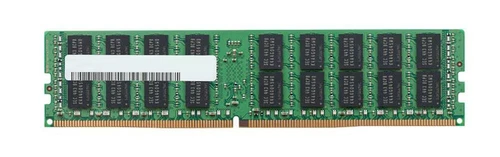
This 32GB DDR4-2666 Registered ECC module (M393A4K40CB2-CTD6Y) is engineered for enterprise server platforms where data integrity and uptime are paramount, making it ideal for virtualization clusters, in-memory databases, and mission-critical workloads. Its Dual Rank x4 organization and Registered signal type enhance signal integrity and memory channel efficiency at higher capacities, while ECC protection proactively corrects single-bit errors to prevent silent data corruption in 24/7 operation.
1. ECC error correction automatically resolves single-bit memory faults, preserving transactional integrity and preventing silent data corruption in mission-critical server workloads.
2. Registered signal buffering isolates the memory controller from electrical loading, enabling stable population of all 24 DIMM slots without sacrificing signal quality in dense racks.
3. The 32GB capacity per stick dramatically increases memory headroom per CPU socket, allowing hypervisors to consolidate more virtual machines without hitting resource limits.
4. Dual Rank x4 organization interleaves bank groups to keep the 2666MT/s channel fully fed, sustaining low-latency throughput during in-memory analytics and large database scans.
5. 2666MT/s DDR4 speed delivers predictable bandwidth for enterprise virtualization, balancing power efficiency against the demands of concurrent VMware or KVM guests.
Designed for enterprise servers, the Samsung M393A4K40CB2-CTD6Y RDIMM transforms raw specifications into tangible datacenter resilience. Its ECC technology is your last line of defense against silent bit flips caused by cosmic radiation or electrical noise—when this 32 GB module safeguards an in-memory database like Redis, a single corrected error can prevent transaction corruption that would otherwise cascade into revenue loss. The registered signal buffer decouples the memory controller from the electrical load of multiple DIMMs, meaning you can fully populate a server with 12 or more modules for dense virtualization clusters without sacrificing boot-time stability or risking sporadic crashes that wake your team at 3 a.m. Dual-rank x4 organization leverages rank interleaving to overlap memory accesses, delivering measurably lower latency under the random read and write storms typical of a virtual desktop infrastructure or a heavily fragmented database instance. Operating at 1.2 V and DDR4-2666 speed, the module delivers a sustained 21.3 GB/s of bandwidth—enough to keep hundreds of simultaneous OLTP queries flowing while drawing less power per gigabyte, which directly shrinks your cooling budget in a colocation rack. These are not chipset talking points; they are the difference between a platform that merely runs and one that consistently serves your users without compromise.
Based on the ECC, Registered signal type and RDIMM form factor, this is server memory. Below is the capacity planning guide for its typical workloads.
General Virtualization
Populate six or eight identical 32 GB RDIMMs per CPU to saturate memory channels evenly and provide sufficient capacity. A typical dual‑socket server with 12 such modules delivers 384 GB, comfortably hosting dozens of general‑purpose VMs while maintaining data integrity through ECC.
In-Memory Database
Maximise both capacity and bandwidth by installing one DIMM per channel to retain the full 2666 MT/s speed. For larger footprints, use two DIMMs per channel, understanding the speed may drop to 2400 MT/s. Target at least 512 GB (16 modules) or 1 TB on supported platforms to keep the entire dataset in memory.
High-Performance Computing (HPC)
Priority goes to sustained memory bandwidth and balanced NUMA access. Install one Dual Rank x4 DIMM per channel, typically eight modules for 256 GB on an 8‑channel platform, guaranteeing 2666 MT/s operation. Avoid mixing capacities and configure interleaving to deliver consistent, low‑latency throughput across all cores.
Server-grade, rigorously tested: compatible with Dell PowerEdge R740, HPE ProLiant DL380 Gen10, Lenovo ThinkSystem SR650, and more.
Q: Can I mix this M393A4K40CB2-CTD6Y with other memory modules of different brands or speeds?
A: Mixing different brands or speeds with registered ECC memory is not recommended. It can cause signal integrity issues and system instability. For reliable operation, use identical M393A4K40CB2-CTD6Y modules across all channels.
Q: Is this memory compatible with my system?
A: This 32GB DDR4-2666 RDIMM is compatible with servers using Intel Xeon Scalable or AMD EPYC platforms. Verify your motherboard supports 288-pin DDR4 ECC Registered DIMMs and a 2666MT/s speed grade.
Q: What is the recommended DIMM population order for optimal performance?
A: For optimal performance, populate identical DIMMs per channel balancing the memory controllers. Refer to your server's manual; typically install in sets of 1 DIMM per channel first, then fill remaining slots symmetrically across CPUs.
Q: Does this module support overclocking or XMP profiles?
A: No. This is a JEDEC-compliant server RDIMM operating at standard DDR4-2666 speed. It does not support overclocking or XMP profiles, as enterprise environments prioritize data integrity and stability.
Q: What warranty and typical failure rate can I expect?
A: This module includes a 1-year warranty. As an enterprise-grade Samsung RDIMM with rigorous testing, its annualized failure rate (AFR) is typically below 0.5%, ensuring high reliability in 24/7 operations.