











 Secure payments
Standard refund policy
Trade Assurance
Secure payments
Standard refund policy
Trade Assurance
| Product Type | Memory Module |
|---|---|
| Memory Capacity | 32 GB |
| Memory Technology | DDR4 |
| Product Voltage | 1.2 V |
| RAM Speed | 2666 MHz |
| RAM Standard | DDR4-2666/PC4-21300 |
| Error Identifying | ECC |
| Signal Type | Registered |
| Column Access Strobe (CAS) | CL19 |
| Rank | Dual Rank x4 |
| Quantity of Pins | 288-pin |
| RAM Genre | RDIMM |
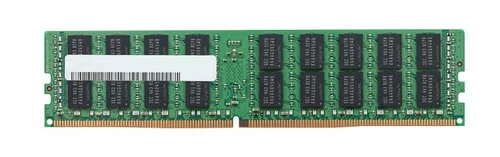
This 32 GB DDR4-2666 Registered ECC RDIMM (Dual Rank x4) is engineered for server platforms running virtualization, in-memory databases, and mission-critical workloads that demand uncompromising data integrity. Its registered signaling provides robust command/address stability under heavy loads, while the dual-rank x4 organization elevates effective bandwidth through memory interleaving and ECC guards against single-bit errors.
1. Registered DIMM architecture stabilizes command and address signaling across high-density server memory channels, ensuring reliable operation in platforms running hundreds of virtual machines simultaneously.
2. ECC protection proactively corrects single-bit errors in real time, safeguarding transactional databases and in-memory analytics from silent data corruption that could crash critical services.
3. Registered signal buffering maintains electrical integrity on fully loaded memory buses, enabling data centers to scale up capacity without sacrificing uptime or introducing intermittent faults.
4. The 32GB capacity per stick substantially increases memory density per rack unit, allowing hypervisors to pack more guest workloads onto each physical host without swapping to slower storage.
5. Dual rank x4 organization leverages bank interleaving to keep server memory pipelines saturated, delivering predictable throughput during peak I/O storms in multi-tenant cloud environments.
The Samsung M393A4K40CB2-CTD8Y is a 32GB DDR4-2666 Registered DIMM built for servers where stability and data integrity are non-negotiable. Its four critical attributes—Error-Correcting Code, Registered buffering, Dual Rank x4 architecture, and a dense 32GB capacity—directly address the top pain points of IT infrastructure. In a virtualized cluster, the Registered clock driver buffers command and address signals, enabling you to fully populate all DIMM slots without signal degradation; this is what lets you scale memory to terabytes for hosting dozens of VMs while maintaining rock-solid stability. ECC silently corrects single-bit memory errors caused by background radiation—a single uncorrected bit-flip can corrupt a financial transaction or crash a hypervisor, leading to immediate downtime and revenue loss. For in-memory databases like SAP HANA or Redis, the Dual Rank x4 design interleaves accesses across internal banks, increasing effective bandwidth and accelerating concurrent query performance under peak loads. Finally, the 32GB density at a low 1.2V maximizes capacity per channel while minimizing power and cooling costs, a direct saving for every rack deployed.
This capacity planning considers 32GB DDR4-2666 ECC Registered RDIMMs (M393A4K40CB2-CTD8Y) for server environments.
General Virtualization
For mixed-VM workloads, use a balanced 1-DPC configuration: populate all six channels per CPU with one 32GB RDIMM, yielding 384GB per dual-socket server at full 2666 MT/s. Increase to 2-DPC (768GB total) for high-density consolidation, but expect a speed reduction to 2400 MT/s.
In-Memory Database
Maximize capacity by installing two 32GB RDIMMs per channel (24 modules) in a dual-socket system for 768GB total. ECC and registered design ensure data integrity for large in-memory datasets. Verify that your platform supports 2666 MT/s at this population; minor downclocking may otherwise occur.
High-Performance Computing
High-bandwidth simulations demand a symmetric 1-DPC layout. Install one 32GB RDIMM in each of the twelve memory channels to deliver 384GB at full 2666 MT/s, avoiding interleaving penalties and keeping latency low. Scale horizontally across nodes for larger memory footprints.
Rigorously tested server memory compatible with Dell PowerEdge R760, HPE ProLiant DL380 Gen10, Lenovo SR650, Cisco UCS C220 M6.
Q: Can I mix this M393A4K40CB2-CTD8Y with other memory modules of different brands or speeds?
A: Mixing brands or speeds in servers is not recommended. Mismatched modules can cause instability, ECC errors, and reduced performance. Always use identical, system‑qualified RDIMMs for guaranteed reliability.
Q: Is this memory compatible with my system?
A: It is compatible with Intel Xeon and AMD EPYC platforms that support DDR4‑2666 ECC Registered DIMMs. Please verify your server’s Qualified Vendor List or check with the system manufacturer for exact compatibility.
Q: What is the recommended DIMM population order for optimal performance?
A: Follow your server motherboard’s population guide. Typically, balanced memory configurations require filling slots from the center of each channel, using identical DIMMs in each memory channel for optimal bandwidth and interleaving.
Q: Does this module support overclocking or XMP profiles?
A: No. This is a JEDEC‑compliant ECC Registered DIMM designed for mission‑critical stability. It does not support overclocking, XMP, or any profile altering the standard DDR4‑2666 parameters.
Q: What warranty and typical failure rate can I expect?
A: It includes a 1‑year warranty. Enterprise‑grade RDIMMs like this exhibit very low annualized failure rates, typically well below 0.5% under specified environmental conditions, ensuring high uptime in server environments.