











 Secure payments
Standard refund policy
Trade Assurance
Secure payments
Standard refund policy
Trade Assurance
| Product Type | Memory Module |
|---|---|
| Memory Capacity | 32 GB |
| Memory Technology | DDR4 |
| Product Voltage | 1.2 V |
| RAM Speed | 2666 MHz |
| RAM Standard | DDR4-2666/PC4-21300 |
| Error Identifying | ECC |
| Signal Type | Registered |
| Column Access Strobe (CAS) | CL19 |
| Rank | Dual Rank x4 |
| Quantity of Pins | 288-pin |
| RAM Genre | RDIMM |
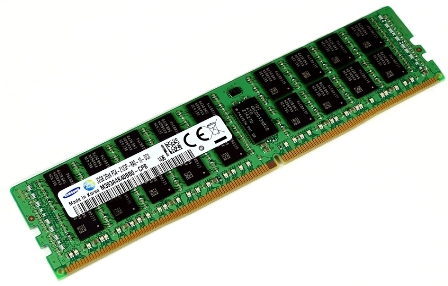
This 32GB DDR4-2666 RDIMM with ECC and registered signaling is purpose-built for server platforms, excelling in virtualization, in-memory databases, and mission-critical workloads where data integrity and system stability are paramount. Its dual-rank x4 organization maximizes memory bandwidth through rank interleaving, while the registered signal type buffers address and command lines to maintain signal integrity in high-density server configurations.
1. ECC error correction actively detects and corrects single-bit memory faults, preserving data integrity for mission-critical database transactions and financial computations in the data center.
2. Registered signal buffering stabilizes the command and address buses under heavy DIMM population, enabling dense server configurations without compromising signal integrity.
3. 32GB capacity module maximizes virtual machine density per server node, allowing more concurrent workloads without hitting memory bottlenecks in hyperconverged infrastructure.
4. Dual Rank x4 organization interleaves memory accesses across two internal ranks, boosting effective bandwidth and keeping multiple CPU cores fed during large-scale in-memory analytics.
5. 2666MT/s transfer rate delivers a balanced throughput sweet spot for mainstream enterprise applications, ensuring consistent read/write performance under sustained multi-tenant loads.
When you deploy this Samsung M393A4K40DB2-CTD6Y 32GB DDR4-2666 RDIMM in a data center, four architectural decisions immediately translate into mission-critical reliability, not just a list of specifications. First, the ECC circuitry silently detects and corrects single-bit errors that cosmic radiation or electrical noise can trigger in memory cells. In a financial transaction database or an in-memory caching layer like Redis, that correction prevents a flipped bit from becoming a silent data corruption that cascades into a wrong billing total. Second, the Registered signal buffer stabilizes command and address lines across heavy memory channels. When you populate a virtualization host with a dozen DIMMs to run 40 virtual machines, registered buffering eliminates the electrical loading that would otherwise cause boot failures or random reboots under load. Third, the dual-rank x4 organization interleaves internal banks so the memory controller can pipeline requests more efficiently. That translates directly into higher sustained bandwidth for memory-hungry workloads such as SAP HANA analytical queries, where every percent of throughput gain cuts batch window time. Finally, 1.2V operation and a 2666MT/s speed with CL19 latency deliver that performance without driving up power and cooling costs per rack unit. For a server running 24/7, you are not merely buying capacity; you are buying uptime, data integrity, and predictable performance under concurrency.
This is a server-grade DDR4-2666 ECC Registered RDIMM (32GB, dual-rank, 1.2V). Capacity planning guidance for typical workloads follows.
General Virtualization
Populate every memory channel with at least one module to balance bandwidth and capacity. On a dual-socket server with six channels per CPU, twelve 32GB modules deliver 384GB—enough for dozens of moderate VMs without bandwidth bottlenecks. If VM density calls for more RAM, install two DIMMs per channel (768GB total), but validate that any drop in frequency under full load remains acceptable.
In-Memory Database
Keep the entire working set in memory by filling all channels. A dual-socket system with 24 slots fully loaded (one 32GB RDIMM per channel) provides 768GB of low-latency, highly interleaved capacity ideal for Redis or SAP HANA. When datasets exceed 768GB, move to two DIMMs per channel and use identical, same-batch modules to preserve signal integrity and ECC reliability.
High-Performance Computing
Prioritize bandwidth by installing exactly one DIMM per memory channel. A twelve-module, 384GB configuration sustains the rated 2666 MT/s and avoids rank-stacking penalties common to multi-DPC setups. If simulations demand more memory, test a two-DPC layout (768GB) thoroughly; in most HPC clusters, scaling out nodes offers better throughput than filling all slots.
Validated compatible with Dell PowerEdge R760, HPE ProLiant DL380 Gen10, Lenovo ThinkSystem SR650, and similar servers after rigorous testing.
Q: Can I mix this M393A4K40DB2-CTD6Y with other memory modules of different brands or speeds?
A: Mixing modules is not recommended in servers. Mismatched speeds or ranks may cause instability, fallback to lowest speed, or unbootable states. Always install identical, certified RDIMMs for guaranteed performance and platform validation.
Q: Is this memory compatible with my system?
A: This DDR4-2666 Registered ECC RDIMM is designed for server platforms. It supports Intel Xeon Scalable and AMD EPYC 7000/7002 series processors. Please verify your motherboard's Qualified Vendor List for this specific 32GB dual-rank part.
Q: What is the recommended DIMM population order for optimal performance?
A: Follow the platform-specific population guide, typically filling all channels equally. For a dual-rank RDIMM, populate identical slots per channel starting from the furthest slot from the CPU to maintain balanced memory interleaving and maximum bandwidth.
Q: Does this module support overclocking or XMP profiles?
A: No. Server-grade RDIMMs operate at fixed JEDEC standard timings (CL19-19-19) and do not support XMP or overclocking. Reliability and stability are prioritized over speed; factory-programmed SPD profiles are non-configurable.
Q: What warranty and typical failure rate can I expect?
A: This module carries a 1-year warranty. DDR4 RDIMMs exhibit very low annualized failure rates (AFR), typically below 0.5%, ensuring high reliability in 24/7 server environments. Defective units are replaced promptly under warranty terms.