











 Secure payments
Standard refund policy
Trade Assurance
Secure payments
Standard refund policy
Trade Assurance
| Product Type | Memory Module |
|---|---|
| Memory Capacity | 32 GB |
| Memory Technology | DDR4 |
| Product Voltage | 1.2 V |
| RAM Speed | 2666 MHz |
| RAM Standard | DDR4-2666/PC4-21300 |
| Error Identifying | ECC |
| Signal Type | Registered |
| Column Access Strobe (CAS) | CL19 |
| Rank | Dual Rank x4 |
| Quantity of Pins | 288-pin |
| RAM Genre | RDIMM |
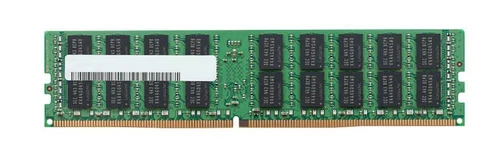
This 32GB DDR4-2666 Registered ECC RDIMM, with its Dual Rank x4 organization and CL19 latency, is engineered for enterprise servers and workstations where data integrity under heavy load is non-negotiable. It excels in virtualization, in-memory databases, and mission-critical workloads by combining registered buffering for signal stability across large memory populations with hardware ECC to correct single-bit errors on the fly.
1. ECC error correction actively detects and corrects single-bit memory faults, preserving data integrity in mission-critical databases and financial ledgers where even one flipped bit can compromise transactional accuracy.
2. Registered signal buffering decouples the memory bus from the physical DRAM load, stabilizing large-capacity deployments so that multi-socket servers can reliably populate all channels with high-density DIMMs.
3. Dual Rank x4 organization interleaves accesses across two internal ranks, keeping memory channels consistently saturated to sustain virtual machine responsiveness during peak consolidation ratios.
4. A thirty-two gigabyte capacity per module raises the overall memory footprint per server node, directly increasing the number of live VMs a hypervisor can host without resorting to costly scale-out expansion.
5. DDR4-2666 operating speed provides the balanced bandwidth needed to accelerate in-memory caching and real-time analytics, cutting query latency for data-intensive workloads that demand fast predicate evaluation.
As a 32GB DDR4-2666 RDIMM, the M393A4K40CB2-CTD8Q is purpose-built for server workloads, where four critical attributes solve real operational headaches. ECC eliminates single-bit soft errors induced by background radiation, preventing silent data corruption that could crash virtualized clusters or corrupt in-memory databases like Redis. The registered interface buffers command and address lines, enabling a server to support multiple high-density ranks without signal degradation—vital for consolidation hosts running dozens of VMs. Its dual-rank x4 organization strikes an ideal balance: rank interleaving boosts bandwidth for analytics, and the x4 chip width supports advanced chip-kill correction, so a failed DRAM chip won't take down a SAP HANA node. A 1.2V supply slashes power and cooling demands across a fleet, directly lowering TCO. For IT, this memory means you can scale capacity and throughput while ensuring every transaction and guest VM stays error-free.
General Virtualization
For moderate VM density, deploy a pair of these 32 GB RDIMMs per server to start with 64 GB of registered ECC memory, providing headroom for a dozen typical virtual machines. When consolidation demands grow, populate all memory channels with identical modules—usually six or eight per socket—to maximize capacity and interleaved bandwidth while preserving error-correcting reliability.
In-Memory Database
Maximise capacity by installing one 32 GB dual-rank DIMM in every available slot, targeting 256 GB to 1 TB depending on the platform. This DDR4-2666 registered ECC module ensures data integrity and low-latency access (CL19), and balanced population across channels sustains high throughput for large in-memory datasets like Redis or SAP HANA.
High-Performance Computing (HPC)
Achieve peak memory bandwidth by placing at least one DIMM per memory channel; an 8-channel system therefore calls for eight of these 1.2 V RDIMMs. Identical dual-rank x4 modules in a symmetric setup eliminate performance skew across NUMA nodes, while ECC protection guards long-running simulations, making this 32 GB part an ideal building block for compute nodes.
Rigorously tested server memory: Samsung 32GB DDR4 RDIMM compatible with Dell R740, HPE DL380 Gen10, Lenovo SR650.
Q: Can I mix this M393A4K40CB2-CTD8Q with other memory modules of different brands or speeds?
A: Mixing is not recommended. Registered ECC modules must be identical in rank, speed, and timings to ensure signal integrity and avoid system instability. Use identical Samsung DIMMs for reliable operation.
Q: Is this memory compatible with my Intel or AMD server platform?
A: This DDR4-2666 RDIMM is validated for Intel Xeon Scalable (C620 series) and AMD EPYC 7001/7002 platforms. Verify your motherboard supports 32GB Dual Rank x4 Registered ECC DIMMs.
Q: What is the recommended DIMM population order for optimal performance?
A: Populate identical DIMMs per memory channel, following the server board’s slot numbering (e.g., A1, B1 first). Balance capacity across CPU memory controllers and use one DIMM per channel for best throughput.
Q: Does this module support overclocking or XMP profiles?
A: No. This is a JEDEC-compliant Registered ECC module intended for stable server operation. Overclocking and XMP are not supported; it runs strictly at DDR4-2666 CL19 under platform management.
Q: What warranty and typical failure rate can I expect?
A: This module carries a 1-year warranty. Enterprise-grade Samsung RDIMMs exhibit an annualized failure rate (AFR) well below 0.5% under specified conditions, ensuring high reliability for data-center environments.