











 Secure payments
Standard refund policy
Trade Assurance
Secure payments
Standard refund policy
Trade Assurance
| Product Type | Memory Module |
|---|---|
| Memory Capacity | 32 GB |
| Memory Technology | DDR4 |
| Product Voltage | 1.2V |
| RAM Speed | 2666MHz |
| RAM Standard | DDR4-2666/PC4-21300 |
| Error Identifying | ECC |
| Signal Type | Registered |
| Column Access Strobe (CAS) | CL19 |
| Rank | Dual Rank x4 |
| Quantity of Pins | 288-pin |
| RAM Genre | RDIMM |
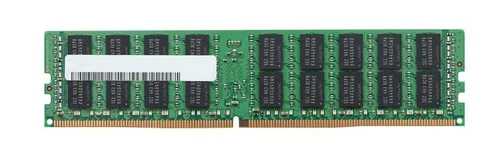
Ideal for virtualization and in-memory database workloads, this 32GB DDR4-2666 RDIMM leverages registered signaling and ECC to ensure data integrity and signal stability in high-density server deployments. Its dual-rank x4 organization and CL19 latency optimize memory bandwidth and command efficiency, making it a reliable choice for platforms requiring consistent performance under sustained load.
1. The 32GB capacity per module allows dense memory configurations in data-center servers, maximizing the number of virtual machines that can run simultaneously without costly swap-to-disk performance penalties.
2. ECC protection continuously corrects single-bit memory errors in the background, which is essential for financial transaction servers and scientific computing where even a silent data corruption is unacceptable.
3. Registered signal buffering stabilizes the memory bus under fully loaded channels, enabling organizations to populate all DIMM slots without sacrificing signal integrity as memory demand scales up.
4. Dual Rank x4 organization interleaves access across multiple internal bank groups, keeping the memory pipeline saturated and delivering predictable throughput for latency-sensitive enterprise databases.
5. The 2666MHz speed provides a prudent balance of bandwidth and power envelope, delivering steady performance for web-serving and virtualization workloads without driving excessive data-center cooling costs.
The M393A4K40CB2-CTD60 is a server-class DDR4 RDIMM engineered for enterprise environments where consistency and uptime are non-negotiable. Its four core attributes directly address the critical pain points of data center operators. First, the ECC technology proactively detects and corrects single-bit memory errors, which can silently corrupt transactional data in an in-memory database or cause a hypervisor to fail during live virtual machine migration. In a 24/7 virtualized cluster, this protects against random bit flips triggered by background radiation, preventing costly service interruptions. Second, the Registered signal buffering stabilizes the command and address lines, enabling fully populated server boards with multiple DIMMs per channel without signal degradation. This means you can confidently scale to 512 GB or 1 TB of RAM for dense VDI deployments or large container orchestration nodes, avoiding the boot failures and sporadic crashes that plague unbuffered modules under heavy load. Third, its Dual Rank x4 organization leverages rank interleaving to parallelize read and write operations, delivering higher sustained bandwidth. For a Redis cluster or SAP HANA instance processing millions of queries per second, this directly translates into lower latency and faster cache response times under concurrent access patterns. Finally, operating at 1.2V, the module reduces thermal dissipation and power draw across a fleet of servers, slashing cooling costs and contributing to a greener data center without sacrificing the 2666 MT/s throughput that keeps your workloads fluid.
General Virtualization
For moderate consolidation, deploy six to eight of these 32 GB RDIMMs per dual-socket server, yielding 192–256 GB total capacity. That ratio supplies roughly 4–6 GB per virtual machine in a 40–50 VM host, comfortably handling web servers and light middleware without triggering ballooning or swapping.
In-Memory Database
Aim for twelve to sixteen modules per two-socket node, providing 384–512 GB. This footprint keeps entire hot datasets in DRAM for Redis, Memcached, or SAP HANA, where the dual-rank x4 organization boosts bank-level parallelism and cuts latency under heavy random access.
High Performance Computing
Populate all eight channels of a dual-processor platform with one 32 GB DIMM each (256 GB total) to achieve balanced memory bandwidth. The registered ECC and 1.2 V operation ensure signal integrity during sustained floating-point workloads, and the 2666 MHz speed aligns well with most Xeon Scalable memory controllers for MPI-based simulations.
Rigorously validated server memory. Compatible with Dell PowerEdge R740, HPE ProLiant DL380 Gen10, Lenovo ThinkSystem SR650, and more.
Q: Can I mix this M393A4K40CB2-CTD60 with other memory modules of different brands or speeds?
A: Mixing this RDIMM with modules of different brands, speeds, or ranks is not recommended. It may lead to system instability, unexpected downtime, or even failure to boot in server environments.
Q: Is this memory compatible with my system?
A: This module is built for server platforms supporting DDR4 Registered ECC memory, such as Intel Xeon Scalable and AMD EPYC. Verify your motherboard’s QVL list and ensure 288-pin RDIMM compatibility.
Q: What is the recommended DIMM population order for optimal performance?
A: Follow your server board’s population guide, typically filling identical DIMMs per channel starting from the farthest slot. Balance across all memory channels to maximize interleaving and bandwidth efficiency.
Q: Does this module support overclocking or XMP profiles?
A: No, as an enterprise‑grade RDIMM, this module adheres to JEDEC DDR4-2666 standards. It does not support overclocking or XMP; operational stability and data integrity take priority over tuning.
Q: What warranty and typical failure rate can I expect?
A: This module includes a one‑year warranty. Enterprise RDIMMs demonstrate an extremely low annualized failure rate (AFR) under 0.5%, ensuring exceptional long‑term reliability for critical workloads.