











 Secure payments
Standard refund policy
Trade Assurance
Secure payments
Standard refund policy
Trade Assurance
| Product Type | Memory Module |
|---|---|
| Memory Capacity | 32 GB |
| Memory Technology | DDR4 |
| Product Voltage | 1.2 V |
| RAM Speed | 2933 MHz |
| RAM Standard | DDR4-2933/PC4-23400 |
| Error Identifying | ECC |
| Signal Type | Registered |
| Column Access Strobe (CAS) | CL21 |
| Rank | Dual Rank x4 |
| Quantity of Pins | 288-pin |
| RAM Genre | RDIMM |
This RDIMM, with its ECC and registered signal architecture, is engineered for server platforms running virtualization stacks, memory-resident databases, and mission-critical workloads where data integrity is non-negotiable. The dual‑rank x4 organization maximizes interleaving efficiency on compatible memory controllers, while the 2933 MT/s speed at CL21 ensures stable, high‑bandwidth performance in dense, multi‑DIMM server configurations.
1. Registered signal type buffers the command and address lines, enabling servers to scale up to massive memory capacities without compromising signal integrity under heavy multi-DIMM configurations.
2. ECC protection detects and corrects single-bit errors in real time, preserving data integrity for financial transactions and mission-critical databases where even silent corruption is unacceptable.
3. Dual Rank x4 organization interleaves memory accesses across two sets of DRAM banks, boosting sustained bandwidth under concurrent workloads and improving virtual machine density without latency penalties.
4. 2933 MT/s transfer speed accelerates in-memory analytics and large dataset processing, shrinking query response times in data-intensive enterprise applications.
5. The 32 gigabyte module density strikes a high-capacity sweet spot, packing substantial working memory into each DIMM slot and maximizing the total RAM footprint in dense server nodes for heavy consolidation.
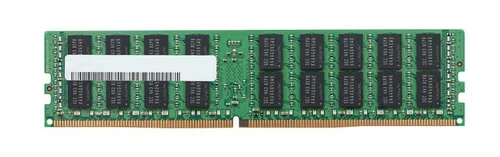
When you deploy a virtualization cluster or an in-memory database like SAP HANA, the memory you choose directly shapes your uptime, consolidation density, and transaction speed. The Samsung M393A4K40CB2-CVFBQ is a 32GB DDR4-2933 Registered DIMM built precisely for these enterprise workloads, and its four defining characteristics translate into concrete operational advantages. The ECC engine silently detects and corrects single-bit errors caused by cosmic radiation or electrical noise, which means a flipped bit will not silently corrupt a virtual machine’s state or produce a faulty financial calculation in your database—this is non-negotiable data integrity that prevents costly application crashes and forensic-level troubleshooting. The registered signal buffer stabilizes the command and address lines across heavy DIMM populations, so you can fully populate a server’s 24 or more slots without sacrificing signal quality, letting you safely allocate terabytes of RAM to a dense multi-tenant hypervisor or a massive in-memory dataset. The dual-rank x4 organization further boosts real-world bandwidth through rank interleaving: while one rank is busy refreshing or completing a cycle, the memory controller can concurrently issue requests to the other rank, effectively hiding latency and accelerating the random access patterns that dominate virtualized environments and high-throughput key-value stores. At 2933MT/s with a standard 1.2V power envelope, the module delivers this performance without driving up cooling costs or power budgets, keeping your TCO predictable as you scale. Ultimately, this RDIMM turns raw specifications into resilience, density, and consistent low-latency throughput—exactly what your mission-critical services demand.
General Virtualization
For dense virtual machine hosting, populate at least 8 of these 32 GB DDR4-2933 RDIMMs (256 GB total) across balanced memory channels to avoid NUMA penalties. This capacity satisfies typical 4:1 vCPU-to-memory overcommit ratios, while registered ECC ensures data integrity for multi-tenant workloads. Add modules in matched sets to maintain dual-rank interleaving and maximize bandwidth per socket.
In-Memory Database
In-memory analytics and caching layers demand both capacity and low latency. Deploy 16 or more modules (512 GB+) in a fully balanced configuration, leveraging dual-rank x4 RDIMMs for optimal bank-level parallelism. The 2933 MT/s speed with CL21 latency keeps response times predictable under heavy read/write loads, and ECC protection eliminates silent data corruption risks critical for transactional consistency.
High-Performance Computing (HPC)
Achieve peak memory bandwidth by installing one dual-rank DIMM per channel—typically 8 or 12 modules across dual-socket platforms. The registered signal type stabilizes multi-DIMM topologies common in simulation and modeling clusters. Plan for 256 GB to 384 GB base capacity, scaling node memory to match core count so that large computation meshes remain resident entirely in DRAM, minimizing costly swap or network I/O.
Rigorously tested and server-ready: fits Dell R740/R750, HPE DL380 Gen10, Lenovo SR650, Supermicro X11.
Q: Can I mix this M393A4K40CB2-CVFBQ with other memory modules of different brands or speeds?
A: Mixing registered ECC modules of different brands or speeds is not recommended. It may cause signal integrity issues, degrade system stability, and force all modules to the slowest common speed.
Q: Is this memory compatible with my Intel Xeon or AMD EPYC server platform?
A: This DDR4-2933 ECC RDIMM is compatible with Intel Xeon Scalable (2nd Gen and newer) and AMD EPYC 7002/7003 series platforms that support 288-pin registered ECC memory.
Q: What is the recommended DIMM population order for optimal performance?
A: Follow the server motherboard's guide: populate one DIMM per channel first, typically filling blue or primary slots. For dual-rank modules, balance channels symmetrically to maximize memory bandwidth.
Q: Does this module support overclocking or XMP profiles?
A: No. This is a JEDEC-compliant server memory module operating at a fixed 2933MT/s. It does not support overclocking or XMP, ensuring enterprise reliability under strict specifications.
Q: What warranty and typical failure rate can I expect?
A: This module includes a one-year replacement warranty. Enterprise-grade ECC RDIMMs exhibit extremely low failure rates, typically with an MTBF exceeding 2 million hours under proper operating conditions.