











 Secure payments
Standard refund policy
Trade Assurance
Secure payments
Standard refund policy
Trade Assurance
| Product Type | Memory Module |
|---|---|
| Memory Capacity | 32 GB |
| Memory Technology | DDR4 |
| Product Voltage | 1.2 V |
| RAM Speed | 2933 MHz |
| RAM Standard | DDR4-2933/PC4-23400 |
| Error Identifying | ECC |
| Signal Type | Registered |
| Column Access Strobe (CAS) | CL21 |
| Rank | Dual Rank x4 |
| Quantity of Pins | 288-pin |
| RAM Genre | RDIMM |
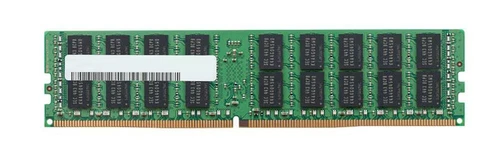
Designed for server platforms, this Samsung 32GB DDR4-2933 RDIMM (M393A4K40CB2-CVFCQ) leverages ECC and registered signaling to ensure data integrity and signal stability under heavy memory loads, making it ideal for virtualization, in-memory databases, and mission-critical enterprise workloads. Its dual-rank x4 organization enhances memory bandwidth through rank interleaving, while the 1.2V low-power design and CL21 latency optimize performance-per-watt in dense 288-pin configurations.
1. Error Correction Code detects and corrects single-bit errors in real time, safeguarding transactional data integrity in mission-critical enterprise servers.
2. Registered signal buffering stabilizes command and address lines, enabling large memory populations essential for dense virtualization hosts.
3. Dual Rank x4 configuration maximizes memory bank interleaving, sustaining high bandwidth efficiency for concurrent database queries.
4. Thirty-two gigabyte module density provides ample headroom for memory-hungry hypervisors, allowing more VMs per physical node without swapping.
5. 2933 MT/s transfer rate accelerates in-memory analytics workloads, reducing latency for real-time decision support systems.
When you deploy the Samsung M393A4K40CB2-CVFCQ, a 32GB DDR4-2933 Registered DIMM, you are not just installing memory; you are engineering resilience for mission-critical workloads. Its four defining characteristics directly answer the pains of data center operators. First, the integrated ECC engine continuously corrects single-bit errors that naturally occur due to cosmic radiation or electrical noise, preventing silent data corruption in an in-memory database where a flipped bit in a financial transaction can cause catastrophic miscalculations. Second, the Registered signal buffer stabilizes the command and address lines, enabling a virtualization cluster to populate all 24 DIMM slots per server without signal degradation; this means you can confidently scale to 768GB of reliable capacity for hosting dozens more virtual machines. Third, the Dual Rank x4 organization activates rank interleaving, overlapping data fetches to significantly boost effective bandwidth when an analytics engine scans large tables. Finally, the 1.2V 2933MT/s speed with CL21 timing strikes a purposeful balance, delivering high throughput while curbing power consumption, directly lowering your cooling overhead in a dense rack. This module turns instability and performance bottlenecks into non-issues.
General Virtualization
Populate one 32 GB RDIMM per memory channel to achieve full DDR4-2933 speed and balanced bandwidth. In a typical dual-socket server with 8 or 12 channels, this yields 256 GB or 384 GB, which comfortably supports high VM densities without premature swapping. Reserve additional DIMM slots for future expansion, and keep all populated channels symmetric to maintain NUMA locality and consistent latency.
In-Memory Database
Maximize capacity by installing two dual‑rank 32 GB RDIMMs per channel (2DPC), even though speed may downgrade to 2666 MT/s under heavy load. In a 12‑channel platform, this provides 768 GB—enough to hold entire datasets in memory. Ensure identical DIMM ranks and firmware settings to avoid training failures, and validate in‑memory replication or query performance under full population.
High Performance Computing
Use a “one DIMM per channel” strategy across all available memory controllers to preserve the peak 2933 MT/s rate and uniform bandwidth. A dual‑socket, 12‑channel system filled with twelve 32 GB modules delivers 384 GB of balanced, low‑latency capacity ideal for bandwidth‑sensitive MPI workloads. Avoid mixing module types or leaving channels unfilled, as unbalanced configurations introduce hot‑spots that degrade collective communication performance.
Validated server memory — rigorously tested with Dell PowerEdge R760, HPE ProLiant DL380 Gen10, Lenovo ThinkSystem SR650, and more.
Q: Can I mix this M393A4K40CB2-CVFCQ with other memory modules of different brands or speeds?
A: Mixing is not recommended. For server reliability, use identical modules with the same part number. Different speeds or brands may cause signal issues and force downclocking, impacting stability.
Q: Is this memory compatible with my server? Which platforms are supported?
A: It is compatible with servers supporting DDR4-2933 ECC RDIMMs, such as 2nd Gen Intel Xeon Scalable and AMD EPYC 7002 series. Please consult your system’s qualified vendor list.
Q: What is the recommended DIMM population order for optimal performance?
A: Follow your server board manual. Generally, populate one DIMM per channel first, balancing across memory controllers. Dual-socket systems should equalize channels between CPUs to ensure uniform bandwidth.
Q: Does this module support overclocking or XMP profiles?
A: No. This is a JEDEC-compliant registered ECC server module operating at fixed 2933 MT/s. Overclocking and XMP are not supported, ensuring strict signal integrity and enterprise reliability.
Q: Can I install this memory in a desktop PC or standard workstation?
A: No. This is a registered ECC RDIMM for server platforms. Desktops and most workstations require unbuffered DIMMs; using this incompatible module will prevent the system from booting.