











 Secure payments
Standard refund policy
Trade Assurance
Secure payments
Standard refund policy
Trade Assurance
| Product Type | Memory Module |
|---|---|
| Memory Capacity | 32 GB |
| Memory Technology | DDR4 |
| Product Voltage | 1.2 V |
| RAM Speed | 2933 MHz |
| RAM Standard | DDR4-2933/PC4-23400 |
| Error Identifying | ECC |
| Signal Type | Registered |
| Column Access Strobe (CAS) | CL21 |
| Rank | Dual Rank |
| Quantity of Pins | 288-pin |
| RAM Genre | RDIMM |
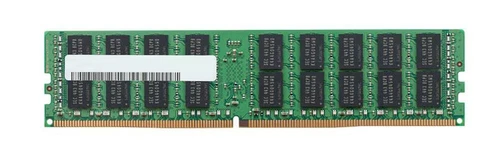
This Registered DDR4-2933 RDIMM with ECC is engineered for enterprise servers and virtualization platforms, where dual-rank interleaving maximizes memory bandwidth under heavy in-memory database and multi-VM workloads. The registered signal buffering and ECC protection together ensure rock‑solid data integrity and scalability in 24×7 mission‑critical deployments.
1. ECC protection silently corrects single-bit memory errors, safeguarding transactional integrity and eliminating data corruption risks in always-on enterprise databases.
2. Registered buffering stabilizes signal integrity across fully loaded memory channels, allowing dense server configurations to maintain uptime under demanding multi-tenant workloads.
3. Generous per-module capacity expands the memory footprint per CPU socket, driving higher virtual machine density and smoother live migration in consolidated private clouds.
4. Dual rank organization keeps both sub-ranks interleaved, saturating the memory bus with concurrent commands and lifting effective bandwidth for in-memory analytics.
5. Elevated transfer speed shrinks data access latency, enabling faster query responses and tighter service-level adherence for latency-sensitive financial or hosting platforms.
In a data center where every clock cycle impacts revenue, the Samsung M393A4K40CB2-CVFGY is not just another 32GB DDR4 module—it is a safeguard for business continuity. As a Registered DIMM with ECC running at 2933 Mbps, it directly addresses the silent crisis of single-bit errors that can corrupt financial transactions or hypervisor memory states in a VMware cluster. That ECC engine continuously corrects these flipped bits, meaning your virtual machines stay consistent under heavy memory pressure without unexplained crashes or data anomalies. The Registered clock driver buffers command and address signals, allowing a server to populate all 24 DIMM slots without signal degradation; for an in-memory database like SAP HANA scaling to terabytes, this ensures stable, large-capacity configurations where unregistered memory would simply fail to boot.
Beyond integrity, the dual-rank design delivers a tangible performance advantage through rank interleaving: while one rank executes a read cycle, the other prepares the next command, effectively overlapping latency and boosting throughput during sustained OLTP workloads. And because power density matters in a fully populated 2U rack server, the native 1.2 V operation keeps thermal envelope in check, helping maintain a lean power budget without sacrificing the 2933 MT/s data rate. Whether you are consolidating a virtual desktop infrastructure or running real-time risk analytics, this module turns memory from a potential failure point into a quiet, deterministic asset.
Based on the specifications (ECC, Registered, 288-pin RDIMM), this is server memory. Here is capacity planning guidance for three common workloads.
General Virtualization
Populate all memory channels with one 32 GB module each. In a dual-socket server, 12 modules (384 GB) or 16 modules (512 GB) deliver balanced capacity and maintain the full 2933 MT/s speed. When higher VM density requires it, add a second DIMM per channel, accepting a slight frequency drop to 2666 MT/s while preserving capacity.
In-Memory Database
Maximize reliable capacity with low latency. Use 24 modules (768 GB) in a one-DIMM-per-channel configuration across dual CPUs. For larger datasets, fully populate all 16 or 24 slots with 32 GB RDIMMs to reach 1 TB or more, and enable rank sparing to strengthen data integrity.
High Performance Computing
Memory bandwidth is paramount. Install 12 modules (384 GB) total—one per channel—to enable full 6‑channel interleaving and peak 2933 MT/s throughput. This supplies 4–6 GB per core for bandwidth‑intensive simulations. Add more modules only if per‑core capacity falls below the application’s working set.
Rigorously tested; compatible with Dell PowerEdge R740, HPE ProLiant DL380 Gen10, Lenovo ThinkSystem SR650.
Q: Can I mix this M393A4K40CB2-CVFGY with other memory modules of different brands or speeds?
A: Mixing is not advised in servers. Different brands or speeds may cause instability; the system downclocks to the slowest module, potentially degrading registered ECC integrity and dual‑rank performance.
Q: Is this memory compatible with my system?
A: Yes, for servers supporting DDR4 ECC Registered DIMMs, such as Intel Xeon Scalable, AMD EPYC platforms. Confirm your board’s QVL lists M393A4K40CB2‑CVFGY for validated 2933 MT/s operation.
Q: What is the recommended DIMM population order for optimal performance?
A: Follow the server board manual. Typically, populate identical DIMMs per channel starting with slot one. For dual‑processor systems, balance memory evenly across CPUs to leverage full interleaving and bandwidth.
Q: Does this module support overclocking or XMP profiles?
A: No. This enterprise RDIMM strictly follows JEDEC standards for mission‑critical stability. Overclocking or XMP is not implemented to guarantee 24/7 data integrity.
Q: What warranty and typical failure rate can I expect?
A: It carries a 1‑year warranty. Samsung server‑grade DIMMs exhibit very low annualized failure rates, typically under 0.5%, ensuring high reliability in continuous data center operation.