











 Secure payments
Standard refund policy
Trade Assurance
Secure payments
Standard refund policy
Trade Assurance
| Product Type | Memory Module |
|---|---|
| Memory Capacity | 32 GB |
| Memory Technology | DDR4 |
| Product Voltage | 1.2 V |
| RAM Speed | 2933 MHz |
| RAM Standard | DDR4-2933/PC4-23400 |
| Error Identifying | ECC |
| Signal Type | Registered |
| Column Access Strobe (CAS) | CL21 |
| Rank | Dual Rank x4 |
| Quantity of Pins | 288-pin |
| RAM Genre | RDIMM |
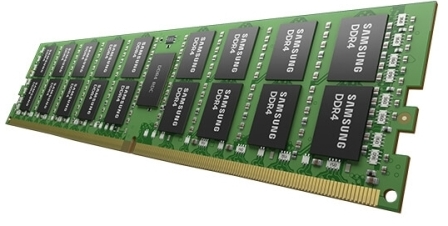
This 32GB DDR4-2933 RDIMM with ECC and registered signaling is designed for server platforms such as AMD EPYC or Intel Xeon, offering strong data integrity and stability for virtualization, in-memory databases, and heavy multi-threaded workloads. Its dual-rank x4 configuration boosts memory bandwidth through interleaving, while CAS latency CL21 and registered signal buffering ensure reliable performance under fully populated memory channels.
1. ECC memory detects and corrects single-bit errors in real time, preserving data integrity for financial transactions and mission-critical enterprise databases.
2. Registered signal buffering stabilizes command and address signals across fully populated server boards, enabling massive memory footprints without compromising reliability.
3. 32GB capacity per module maximizes memory density per channel, allowing more virtual machines to run concurrently on a single host without resorting to slower swap storage.
4. DDR4-2933 speed elevates available memory bandwidth, sharply reducing data bottlenecks in analytics workloads that stream large in-memory datasets.
5. Dual Rank x4 organization interleaves accesses across internal bank groups, sustaining high throughput during simultaneous read and write operations in multi-tenant cloud environments.
In a data center where every second of downtime costs real revenue and data integrity is non-negotiable, the Samsung M393A4K40DB2-CVFB0 serves as a critical foundation. As a 32GB DDR4-2933 Registered DIMM with ECC, it directly addresses the operational pain points of virtualized clusters and in-memory databases. When you are consolidating dozens of virtual machines onto a single physical host, the registered signal buffer stabilizes high-density memory configurations, allowing you to populate all channels without the signal degradation that plagues unbuffered modules. Meanwhile, the end-to-end ECC silently detects and corrects single-bit flips caused by background radiation—errors that would otherwise silently corrupt financial transactions or database indices over time.
For performance-sensitive workloads like Redis or SAP HANA, the dual-rank x4 organization provides internal rank interleaving, which boosts effective memory bandwidth by overlapping command pipelining between ranks. This translates into faster query responses even under heavy concurrent access. The 1.2V operating voltage further reduces thermal load inside densely packed 2U servers, preserving cooling headroom and lowering energy costs in multi-node deployments. Every aspect of this module is engineered so that your infrastructure scales reliably from routine business hours to peak transaction spikes without compromise.
This 32GB DDR4-2933 Registered ECC RDIMM targets server environments. The following capacity planning scenarios illustrate optimal module quantities and population patterns.
General Virtualization
Use a balanced 1DPC or 2DPC approach. In a dual-socket server with eight channels per CPU, install one 32GB DIMM per channel (256GB total) for optimal speed or two per channel (512GB) for higher VM density. The dual-rank design provides solid bandwidth and capacity for mixed workloads.
In-Memory Database
Maximize memory capacity by fully populating channels with two DIMMs each. A 16-slot server yields 512GB, while 32-slot nodes reach 1TB. Accept a slight speed reduction to 2666 MT/s if needed; the priority is fitting the entire dataset in RAM and ECC ensures data integrity.
High-Performance Computing (HPC)
Stick to one DIMM per channel to sustain the full 2933 MT/s clock. This 32GB RDIMM populates all 16 channels of a dual-socket compute node with 512GB of low-latency, high-bandwidth memory. Avoid 2DPC configurations to prevent speed penalties and maintain deterministic performance.
Rigorously tested server memory. Compatible: Dell PowerEdge R760, HPE ProLiant DL380 Gen11, Lenovo ThinkSystem SR650.
Q: Can I mix this M393A4K40DB2-CVFB0 with other memory modules of different brands or speeds?
A: Mixing is not recommended for optimal reliability. The system will downclock all modules to the slowest speed and may disable ECC features, compromising stability in server environments.
Q: Is this memory compatible with my system?
A: It requires a server platform with DDR4 Registered ECC support (e.g., Intel Xeon Scalable or AMD EPYC). Verify that your motherboard supports 288-pin RDIMMs and 2933MT/s speeds.
Q: What is the recommended DIMM population order for optimal performance?
A: Follow your server motherboard's memory population guide. Typically, populate identical DIMMs in balanced channels (e.g., one per channel) to maximize bandwidth and maintain interleaving.
Q: Does this module support overclocking or XMP profiles?
A: No. This is a JEDEC-compliant server RDIMM running at its specified 2933MT/s. It does not feature XMP profiles, and overclocking is not supported in standard server configurations.
Q: What warranty and typical failure rate can I expect?
A: This module includes a 1-year warranty. Its enterprise-grade ECC design and rigorous validation result in a typical annualized failure rate (AFR) well below 0.5% under normal operating conditions.