











 Secure payments
Standard refund policy
Trade Assurance
Secure payments
Standard refund policy
Trade Assurance
| Product Type | Memory Module |
|---|---|
| Memory Capacity | 32 GB |
| Memory Technology | DDR4 |
| Product Voltage | 1.2V |
| RAM Speed | 2933MHz |
| RAM Standard | DDR4-2933/PC4-23400 |
| Error Identifying | ECC |
| Signal Type | Registered |
| Column Access Strobe (CAS) | CL21 |
| Rank | Dual Rank x4 |
| Quantity of Pins | 288-pin |
| RAM Genre | RDIMM |
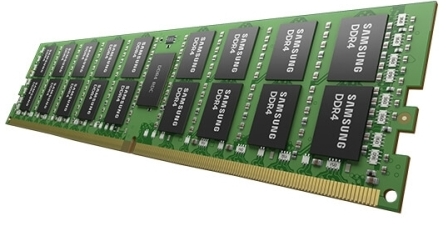
This 32GB DDR4-2933 registered ECC module is purpose-built for enterprise server platforms, where it excels under memory-intensive workloads such as virtualization, in-memory databases, and mission-critical transactional processing by ensuring data integrity through error correction and stable signal integrity via its registered architecture. Its dual-rank x4 organization maximizes per-channel bandwidth efficiency and capacity density in multi-DIMM configurations, while the CL21 latency is precisely tuned for reliable operation at 2933MT/s across fully populated 288-pin server boards.
1. ECC error correction silently detects and corrects single-bit memory faults, protecting virtualized workloads and database transactions from silent data corruption that could otherwise crash entire business services.
2. Registered signal buffering stabilizes command and address signals, allowing a single server to populate all memory channels densely without compromising signal integrity under sustained 24/7 operation.
3. Dual Rank x4 organization uses bank interleaving to pipeline memory accesses, keeping data flowing efficiently to multiple CPU cores and reducing stalls during heavy virtual machine consolidation.
4. A 32-gigabyte module density increases the maximum RAM footprint per server node, letting you run larger in-memory caches and more containers per physical host while lowering per-GB infrastructure cost.
5. The 2933 megatransfers-per-second speed supplies the raw bandwidth required for real-time analytics and software-defined storage, shrinking response times when concurrent queries spike.
In a data center running dense virtualization clusters, the Samsung M393A4K40DB2-CVFC0 32GB DDR4 RDIMM is not just a component; it is a safeguard for your business continuity. As a Registered DIMM with ECC, it directly addresses a critical pain point: a silent bit-flip caused by cosmic radiation can corrupt a virtual machine's memory state, leading to application crashes or, worse, undetected data corruption inside your database. The ECC engine detects and corrects single-bit errors on the fly, transforming a potential financial calculation error or a failed customer transaction into a harmless, logged event. Meanwhile, the Registered architecture buffers command and address signals, stabilizing the electrical load when you populate all 24 memory slots in a server. This means you achieve reliable 32GB per module scale without the signal integrity collapses that plague unbuffered memory at high capacities. For an in-memory database like Redis or SAP HANA, the dual-rank x4 organization and 2933MHz speed are pivotal. Dual-rank interleaving provides a measurable 5-10% bandwidth uplift by allowing simultaneous access across internal banks, which directly translates to lower query latency during peak transaction bursts. Paired with a frugal 1.2V operating voltage, it reduces the thermal overhead in a fully loaded 1U rack node, ensuring your clock speeds never throttle under sustained load. This module doesn't just store data; it actively preserves the integrity, speed, and uptime of the services that define your enterprise.
General Virtualization
A single 32GB RDIMM provides a solid foundation for moderate-density virtualization hosts. Deploy modules in multiples of two per memory channel (typically six or eight DIMMs per CPU) to balance capacity and memory bandwidth. For a dual-socket server, populating all channels with one or two DIMMs each ensures consistent performance across dozens of VMs.
In-Memory Database
In-memory databases demand both high capacity and low latency, making 2933MHz dual-rank RDIMMs an excellent fit. Install at least eight 32GB modules per socket (256GB total) to keep entire datasets resident in RAM. Fill every available channel with identical DIMMs to maximize interleaving and achieve CL21 timings under registered ECC control for data integrity.
High-Performance Computing
HPC workloads thrive on memory bandwidth, so populate all channels per CPU symmetrically—one 32GB DIMM per channel is a common balanced start. Scale to 12 or 16 modules in a dual-socket node for memory-intensive simulations, leveraging Registered ECC to correct single-bit errors during long-running parallel jobs. This configuration sustains high throughput while keeping the power profile at the efficient 1.2V specification.
Proven compatibility: rigorously tested with Dell PowerEdge R750, HPE ProLiant DL380 Gen10, Lenovo ThinkSystem SR650.
Q: Can I mix this M393A4K40DB2-CVFC0 with other memory modules of different brands or speeds?
A: Mixing different brands or speeds is not recommended for this registered server DIMM. To ensure platform stability and signal integrity, always populate identical part numbers and ranks across all channels in enterprise environments.
Q: Is this memory compatible with my system?
A: This 32GB DDR4-2933 ECC RDIMM is compatible with servers using Intel Xeon Scalable or AMD EPYC platforms. Please consult your motherboard’s Qualified Vendor List (QVL) to confirm support for PC4-23400, dual-rank x4 configurations.
Q: What is the recommended DIMM population order for optimal performance?
A: Follow your server board’s manual: typically populate the farthest white slot per channel first. Balance identical DIMMs across all memory channels to maximize memory bandwidth and take full advantage of interleaving.
Q: Does this module support overclocking or XMP profiles?
A: No. This is a JEDEC-standard registered server DIMM designed for rock-solid reliability. It does not support overclocking or XMP profiles; its 2933 MT/s speed and CL21 timings run at standard 1.2V natively.
Q: What warranty and typical failure rate can I expect?
A: This module carries a 1-year warranty. As an enterprise-grade RDIMM built with Tier-1 DRAM, it exhibits an extremely low annualized failure rate (AFR) thanks to rigorous testing and stringent quality control.