











 Secure payments
Standard refund policy
Trade Assurance
Secure payments
Standard refund policy
Trade Assurance
| Product Type | Memory Module |
|---|---|
| Compliance Standards | |
| Memory Capacity | 32 GB |
| Memory Technology | DDR4 |
| Product Voltage | 1.2 V |
| RAM Speed | 3200 MHz |
| RAM Standard | DDR4-3200/PC4-25600 |
| Error Identifying | ECC |
| Signal Type | Registered |
| Column Access Strobe (CAS) | CL22 |
| Rank | Single Rank x4 |
| Quantity of Pins | 288-pin |
| RAM Genre | RDIMM |
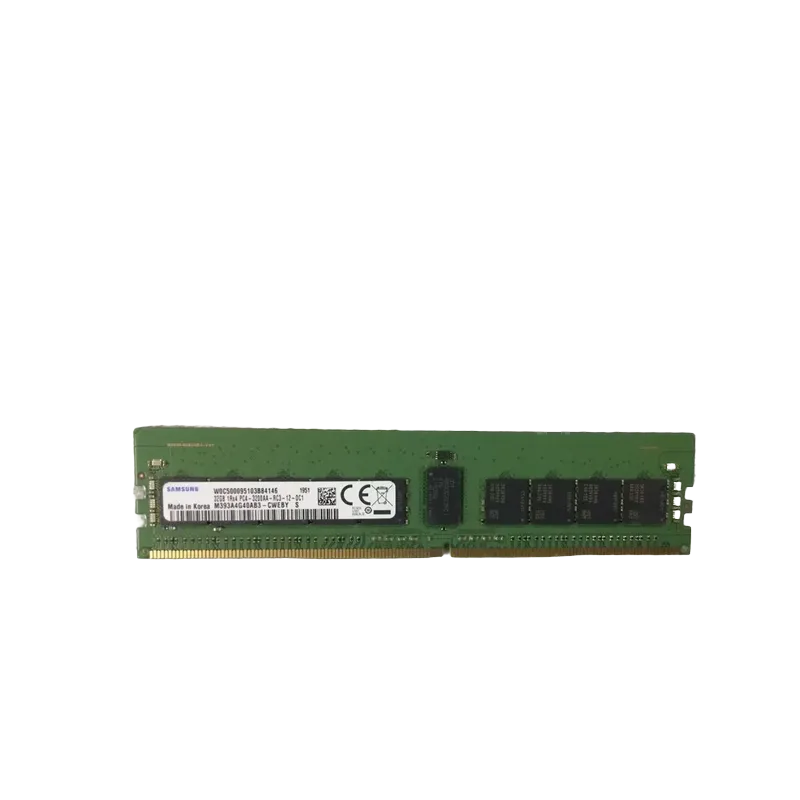
This Samsung 32GB DDR4-3200 RDIMM, with ECC and registered signal buffering, is engineered for server platforms handling memory-intensive workloads such as virtualization and in-memory databases where data integrity and stability under high-density configurations are critical. Its single-rank x4 organization and CL22 latency deliver predictable electrical loading and reliable low-latency access on multi-DIMM-per-channel enterprise architectures, ensuring consistent performance in mission-critical environments.
1. Ample capacity per module allows dense memory configurations, enabling more virtual machines and larger in-memory databases without sacrificing expansion headroom.
2. ECC protection detects and corrects single-bit errors, safeguarding long-running enterprise workloads against silent data corruption.
3. Registered signal buffering stabilizes high-capacity memory arrays, ensuring reliable operation when all channels are fully populated in multi-socket servers.
4. High-speed data rate elevates memory bandwidth, accelerating parallel processing tasks like real-time analytics and high-frequency trading.
5. Single Rank x4 organization minimizes bus loading while the narrow device width strengthens Chipkill and advanced error correction, essential for data integrity in scale-out storage servers.
The M393A4G40AB3-CWEC0 is a 32GB DDR4-3200 Registered DIMM built specifically for server environments, and its four defining characteristics directly answer the pain points of enterprise IT. In a dense virtualization cluster running dozens of VMs per node, memory errors are not a possibility but a statistical certainty. The ECC engine silently corrects single-bit flips caused by cosmic radiation or electrical noise, preventing data corruption that could crash a hypervisor or corrupt a critical virtual disk. Meanwhile, the Registered signal buffer stabilizes the command and address lines when fully populating all memory channels—essential for achieving the 25600 MB/s peak bandwidth without signal degradation. This means you can confidently scale to multi-terabyte footprints for an in-memory database like Redis or SAP HANA, where a single uncorrectable error would directly translate into financial discrepancy. The single‑rank x4 organization pushes 3200 MT/s with a CL22 latency, delivering balanced throughput for real‑time analytics. With a low 1.2V operating voltage, the module reduces thermal load inside 1U rack servers, sustaining performance under continuous, heavy query loads without throttling. For your business, this module transforms raw capacity into reliable, responsive infrastructure that keeps virtualized services and transactional databases running cleanly around the clock.
Based on the ECC, registered signal type, and 288-pin RDIMM form factor, this 32GB DDR4-3200 module is a server-class memory component. The capacity planning guidelines below address key server workload scenarios.
General Virtualization
Populate one DIMM per memory channel to maintain balanced architecture and peak bandwidth. For a dual-socket server with eight channels per CPU, install eight of these 32GB modules per processor, delivering 256GB per socket (512GB total). This cost-effective symmetrical configuration easily consolidates 25–40 typical virtual machines while preserving registered ECC integrity.
In-Memory Database
Maximize capacity by filling every available DIMM slot with identical 32GB RDIMMs. A platform supporting 16 slots per socket reaches 512GB per CPU, allowing multi-terabyte in-memory datasets without resorting to slower storage tiers. Always use matching single-rank x4 modules to avoid rank-mixing penalties and sustain low-latency access under heavy transactional loads.
HPC (High Performance Computing)
Install one DIMM per channel to retain the full DDR4-3200 transfer rate, crucial for simulation and modelling codes. An 8-channel node equipping 8×32GB provides 256GB of high-bandwidth memory per CPU, supporting tightly coupled parallel workloads. The registered ECC design safeguards long-duration calculations, while the single-rank layout helps maintain signal stability across dense clusters.
Rigorously tested server memory; compatible with Dell PowerEdge R750, HPE ProLiant DL380 Gen10 Plus, Lenovo ThinkSystem SR650 V2.
Q: Can I mix this M393A4G40AB3-CWEC0 with other memory modules of different brands or speeds?
A: Mixing RDIMMs of different brands or speeds is not recommended. It may cause stability issues or downgrade to the lowest common speed, compromising the registered ECC functionality essential for server reliability.
Q: Is this memory compatible with my server platform, such as Intel Xeon Scalable or AMD EPYC?
A: This DDR4-3200 RDIMM is compatible with platforms supporting Registered ECC memory, including Intel Xeon Scalable and AMD EPYC 7002/7003 series. Verify motherboard QVL for specific model support.
Q: What is the recommended DIMM population order for optimal performance with this module?
A: Follow your server board's manual. Typically, populate identical DIMMs per channel, starting with the farthest slot from the CPU. Balancing across memory channels maximizes bandwidth and maintains 1 DIMM per channel configuration.
Q: Does this module support overclocking or XMP profiles?
A: No. This is a JEDEC-compliant server RDIMM operating at standard 3200MT/s with CL22 latency. It does not support XMP profiles or overclocking, prioritizing data integrity and 24/7 reliability.
Q: What warranty and typical failure rate can I expect for this memory?
A: This module includes a 1-year warranty. As an enterprise-grade Samsung RDIMM, it has a very low annualized failure rate (AFR), typically under 0.5%, ensuring dependable long-term operation in data center environments.