











 Secure payments
Standard refund policy
Trade Assurance
Secure payments
Standard refund policy
Trade Assurance
| Product Type | Memory Module |
|---|---|
| Memory Capacity | 32 GB |
| Memory Technology | DDR4 |
| Product Voltage | 1.2 V |
| RAM Speed | 3200 MHz |
| RAM Standard | DDR4-3200/PC4-25600 |
| Error Identifying | ECC |
| Signal Type | Registered |
| Column Access Strobe (CAS) | CL22 |
| Rank | Single Rank x4 |
| Quantity of Pins | 288-pin |
| RAM Genre | RDIMM |
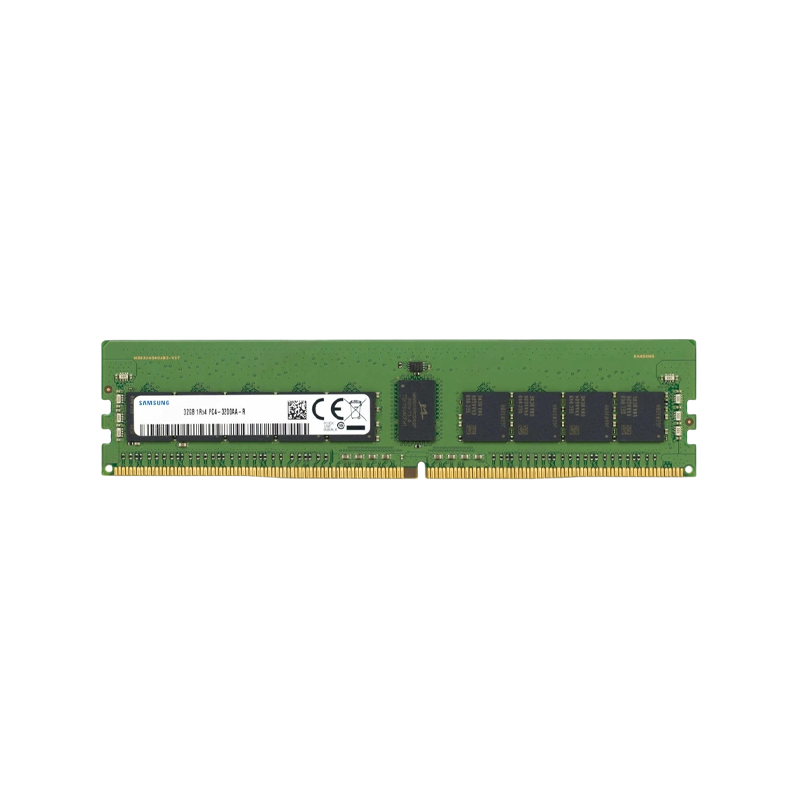
This 32GB DDR4-3200 RDIMM, engineered with a registered ECC architecture and a single-rank x4 organization, delivers determined data integrity and reduced electrical loading for dense server environments. It is ideally suited for memory-intensive workloads such as virtualization clusters and in-memory databases, where its CL22 latency and 1.2V efficiency directly enhance transaction throughput and system uptime.
1. A 32GB capacity per module maximizes memory density in data center servers, allowing more virtual machines and in-memory databases to run simultaneously without costly physical expansion.
2. The 3200 MT/s transfer rate elevates memory bandwidth, accelerating real-time analytics and high-frequency trading applications where every microsecond matters for throughput.
3. ECC protection actively detects and corrects single-bit errors, safeguarding financial transactions and long-running scientific computations from silent data corruption.
4. Registered signaling stabilizes heavy DIMM configurations by buffering command and address lines, essential for maintaining uptime in multi-socket servers under full load.
5. Single Rank x4 organization optimizes electrical loading and signal integrity, enabling populated high-capacity memory channels to sustain peak performance in virtualized clusters.
The Samsung M393A4G40BB3-CWECQ is a 32GB DDR4-3200 Registered DIMM built for servers, where unplanned downtime directly translates into revenue loss. Its ECC technology actively corrects single-bit memory errors caused by background radiation, a silent threat that silently corrupts financial transactions or hypervisor data structures. In a dense virtualization cluster running dozens of VMs, this means your critical instances don’t mysteriously crash due to flipped bits. The Registered architecture buffers command and address signals, letting you populate all DIMM slots while preserving signal integrity; when you need to scale a Redis in-memory database to 512GB or beyond, that buffering ensures the entire key-value store remains stable under heavy write loads. The single-rank x4 organization proves vital for bandwidth-hungry workloads: it exposes more internal banks for interleaving, cutting access conflicts when multiple analytics queries hit the same rank, so a real-time SAP HANA instance can sustain low-latency reads even during a report burst. Finally, the PC4-25600 speed ceiling matters most during peak consolidation hours, where each extra gigabyte per second of throughput allows your hypervisor to migrate virtual machines without perceptible service degradation, keeping response times predictable for end users.
General Virtualization
For a typical dual-socket virtualization host, deploy six to eight 32 GB RDIMMs per CPU to deliver 192–256 GB per node. Distribute modules evenly across all memory channels, aiming for one DIMM per channel (1DPC) to maintain the full 3200 MT/s speed. This balanced configuration supports dense VM consolidation while preserving memory bandwidth and ECC reliability.
In-Memory Database
Maximize capacity by populating all available DIMM slots—for example, sixteen 32 GB RDIMMs in a two-socket platform to reach 512 GB. Although 2DPC may impose minor speed reductions, the large ECC-protected footprint ensures the entire dataset remains in memory for near-zero latency. Prioritize identical, single-rank x4 modules to sustain cache-line interleaving and consistent low-latency access.
High-Performance Computing
Provision one 32 GB RDIMM per channel (1DPC) across all eight channels of a modern server processor, supplying 256 GB per socket at the module’s native DDR4-3200 frequency. This layout achieves maximum bandwidth critical for tightly coupled parallel workloads. For large-scale clusters, use homogeneous, single-rank registered DIMMs exclusively to avoid performance variability and fully exploit the 3200 MT/s CAS 22 timing.
Rigorously tested server memory, compatible with Dell PowerEdge R750, HPE ProLiant DL380 Gen10 Plus, Lenovo ThinkSystem SR650 V2, and more.
Q: Can I mix this M393A4G40BB3-CWECQ with other memory modules of different brands or speeds?
A: We strongly advise against mixing differing brands, speeds, or part numbers. Registered ECC memory requires identical module specifications to ensure signal integrity and stable system operation in server environments.
Q: Is this memory compatible with my server system?
A: It is compatible with DDR4 server platforms from Intel and AMD that support 288-pin Registered ECC DIMMs. Please consult your motherboard or system HCL for validated configurations.
Q: What is the recommended DIMM population order for optimal performance?
A: Follow your server manual's population sequence, typically filling one DIMM per channel first (e.g., slots A1, B1, C1, D1) to maximize memory bandwidth and maintain balanced interleaving.
Q: Does this module support overclocking or XMP profiles?
A: No. This is a JEDEC-compliant DDR4-3200 ECC RDIMM running at its standard JEDEC profile. Server-class memory does not support XMP or user overclocking to guarantee data integrity.
Q: What warranty and typical failure rate can I expect?
A: This module includes a one-year warranty. It is built to enterprise-grade standards with an extremely low annualized failure rate (AFR), typically far below 0.1% under specified operating conditions.