











 Secure payments
Standard refund policy
Trade Assurance
Secure payments
Standard refund policy
Trade Assurance
| Product Type | Memory Module |
|---|---|
| Memory Capacity | 32 GB |
| Memory Technology | DDR4 |
| Product Voltage | 1.2 V |
| RAM Speed | 3200 MHz |
| RAM Standard | DDR4-3200/PC4-25600 |
| Error Identifying | ECC |
| Signal Type | Registered |
| Rank | Dual Rank x8 |
| RAM Genre | DIMM |
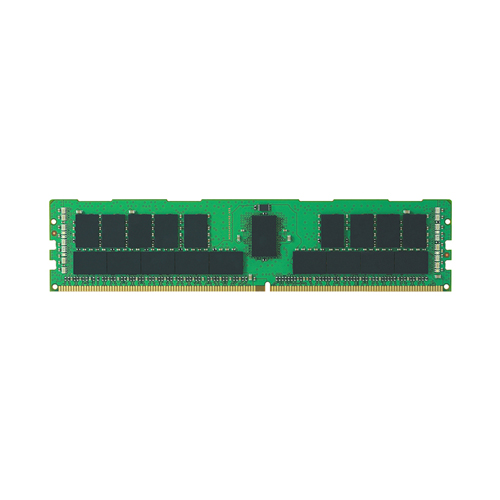
This is a server-class DDR4-3200 Registered DIMM with ECC, purpose-built for memory-intensive enterprise workloads such as virtualization, in-memory databases, and mission-critical data processing. Its dual-rank x8 organization and registered signaling enhance signal integrity and stability under high-capacity, multi-DIMM configurations, while ECC protection ensures end-to-end data integrity.
1. 32 GB capacity per module raises the memory ceiling in rack servers, allowing far more containers and VMs to co-reside without triggering storage swap latency.
2. ECC error correction silently catches and repairs single-bit flips as they occur, preserving transactional integrity for databases and financial processing.
3. Registered buffering offloads electrical loads from the CPU memory controller, so all channels stay reliably populated at maximum DIMM count in dense virtualization hosts.
4. 3200 MT/s throughput supplies 25.6 GB/s of peak bandwidth per channel, shrinking response times for in-memory caching and real-time data analytics.
5. Dual rank x8 layout enables interleaved access across internal banks, sustaining consistent command efficiency under the heavy, mixed I/O traffic of multi-tenant workloads.
As a server-class Registered DIMM built for enterprise workloads, the M393A4G43CB4-CWECO turns four critical specifications into measurable reliability and performance where downtime is not an option. Its ECC capability actively detects and corrects single-bit memory errors, directly preventing silent data corruption in high-stakes environments like financial databases or virtualized transaction clusters—what feels like a minor cosmic-ray flip can otherwise invalidate an entire dataset without warning. The Registered signal architecture buffers command and address lines, meaning you can populate every channel with large-capacity modules while maintaining rock-stable signal integrity across a multi-node VMware or hyper-converged infrastructure, eliminating the memory-related blue screens that erode consolidation ratios. The dual-rank x8 organization leverages interleaving to keep more pages open concurrently, significantly reducing latency for in-memory databases such as Redis or SAP HANA where hot-data retrieval speed defines user experience and revenue. Backed by DDR4-3200 throughput and 1.2 V low-power operation, this Samsung DIMM delivers the bandwidth density needed for heavy virtual machine densities and real-time analytics while helping cap a data center’s thermal and energy budget, making it a strategic asset for any IT team scaling resilient, latency-sensitive services.
This DDR4-3200 ECC Registered DIMM is server memory. Below is capacity planning guidance for a 32GB RDIMM.
General Virtualization
Virtualized hosts are memory-bound before CPU; a 32GB RDIMM offers an efficient building block. For typical mid-range deployments, populate six to eight identical modules (192–256GB) across all memory channels in a dual-socket server, using one DIMM per channel to preserve full 3200MT/s speed. Balance capacity identically between sockets for consistent NUMA performance.
In-Memory Database
In-memory databases demand large, low-latency footprints. Start with at least sixteen 32GB modules (512GB) to house active datasets entirely in RAM. Populate all memory channels with identical DIMMs per CPU socket to minimize latency and maximize parallelism.
High-Performance Computing (HPC)
HPC workloads prioritize bandwidth over raw capacity. Configure eight 32GB DIMMs (256GB) in a dual-socket server, installing one DIMM per channel to operate at 3200MT/s without downclocking. This symmetric population delivers peak memory throughput for simulation codes. If more capacity is needed, populate two DIMMs per channel, but expect a clock reduction to 2933MT/s.
Rigorously tested, compatible with Dell PowerEdge R750, HPE ProLiant DL380 Gen10 Plus, Lenovo ThinkSystem SR650 V2, and more.
Q: Can I mix this M393A4G43CB4-CWECO with other memory modules of different brands or speeds?
A: Mixing brands or speeds is not advised. Registered ECC memory requires matched kits for signal integrity and stability. Mixing may cause POST failures or silent data corruption in server environments.
Q: Is this memory compatible with my server system? (Intel Xeon / AMD EPYC)
A: Compatible with servers using Intel Xeon Scalable or AMD EPYC processors with DDR4-3200 RDIMM support. Please confirm your motherboard's qualified vendor list (QVL) includes registered ECC DIMMs.
Q: What is the recommended DIMM population order for optimal performance?
A: For dual-socket servers, populate identical DIMMs in the first slot of each memory channel, balancing across CPU memory controllers. Follow your server board’s manual for channel interleaving and balanced configuration.
Q: Does this module support overclocking or XMP profiles?
A: No, this is a server-grade registered DIMM built for reliability. It runs at JEDEC standard DDR4-3200 with default timings. Overclocking or XMP is not supported and may compromise data integrity.
Q: Can this registered ECC memory be used in a standard desktop motherboard?
A: No, it requires a server motherboard and a CPU that explicitly supports Registered ECC DIMMs. Standard desktop platforms typically only accept unbuffered non-ECC or ECC UDIMMs.