











 Secure payments
Standard refund policy
Trade Assurance
Secure payments
Standard refund policy
Trade Assurance
| Product Type | Memory Module |
|---|---|
| Compliance Standards | |
| Memory Capacity | 32 GB |
| Memory Technology | DDR4 |
| Product Voltage | 1.2 V |
| RAM Speed | 3200 MHz |
| RAM Standard | DDR4-3200/PC4-25600 |
| Error Identifying | ECC |
| Signal Type | Registered |
| Column Access Strobe (CAS) | CL22 |
| Rank | Dual Rank x4 |
| Quantity of Pins | 288-pin |
| RAM Genre | RDIMM |
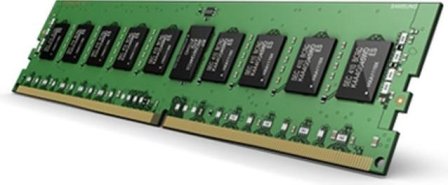
This is a server-grade DDR4-3200 Registered ECC memory module, ideally suited for dual-socket platforms running virtualization, in-memory databases, or mission-critical workloads where data integrity is paramount. Its dual-rank x4 organization and CL22 latency maximize signal stability and memory density per channel, while registered buffering ensures reliable operation even under fully populated configurations.
1. ECC protection detects and corrects single-bit errors in real time, preventing silent data corruption that could compromise financial transactions or critical database integrity.
2. Registered signal buffering stabilizes electrical loads across the memory bus, enabling densely populated server boards to scale beyond a terabyte without sacrificing command reliability.
3. Dual Rank x4 configuration interleaves access across two internal rank groups, saturating memory channels for sustained throughput during heavy virtualization and container consolidation.
4. The 32-gigabyte per module density maximizes capacity per channel slot, allowing hyperscalers to provision more guest machines and in-memory caches within a limited server footprint.
5. 3200 megatransfers per second bandwidth accelerates large dataset processing, shrinking query response times for analytics workloads and improving real-time decision support.
As a server-grade RDIMM, the Samsung M393A4K40DB3-CWECY is engineered to resolve the most persistent pain points in enterprise data centers. Its ECC technology catches and corrects single-bit errors instantly, preventing silent data corruption that could crash your entire virtualization stack or distort transactional records in an in-memory database; in a VMware vSAN cluster, this means true VM uptime and unquestionable data fidelity. The registered signal buffer decouples the memory controller from raw load, letting you fully populate a server with multiple 32 GB modules and still run stable—critical when scaling virtualized infrastructure to hundreds of VMs. With a dual-rank x4 organization, this module interleaves access to deliver higher bandwidth, directly accelerating massive analytical queries on a SAP HANA database by shrinking access latency. Operating at a fast 3200 MT/s and a low 1.2 V, it ensures that every workload, from real-time bidding engines to dense containerized environments, achieves peak throughput without thermal throttling. For you, that means fewer support calls, lower TCO, and a platform that consistently meets aggressive SLAs.
General Virtualization
For a hypervisor hosting moderate VM densities, deploy one 32GB RDIMM per populated memory channel to balance cost and capacity. A typical dual‑socket server with 8 channels per CPU should start with eight modules (256GB total), leaving slots open for future scale‑out while maintaining full bandwidth.
In‑Memory Database
In‑memory workloads like Redis or SAP HANA demand maximum capacity and simultaneous bank access. Install pairs of these dual‑rank x4 RDIMMs across all channels—sixteen 32GB modules (512GB) per dual‑socket server ensures low latency with quad‑rank interleaving and minimizes NUMA penalties.
High‑Performance Computing
HPC clusters favor bandwidth over density for most codes, but large‑footprint simulations benefit from balancing both. Populate two 32GB DIMMs per channel (2‑DPC) only where capacity is the bottleneck; otherwise use one DIMM per channel to sustain 3200MT/s and avoid speed drops, often achieving 128–256GB per node efficiently.
Rigorously tested, this server memory ensures compatibility with Dell PowerEdge R750, HPE DL380 Gen10, Lenovo SR650 V2, and more.
Q: Can I mix this M393A4K40DB3-CWECY with other memory modules of different brands or speeds?
A: Mixing different brands or speeds is strongly discouraged. The system will downclock to the slowest module, and mismatched Registered ECC DIMMs can cause stability issues on server platforms. Best practice is to use identical part numbers.
Q: Is this memory compatible with my system?
A: This is a DDR4-3200 Registered ECC RDIMM designed for dual-socket Intel Xeon Scalable and AMD EPYC platforms. Ensure your server board supports Registered DIMMs, x4 organization, and a 3200 MT/s speed grade before purchase.
Q: What is the recommended DIMM population order for optimal performance?
A: Populate identical DIMMs per channel, starting with the farthest slot from the CPU. For dual-rank x4 RDIMMs, balance across memory channels. Always follow the motherboard manual's population sequence to maintain interleaving and full memory bandwidth.
Q: Does this module support overclocking or XMP profiles?
A: No. This is a JEDEC-compliant server RDIMM with CL22 latency. Overclocking and XMP are not supported, as enterprise platforms prioritize data integrity and error correction over speed adjustments.
Q: What warranty and typical failure rate can I expect?
A: This module includes a one-year warranty. Built with Samsung components and rigorous validation, enterprise DDR4 ECC RDIMMs exhibit an extremely low annualized failure rate, typically under 0.5% under normal operating conditions.