











 Secure payments
Standard refund policy
Trade Assurance
Secure payments
Standard refund policy
Trade Assurance
| Product Type | Memory Module |
|---|---|
| Compliance Standards | |
| Memory Capacity | 32 GB |
| Memory Technology | DDR4 |
| Product Voltage | 1.2 V |
| RAM Speed | 3200 MHz |
| RAM Standard | DDR4-3200/PC4-25600 |
| Error Identifying | ECC |
| Signal Type | Registered |
| Column Access Strobe (CAS) | CL22 |
| Rank | Dual Rank x4 |
| Quantity of Pins | 288-pin |
| RAM Genre | RDIMM |
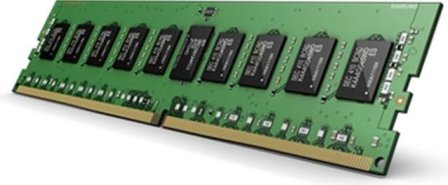
Designed for enterprise server platforms, this 32GB DDR4-3200 RDIMM leverages ECC and registered signal buffering to ensure uncompromised data integrity and signal stability in dense, multi-DIMM deployments. Its dual-rank x4 organization and CL22 latency strike an optimal balance between capacity and memory bandwidth, making it an ideal choice for virtualization clusters and in-memory database workloads.
1. The 32 GB capacity per module allows dense memory configurations in 2U servers, supporting larger in-memory databases and more virtual machines without sacrificing performance.
2. DDR4-3200 speed delivers up to 25.6 GB/s of bandwidth per channel, accelerating real-time analytics and reducing data bottlenecks in multi-socket platforms.
3. ECC protection corrects single-bit errors and detects multi-bit faults, preserving data integrity in financial transactions and long-running scientific computations.
4. Registered signal buffering stabilizes high-capacity memory ranks, enabling fully populated 24-DIMM servers to operate reliably under heavy, sustained workloads.
5. Dual rank x4 organization interleaves memory banks for higher effective concurrency, boosting throughput in virtualized environments where many VMs compete for memory access.
The Samsung M393A4K40EB3-CWECO is a server-class 32GB DDR4-3200 RDIMM purpose-built for data centers, and its four defining characteristics—ECC, Registered clocking, 3200MT/s speed, and a Dual Rank x4 organization—directly solve the pain points of mission-critical infrastructure. In a dense virtualization cluster running dozens of VMs, the Registered signal buffer preserves clean command and address signaling even when every memory channel is fully populated. This means you can maximize capacity without the instability that causes a host-level crash, preventing revenue-draining outages. That stability pairs with ECC, which continuously corrects single-bit errors caused by background radiation. For an in-memory database like SAP HANA processing real-time transactions, a silent bit flip does not just corrupt a log entry—it can propagate across cluster replicas and poison financial analytics. Here, ECC is not optional; it is the last line of defense against data corruption. The 3200MT/s bandwidth and Dual Rank interleaving then ensure this protection never causes a performance penalty. Dual Rank allows the memory controller to pipeline access across internal ranks, substantially improving throughput during concurrent queries, so your Redis instance serves cache data faster under heavy load. It all runs at 1.2V, helping you cram more compute into fixed thermal limits.
General Virtualization
For a typical hypervisor hosting 20–30 mixed-role VMs, populate six to eight identical 32 GB RDIMMs per CPU socket to reach 192–256 GB total capacity while maintaining balanced memory channels. This registered ECC DDR4-3200 module ensures data integrity and stable overcommit ratios, making it ideal for mid-density consolidation without entering costly LRDIMM territory.
In-Memory Database
In-memory analytics and caching platforms like Redis or SAP HANA demand large, contiguous memory pools. Equip a dual-socket server with 16 of these 32 GB dual‑rank x4 RDIMMs (512 GB per node) to keep entire datasets resident, leveraging the 1.2 V operation for lower power draw under sustained load. Spread modules evenly across all memory channels to maximize throughput and avoid NUMA bottlenecks.
High-Performance Computing
HPC clusters running tightly coupled MPI workloads benefit from full channel population to saturate memory bandwidth. Install one 32 GB RDIMM per channel (eight modules per socket) for 256 GB per node, matching the 3200 MT/s speed to the fabric interconnect. The dual-rank x4 organization improves bank-level parallelism, and registered signaling stabilizes large-scale deployments, letting compilers vectorize aggressively without memory faults.
Rigorously tested for server compatibility: Dell PowerEdge R750, HPE ProLiant DL380 Gen10 Plus, Lenovo ThinkSystem SR650 V2.
Q: Can I mix this M393A4K40EB3-CWECO with other memory modules of different brands or speeds?
A: Mixing is not recommended. Registered ECC modules require strict consistency. Different brands or speeds may cause POST failures, instability, or silent data corruption in server environments.
Q: Is this memory compatible with my system?
A: This RDIMM is designed for DDR4 ECC platforms supporting Intel Xeon Scalable or AMD EPYC processors. Verify your server board's Qualified Vendor List (QVL) for the exact MPN to ensure proper compatibility.
Q: What is the recommended DIMM population order for optimal performance?
A: Follow your server motherboard manual precisely. Typically, populate identical RDIMMs in sets matching memory channels, starting from the farthest white slots per channel to maintain balanced, multi-channel interleaving.
Q: Does this module support overclocking or XMP profiles?
A: No. As an ECC Registered server DIMM adhering to JEDEC DDR4-3200 standard, it runs at fixed native timings. Overclocking or XMP is not supported to guarantee mission-critical data integrity.
Q: What warranty and typical failure rate can I expect?
A: This module comes with a 1-year warranty. While typical enterprise DDR4 RDIMMs exhibit very low annual failure rates, actual figures depend on operating conditions and proper cooling.