











 Secure payments
Standard refund policy
Trade Assurance
Secure payments
Standard refund policy
Trade Assurance
| Product Type | Memory Module |
|---|---|
| Memory Capacity | 32 GB |
| Memory Technology | DDR4 |
| Product Voltage | 1.2 V |
| RAM Speed | 3200 MHz |
| RAM Standard | DDR4-3200/PC4-25600 |
| Error Identifying | ECC |
| Signal Type | Registered |
| Column Access Strobe (CAS) | CL22 |
| Rank | Dual Rank x4 |
| Quantity of Pins | 288-pin |
| RAM Genre | RDIMM |
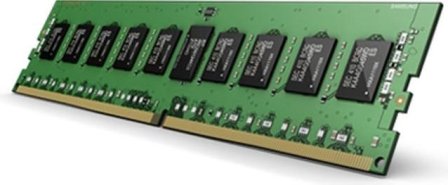
This RDIMM is engineered for enterprise servers and workstations requiring robust data integrity, making it ideal for memory-intensive workloads such as virtualization, in-memory databases, and mission-critical applications. Its dual-rank x4 configuration and registered ECC design ensure exceptional signal stability and error correction at 3200 MT/s, while the CL22 latency balances responsive performance with server-grade reliability.
1. The 32 GB capacity per module maximizes memory density in server nodes, enabling more virtual machines and larger in-memory databases without scaling hardware footprint.
2. DDR4-3200 speed delivers 25.6 GB/s of peak bandwidth per channel, accelerating real-time analytics and reducing latency in high-frequency trading platforms.
3. ECC protection corrects single-bit errors and detects multi-bit faults, preserving data integrity for financial transactions and mission-critical enterprise workloads.
4. Registered signal buffering stabilizes command and address lines across fully loaded server boards, ensuring reliable operation even with 24 DIMMs per chassis.
5. Dual Rank x4 organization interleaves memory accesses across internal banks, sustaining high throughput during dense virtualization and heavy multi-tenant workloads.
The Samsung M393A4K40DB3-CWEBY is a server-grade 32GB DDR4-3200 Registered DIMM, and its four core characteristics directly address the pain points of enterprise data centers. The ECC capability is not just error detection—it silently corrects single-bit flips caused by cosmic background radiation, preventing silent data corruption that could wreck a financial ledger or a hypervisor’s memory state. Registered signaling buffers the command and address buses, drastically reducing electrical load on the CPU’s memory controller. For a virtualization cluster running dozens of VMs, this means you can populate all channels with high-capacity modules without sacrificing signal integrity, achieving the massive memory footprints that live migration and resource overcommitment demand. The dual-rank x4 organization takes this further by enabling rank interleaving; the memory controller can issue concurrent reads and writes across ranks, significantly boosting effective bandwidth and reducing queue latency. In an in-memory database like Redis or SAP HANA under heavy concurrency, that translates to faster transaction response and higher throughput under the same clock speed. Combined with the 3200 MT/s transfer rate at a standard 1.2V, the module delivers a thermal and power efficiency balance that keeps cooling costs in check while providing the deterministic, high-capacity performance that enterprise workloads cannot afford to compromise.
Capacity Planning for Server Memory (DDR4-3200 ECC RDIMM)
Based on the specs — ECC, Registered (RDIMM), dual-rank x4, 32GB capacity — this is a server-class module designed for data integrity and high-capacity deployments. Below are capacity planning recommendations for typical server workloads, assuming a dual-socket platform with 8 or 16 memory channels per CPU to leverage balanced configurations.
General Virtualization
Virtualized environments are memory-bound and benefit heavily from population balance. Deploy these 32GB RDIMMs in multiples of 8 (e.g., 8 or 16 modules) to fully populate the memory channels of each processor, maximizing memory bandwidth and reducing NUMA penalties. Plan for 256GB to 512GB per host for 20–40 typical VMs, leaving headroom for hypervisor overhead and failover capacity.
In-Memory Database
In-memory databases like Redis, SAP HANA, or MemSQL demand low latency and absolute data reliability, making ECC non-negotiable. Use the largest supported count of these 32GB RDIMMs, populating all memory channels (often 12 or 16 modules per socket) to reach 384GB to 1TB per host. The dual-rank x4 design provides excellent bank-level parallelism, improving throughput under heavy, concurrent read/write loads.
High-Performance Computing (HPC)
HPC tasks rely on both capacity and sustained bandwidth. Configure these modules in a fully balanced, symmetric population across all memory controllers (e.g., 1 DIMM per channel, 8 modules per CPU) to eliminate channel contention. For memory-intensive simulations, scale from 256GB (8 modules) to 1TB (32 modules) per node depending on problem size; the registered buffer and dual-rank layout maintain stable signal integrity at 3200 MT/s in fully loaded configurations.
Rigorously tested server DDR4 RDIMM, compatible with Dell PowerEdge R750, HPE ProLiant DL380 Gen10 Plus, Lenovo ThinkSystem SR650 V2.
Q: Can I mix this M393A4K40DB3-CWEBY with other memory modules of different brands or speeds?
A: Mixing different brands or speeds is not recommended for registered server memory. To ensure signal integrity and reliable 24/7 operation, always use identical Samsung modules with the same part number and dual-rank x4 configuration.
Q: Is this memory compatible with my Intel Xeon or AMD EPYC server platform?
A: This 32GB DDR4-3200 ECC RDIMM is compatible with Intel Xeon Scalable and AMD EPYC 7002/7003 series processors that support registered 288-pin DDR4-3200/PC4-25600 modules. Verify your motherboard’s qualified vendor list.
Q: What is the recommended DIMM population order for optimal performance?
A: Populate identical dual-rank RDIMMs in balanced groups across memory channels. Typically, fill the farthest slot from the CPU in each channel first, then the next closest, following your server’s specific population guidelines for symmetric interleaving.
Q: Does this module support overclocking or XMP profiles?
A: No. This Samsung enterprise RDIMM adheres strictly to JEDEC DDR4-3200 standards at 1.2V and CL22 timing. Overclocking and XMP profiles are not supported, ensuring maximum stability and data integrity for server workloads.
Q: What warranty and typical failure rate can I expect?
A: This module includes a 1-year warranty. Being a Samsung enterprise-grade component with rigorous testing, its annualized failure rate (AFR) is extremely low, typically well below 0.5% under normal server operating conditions.