











 Secure payments
Standard refund policy
Trade Assurance
Secure payments
Standard refund policy
Trade Assurance
| Product Type | Memory Module |
|---|---|
| Memory Capacity | 32 GB |
| Memory Technology | DDR4 |
| Product Voltage | 1.2 V |
| RAM Speed | 3200 MHz |
| RAM Standard | DDR4-3200/PC4-25600 |
| Error Identifying | ECC |
| Signal Type | Registered |
| Column Access Strobe (CAS) | CL22 |
| Rank | Dual Rank |
| Quantity of Pins | 288-pin |
| RAM Genre | RDIMM |
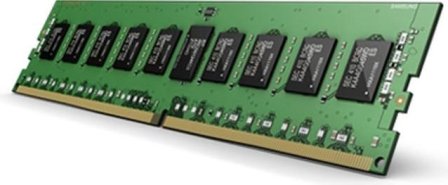
Designed for enterprise server environments, this DDR4-3200 RDIMM with ECC and Registered signaling ensures rock-solid data integrity and stability under heavy multi-rank memory configurations, making it ideal for virtualization clusters and in-memory databases. Its dual-rank design and CL22 latency provide a balanced combination of high capacity density and reliable throughput, effectively handling intensive, concurrent workloads without compromising uptime.
1. With 32GB per module, dense server configurations can allocate ample memory per virtual machine, maximizing consolidation ratios in private cloud environments.
2. The 3200MT/s data rate boosts memory bandwidth, accelerating in-memory databases and real-time analytics under sustained query loads.
3. Integrated ECC corrects single-bit errors and detects multi-bit corruptions, preserving data integrity in mission-critical financial or healthcare transactions.
4. The registered buffer isolates the command bus, enabling fully populated multi-DIMM channels without signal degradation for rock-solid uptime.
5. Dual-rank organization interleaves accesses across internal banks, delivering consistent throughput gains that benefit virtualized workloads with mixed read/write patterns.
The M393A4K40DB3-CWEBYFU is a server-class Registered ECC DDR4 RDIMM built for workloads where uptime and accuracy are non-negotiable. In a virtualization cluster hosting dozens of mission-critical VMs, its Error Correcting Code is your first line of defense against silent data corruption caused by cosmic ray bit-flips. When a single-bit error is detected and corrected on the fly, you avoid unexplained guest crashes or in-memory data anomalies that ripple into corrupted customer transactions. Coupled with a Registered signal buffer, this module allows dense population of 32 GB Dual Rank DIMMs across all memory channels without compromising signal integrity; the platform remains rock-stable even when you push to 512 GB or more per node, letting you confidently overcommit memory to fit extra VMs without risking a server-wide fault.
In an in-memory database such as SAP HANA or a real-time Redis cluster, the same ECC protection ensures that every index lookup and persisted record remains mathematically exact. The Dual Rank organization here interleaves accesses across two internal rank groups on a single module, boosting effective bandwidth under heavy, parallel query loads. Together with DDR4-3200 speed, this means larger in-memory tables load faster, analytical joins complete sooner, and dashboard refreshes feel instantaneous. The 1.2 V low-voltage operation then becomes a TCO advantage: across a rack of servers running 24/7, that reduced power draw shrinks cooling costs and extends component lifespan, directly improving your data center’s performance-per-watt and long-term reliability.
General Virtualization
For a typical hypervisor host running multiple VMs, memory capacity often becomes the limiting factor before CPU. Install at least eight 32 GB RDIMMs (256 GB total) across all memory channels to enable balanced population and maximize interleaving. On dual-socket servers, populate identically per socket—this configuration easily supports 30–40 moderately sized VMs while leaving room for memory bursting.
In-Memory Database
Databases such as Redis or SAP HANA demand both capacity and reliability. Deploy a fully populated memory architecture with 16 or more 32 GB RDIMMs per node, targeting 512 GB to 1 TB. The registered ECC design prevents silent data corruption during intensive in-memory operations, and dual-rank modules enhance bandwidth, helping sustain low latency under high query loads.
High-Performance Computing
HPC clusters prioritize bandwidth and balanced configurations. Use one 32 GB RDIMM per channel (typically 8 modules per socket) to achieve maximum memory bandwidth via all available channels. The DDR4-3200 speed and dual-rank design deliver the throughput required for simulation checkpoints and MPI workloads, while ECC ensures result integrity during multi-day compute runs.
Rigorously tested server memory; works with Dell PowerEdge R750, HPE DL380 Gen10 Plus, Lenovo SR650 V2, and more.
Q: Can I mix this M393A4K40DB3-CWEBYFU with other memory modules of different brands or speeds?
A: Mixing is strongly discouraged for enterprise RDIMMs. Different speeds, ranks, or brands can cause POST failures and signal integrity issues. Always populate identical Samsung ECC Registered DIMMs for guaranteed stability and validated system performance.
Q: Is this memory compatible with my server based on Intel Xeon Scalable or AMD EPYC platforms?
A: Yes, this Samsung RDIMM is validated for modern platforms supporting DDR4-3200 Registered ECC memory, such as Intel Xeon Scalable (2nd/3rd Gen) and AMD EPYC 7002/7003 series. Verify your server’s memory QVL for exact compatibility.
Q: What is the recommended DIMM population order for optimal performance?
A: Populate identical DIMMs per channel, starting with the slot farthest from the CPU. Balance across all memory channels and match configurations symmetrically. Consult your server’s manual — typically fill blue slots first, then black, to enable optimal interleaving.
Q: Does this module support overclocking or XMP profiles?
A: No. This is a server-grade RDIMM operating strictly at JEDEC standard DDR4-3200 (PC4-25600) with fixed CL22 timings. Overclocking and XMP are not supported, ensuring 24/7 reliability under sustained workloads.
Q: What warranty and typical failure rate can I expect?
A: This Samsung module comes with a one-year warranty. Typical annualized failure rate (AFR) is extremely low, around 0.2–0.4%, reflecting enterprise-class reliability. Actual lifespan often exceeds five years in well-cooled environments.