











 Secure payments
Standard refund policy
Trade Assurance
Secure payments
Standard refund policy
Trade Assurance
| Product Type | Memory Module |
|---|---|
| Memory Capacity | 32 GB |
| Memory Technology | DDR5 |
| Product Voltage | 1.1 V |
| RAM Speed | 4800 MHz |
| RAM Standard | DDR5-4800/PC5-38400 |
| Error Identifying | ECC |
| Signal Type | Registered |
| Column Access Strobe (CAS) | CL40 |
| Rank | Single Rank x4 |
| Quantity of Pins | 288-pin |
| RAM Genre | RDIMM |
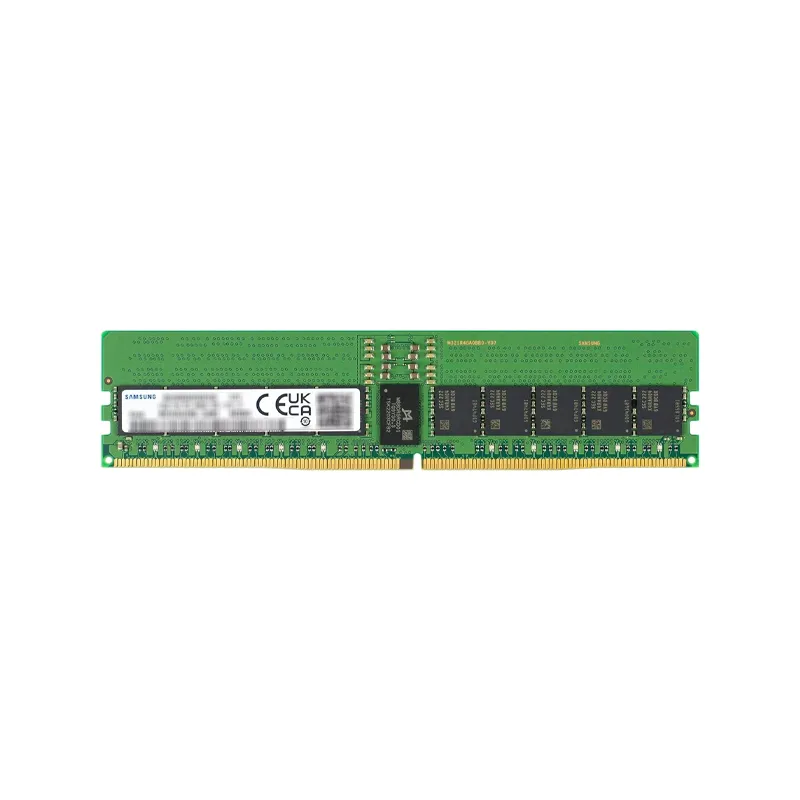
This DDR5-4800 Registered DIMM with ECC is engineered for server platforms handling latency-sensitive workloads such as virtualization, in-memory databases, and large-scale data analytics where data integrity is non-negotiable. Its single-rank x4 configuration and registered signal architecture deliver exceptional signal integrity and stability across heavily loaded memory channels, while the integrated ECC ensures end-to-end error correction to prevent silent data corruption.
1. ECC error correction continuously monitors data for silent corruption, ensuring the rock-solid integrity required for financial ledgers and mission-critical database transactions.
2. Registered signal buffering stabilizes the command and address buses across fully populated multi-DIMM channels, preserving signal integrity in dense rack-scale server deployments.
3. Generous module capacity maximizes the number of virtual machines that can be packed onto a single physical host, reducing licensing and power overhead in consolidated data center environments.
4. DDR5 technology doubles the core prefetch and bank groups, delivering the sustained throughput needed for real-time analytics and massive in-memory computing clusters.
5. Elevated memory clock speed cuts transfer latency under heavy concurrent access, keeping response times snappy for thousands of simultaneous users on multi-tenant cloud platforms.
The M321R4GA0BB0-CQK is a 32 GB DDR5-4800 Registered DIMM engineered for modern servers, and its four defining characteristics directly solve the real-world pain points of data center operators. The ECC technology silently corrects single-bit memory errors before they corrupt transactional data—an absolute necessity when a financial database processes millions of write operations per day, where even one undetected bit flip could cascade into financial discrepancy. The Registered interface buffers command and address signals, which means you can populate all memory channels with high-capacity modules without compromising signal integrity; this becomes critical in a dense virtualization cluster running dozens of virtual machines, where stability under simultaneous workloads outweighs raw speed. The 4800 MT/s bandwidth combined with single-rank x4 organization provides predictable, low-latency access that in-memory databases like Redis or SAP HANA crave, reducing query latency during peak loads. Operating at just 1.1 V, it also helps constrain the thermal envelope inside a 1U rack server, where every watt saved translates into sustained turbo frequency headroom for the CPUs. For the infrastructure architect, this module means consolidating more VMs per host and shrinking the overnight batch processing window without sacrificing data integrity.
Server Memory (DDR5 ECC Registered RDIMM)
This 32GB DDR5-4800 RDIMM with ECC and registered signaling is designed for server platforms. Below are capacity planning recommendations for typical workloads.
General Virtualization
Balance capacity and bandwidth by populating all memory channels with one DIMM per channel (1DPC). On an 8-channel platform, eight 32GB modules provide 256GB total, supporting numerous VMs while maintaining 4800MT/s speed. For denser consolidation, add a second DIMM per channel, though speed may drop to 4400MT/s—acceptable for less latency-sensitive workloads.
In-Memory Database
Maximize total capacity to keep entire datasets in RAM. Deploy two DIMMs per channel (2DPC) with these 32GB RDIMMs: 16 modules per socket deliver 512GB at slightly reduced frequency. This configuration is ideal for Redis, SAP HANA, or large-scale analytics where capacity trumps peak bandwidth. Ensure active cooling and sufficient power budget.
High-Performance Computing (HPC)
Achieve highest bandwidth by installing one DIMM per channel across all available memory channels. For a dual-socket server with 8 channels each, sixteen 32GB modules yield 512GB total and full 4800MT/s throughput. This layout minimizes latency and maximizes the memory bandwidth critical for simulation, CFD, and tightly coupled parallel jobs.
Rigorously tested, compatible with Dell PowerEdge R760, HPE ProLiant DL360 Gen11, Lenovo ThinkSystem SR650 V3, and more.
Q: Can I mix this M321R4GA0BB0-CQK with other memory modules of different brands or speeds?
A: Mixing this Registered DDR5-4800 RDIMM with different brands or speeds is not advisable. It forces the memory controller to downgrade speed and timings, potentially causing stability issues in server environments. Use identical modules for guaranteed reliability.
Q: Is this memory compatible with my server platform?
A: This is a DDR5-4800 Registered ECC RDIMM. It requires a server motherboard with an Intel Xeon Scalable 4th Gen (Sapphire Rapids) or AMD EPYC 9004 Series processor that explicitly supports 288-pin DDR5 RDIMMs. Verify the platform's memory QVL.
Q: What is the recommended DIMM population order for optimal performance with this module?
A: Follow the platform's specified memory population guidelines. Generally, populate one DIMM per channel to maintain single-rank x4 signal integrity, maximizing 4800MT/s speed. Use the white DIMM slots first for balanced memory interleaving and full ECC benefits.
Q: Does this module support overclocking or XMP profiles?
A: No, this server-grade RDIMM does not support overclocking or Intel XMP. It adheres to JEDEC DDR5-4800 standards at 1.1V and CL40 timings to prioritize stability and data integrity in enterprise ECC environments, where any memory overclocking is prohibited.
Q: What warranty and typical failure rate can I expect for this Samsung memory?
A: This module carries a one-year warranty. As a Samsung enterprise RDIMM, it exhibits an extremely low ARR (Annualized Failure Rate) typically under 0.1%, backed by rigorous testing, ECC correction, and a design life suited for 24/7 mission-critical server deployments.