











 Secure payments
Standard refund policy
Trade Assurance
Secure payments
Standard refund policy
Trade Assurance
| Product Type | Memory Module |
|---|---|
| Memory Capacity | 32 GB |
| Memory Technology | DDR5 |
| Product Voltage | 1.1 V |
| RAM Speed | 4800 MHz |
| RAM Standard | DDR5-4800/PC5-38400 |
| Error Identifying | ECC |
| Signal Type | Registered |
| Column Access Strobe (CAS) | CL40 |
| Rank | Dual Rank x4 |
| Quantity of Pins | 288-pin |
| RAM Genre | RDIMM |
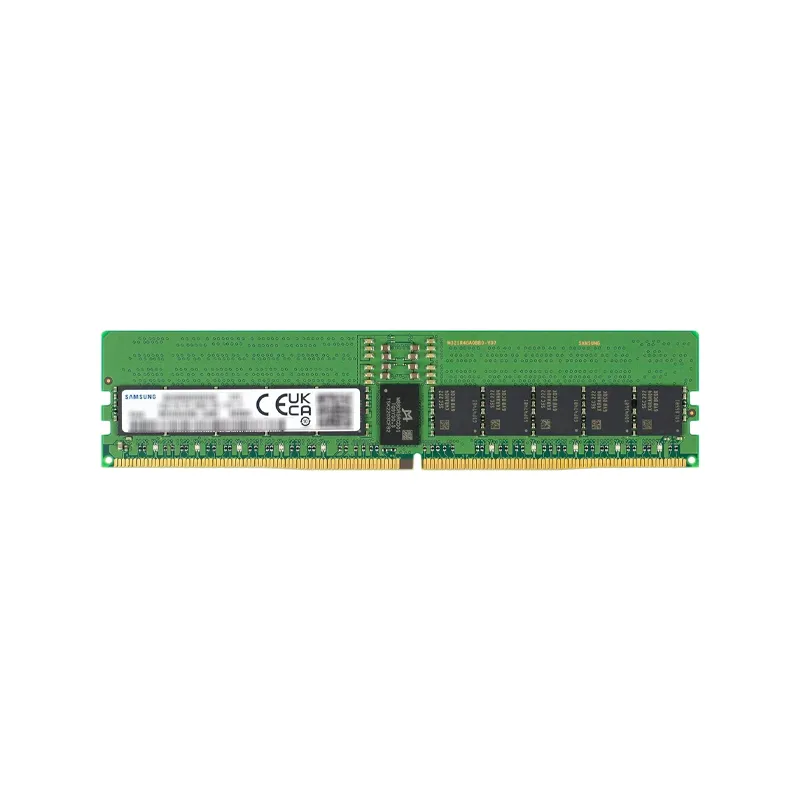
This DDR5 Registered ECC server memory module is ideally suited for enterprise virtualization and in-memory database workloads that demand uncompromising data integrity and rock-solid stability. The dual-rank x4 configuration combined with registered signal buffering enhances signal integrity across high-density memory channels, ensuring reliable throughput under the most strenuous, scaled-out deployments.
1. Registered clock driver buffers control signals, enabling the deployment of massive memory footprints without signal degradation—vital for large-scale virtualization hosts.
2. ECC protection silently corrects single-bit errors, safeguarding in-memory financial and scientific datasets against silent data corruption.
3. Dual Rank x4 organization interleaves access across multiple banks, sustaining peak channel utilization under heavy multi-tenant workloads.
4. The 32 GB capacity per stick allows a single server to host significantly more virtual machines, maximizing consolidation ratios and license efficiency.
5. DDR5 technology elevates memory bandwidth per core, directly accelerating real-time analytics and in-memory databases in dense data-center environments.
This is server-grade memory, a DDR5 Registered DIMM with ECC, and every specification here speaks directly to the demands of mission-critical enterprise infrastructure. When you are running a dense virtualization cluster hosting dozens of VMs on a single node, a 32GB Dual Rank x4 module like the M321R4GA3BB6-CQKDG unlocks higher interleaving and memory bandwidth, meaning your hypervisor can sustain far more simultaneous I/O operations without stalling guest performance. In an in-memory database such as Redis or SAP HANA, the combination of ECC error correction and registered signal buffering is non-negotiable: a single undetected bit-flip caused by background radiation can corrupt a financial transaction or compromise data integrity, but ECC catches and corrects those errors on the fly, while the RDIMM’s command-address buffer stabilizes high-capacity configurations, allowing you to populate all channels without signal degradation. The 4800MT/s speed at a conservative 1.1V with CL40 latency delivers a deliberate balance of throughput and power efficiency across a rack of 2U servers, reducing thermal strain and operational cost while still feeding hungry CPU cores in analytics workloads. This is not about benchmarks—it is about ensuring that a 24/7 transactional database or a virtualized environment never drops a query and never silently corrupts a record, because downtime or data loss at that scale carries a price tag a consumer DIMM simply cannot shoulder.
General Virtualization
Populate each memory channel with one 32 GB DDR5-4800 RDIMM (1DPC) to deliver 256 GB per processor socket while sustaining maximum memory speed. This balanced configuration supports high VM density without the latency penalty of two DIMMs per channel. For heavier consolidation, deploy two modules per channel to reach 512 GB per socket—ideal when capacity outweighs the small drop in transfer rate.
In-Memory Database
Maximize capacity by installing two 32 GB dual-rank RDIMMs per channel, achieving 512 GB per processor. The dual-rank x4 organization increases bank-level parallelism, which accelerates large in-memory analytics and real-time transaction processing at 4800 MT/s. This approach keeps the entire working set in DRAM, eliminating storage bottlenecks and enabling consistent low-latency queries.
High-Performance Computing (HPC)
For bandwidth-sensitive workloads, use one 32 GB module per channel to maintain the platform’s peak 4800 MT/s transfer rate and full memory interleaving. A typical dual-socket node with eight channels per CPU yields 256 GB of high-speed memory, sufficient for most simulation and modeling tasks. Reserve dual-DIMM-per-channel configurations only when dataset size exceeds the 1DPC ceiling, accepting a modest frequency trade-off.
Rigorously tested server DDR5 RDIMM, compatible with Dell PowerEdge R760, HPE ProLiant DL380 Gen11, Lenovo SR650 V3, SuperMicro 620P-TR.
Q: Can I mix this M321R4GA3BB6-CQKDG with other memory modules of different brands or speeds?
A: Mixing RDIMMs of different brands or speeds is not recommended. It may cause instability, reduced performance, or system POST failure. For guaranteed compatibility, use identical modules with the same part number and specifications.
Q: Is this memory compatible with my system?
A: This DDR5-4800 Registered ECC module is designed for server platforms supporting DDR5 RDIMMs, such as Intel Xeon Scalable (Sapphire Rapids) or AMD EPYC 7003/9004 series. Please verify your server board's qualified vendor list.
Q: What is the recommended DIMM population order for optimal performance?
A: Follow your server manual's memory population guidelines. Typically, populate identical DIMMs per channel, starting with blue slots or the farthest from the CPU. Balanced configuration across memory channels ensures optimal bandwidth and interleaving.
Q: Does this module support overclocking or XMP profiles?
A: No. This server-grade Registered DIMM adheres strictly to JEDEC DDR5-4800 standards. It does not support XMP or overclocking; system stability and data integrity rely on validated standard speeds and timings.
Q: What warranty and typical failure rate can I expect?
A: This module is backed by a 1-year warranty. Built with enterprise-grade components and rigorous testing, it delivers high reliability with an extremely low annualized failure rate under normal server operating conditions.