











 Secure payments
Standard refund policy
Trade Assurance
Secure payments
Standard refund policy
Trade Assurance
| Product Type | Memory Module |
|---|---|
| Memory Capacity | 32 GB |
| Memory Technology | DDR5 |
| Product Voltage | 1.1 V |
| RAM Speed | 4800 MHz |
| RAM Standard | DDR5-4800/PC5-38400 |
| Error Identifying | ECC |
| Signal Type | Registered |
| Column Access Strobe (CAS) | CL40 |
| Rank | Dual Rank x8 |
| Quantity of Pins | 288-pin |
| RAM Genre | RDIMM |
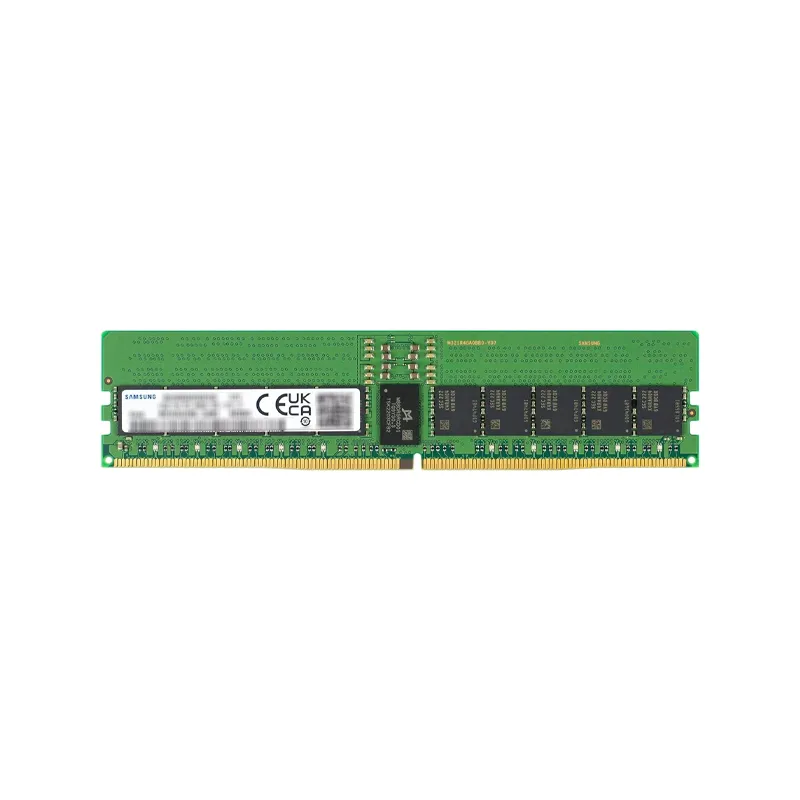
Designed specifically for enterprise servers and virtualization platforms, this Samsung 32GB DDR5-4800 Registered ECC RDIMM delivers exceptional data integrity and stability for mission-critical workloads. Its dual-rank x8 configuration and CL40 latency optimize memory bandwidth for in-memory databases and heavy multi-tenant environments, ensuring reliable 24/7 operation with hardware-level error correction.
1. A 32GB per module density crams more active data sets into each server node, letting virtualization clusters pack additional VMs without expanding their physical footprint.
2. ECC actively scrubs single-bit memory faults in real time, preserving the clean data integrity that financial ledgers and transactional databases cannot afford to lose.
3. Registered signal buffering decouples the DRAM load from the memory controller, stabilizing commands across fully populated multi-socket boards so that terabyte-scale deployments boot without signal degradation.
4. Dual Rank x8 interleaving rotates accesses between parallel internal banks, sustaining the high effective bandwidth that in-memory analytics and real-time inferencing demand under concurrent load.
5. DDR5-4800 throughput feeds modern server CPUs with the sheer memory bandwidth required to keep dozens of hungry cores busy, slashing latency-bound stalls during massive parallel data crunching.
In enterprise server environments, the M321R4GA3BB6-CQKVS DDR5-4800 RDIMM directly addresses the two hardest challenges you face: preserving data integrity at scale and delivering consistent low-latency performance under massive parallelism. Its built-in ECC silently corrects single-bit memory errors before they can corrupt a virtual machine state or poison a database transaction—an absolute necessity when a flipped bit in a multi-tenant virtualization cluster could cascade into application failure or financial discrepancy. The registered signal buffer stabilizes high-density 32GB modules across populated memory channels, so your hypervisor can confidently pack more VMs onto each node without random reboot risks. Dual-rank x8 organization pushes interleaved bandwidth higher, which becomes transformative for in-memory databases like Redis or SAP HANA: query throughput scales smoothly because the memory controller can pipeline accesses across ranks, slashing the latency penalty of back-to-back column strobes. At 1.1V, it also reins in power draw inside dense rack deployments, keeping thermal headroom predictable. This module translates directly into fewer unexplained outages, tighter transaction latency, and higher VM density—the very metrics that define infrastructure reliability.
This is server-class memory (Registered ECC DDR5 RDIMM), purpose-built for data-center workloads. Below are capacity planning guidelines for three key enterprise scenarios.
General Virtualization
Populate all available memory channels symmetrically to maximize DDR5 bandwidth per CPU. Use identical 32 GB dual-rank RDIMMs – typically one DIMM per channel (1DPC) to maintain the native 4800 MT/s speed, delivering the best balance of capacity and latency. For a dual-socket server with 8 channels per CPU, 16 x 32 GB modules provide 512 GB, comfortably supporting 50+ general-purpose VMs while leaving headroom for memory overcommit.
In-Memory Database
Maximize capacity within the platform’s rank and DIMM limits, as these workloads are extremely sensitive to data access latency. Fill a two-DIMM-per-channel (2DPC) configuration with 32 GB dual-rank modules, accepting a slight speed reduction to 4000 MT/s on many platforms. Plan for fully populated memory risers – for example, 32 x 32 GB yielding 1 TB – to keep entire datasets in memory, and validate ECC logging to maintain data integrity under heavy write loads.
High-Performance Computing
Prioritize memory bandwidth and predictability. Use one 32 GB dual-rank RDIMM per channel (1DPC) to achieve the full 4800 MT/s clock and avoid bank-group contention. For a typical HPC node with 12 memory channels, 12 modules supply 384 GB, delivering over 460 GB/s of theoretical bandwidth – ideal for CFD and molecular dynamics codes. Interleave identical dual-rank x8 modules across all channels to guarantee uniform access times during tightly coupled parallel jobs.
Tested server RDIMM, validated for Dell PowerEdge R760, HPE ProLiant DL380 Gen11, Lenovo ThinkSystem SR650 V3.
Q: Can I mix this M321R4GA3BB6-CQKVS with other memory modules of different brands or speeds?
A: Mixing with different brands or speeds is not advised. It can impair ECC functionality and system stability. For optimal reliability, always pair with identical Samsung RDIMMs or modules validated for your server platform.
Q: Is this memory compatible with my system?
A: This 32GB DDR5-4800 ECC RDIMM is compatible with platforms supporting registered DDR5, such as Intel Xeon Scalable (Sapphire Rapids) and AMD EPYC 9004 series. Verify your motherboard’s memory QVL and ECC support.
Q: What is the recommended DIMM population order for optimal performance?
A: Populate identical DIMMs in balanced channels per your server manual. Typically, fill the first slot of each memory channel (e.g., A1, B1, C1, D1) to enable maximum interleaving and bandwidth. Avoid unbalanced configurations.
Q: Does this module support overclocking or XMP profiles?
A: No. This is a JEDEC-compliant RDIMM running at standard DDR5-4800. It does not support XMP or overclocking. Stability and data integrity in enterprise environments require strict adherence to rated specifications.
Q: What warranty and typical failure rate can I expect?
A: It comes with a 1-year warranty. Enterprise-class RDIMMs exhibit an extremely low annualized failure rate (AFR), typically well below 0.5%. This ensures high reliability for mission-critical server workloads.