











 Secure payments
Standard refund policy
Trade Assurance
Secure payments
Standard refund policy
Trade Assurance
| Product Type | Memory Module |
|---|---|
| Memory Capacity | 32 GB |
| Memory Technology | DDR5 |
| RAM Speed | 4800 MHz |
| RAM Standard | DDR5-4800/PC5-38400 |
| Error Identifying | ECC |
| Signal Type | Registered |
| Column Access Strobe (CAS) | CL40 |
| Rank | Single Rank x4 |
| Quantity of Pins | 288-pin |
| RAM Genre | RDIMM |
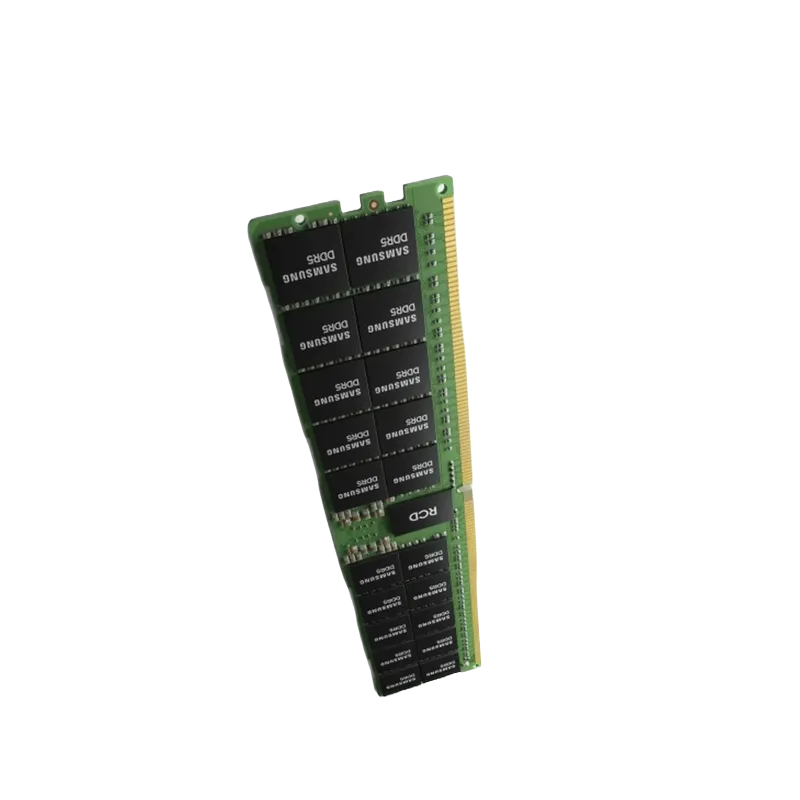
This Samsung M321R4GA0BB0-CQKD 32 GB DDR5-4800 Registered DIMM is engineered specifically for next-generation server platforms, excelling in memory-intensive workloads such as virtualization, in-memory databases, and large-scale data analytics. Its ECC and registered signal architecture ensure superior data integrity and signal stability under high-density configurations, while the single-rank x4 organization reduces electrical loading to maximize memory bandwidth per channel.
1. ECC error correction actively detects and fixes single-bit memory faults, preventing silent data corruption that could crash critical financial transactions or database operations.
2. Registered signal buffering isolates the memory controller from heavy electrical loads, allowing dense population of large-capacity modules to support thousands of virtual machines on a single host.
3. Generous per-module capacity boosts virtualized workload consolidation, letting infrastructure teams pack more tenants and in-memory caches into each server without degrading response times.
4. DDR5 technology supplies massively higher bandwidth per core, accelerating parallel processing in real-time analytics and AI inferencing while improving power efficiency across rack-scale deployments.
5. Single-rank x4 organization balances bank-level parallelism and channel utilization, sustaining steady throughput for storage and networking functions in software-defined data centers under non-stop I/O pressure.
The M321R4GA0BB0-CQKD is a 32GB DDR5-4800 RDIMM with ECC and Single Rank x4 architecture, designed specifically for server environments where data integrity and uptime are paramount. In dense virtualization clusters, the 4800MT/s bandwidth ensures that dozens of virtual machines run without memory starvation, and the DDR5 doubled bank groups reduce latency for response-critical applications. Its ECC silently corrects single-bit errors—in a fintech Redis cluster or a virtualized PostgreSQL farm, this prevents a random cosmic particle from corrupting a cached transaction or an entire hypervisor page table, which could otherwise crash every VM on the host. The registered buffer redrives signals cleanly across heavy memory loads, letting you fully populate all channels with these 32GB modules to build a terabyte-scale pool without worrying about signal degradation or sudden reboots. The x4 Single Rank layout leverages narrower but more numerous DRAM devices, boosting error scrubbing efficiency and maximizing sustained write performance for write-ahead logging in databases like SAP HANA. For you, that translates to uncompromised stability, higher VM density, and absolute trust in your in-memory data.
General Virtualization
In a dual-socket server, populate each memory channel with a single 32GB DDR5-4800 RDIMM — typically 16 modules for 512GB total. This delivers a strong balance of capacity, bandwidth, and cost for moderate VM densities. When higher consolidation is needed, move to two DIMMs per channel, accepting a slight frequency drop while scaling up to 1TB.
In-Memory Database
For in-memory workloads, fill all available channels to maximize interleaving and bandwidth. Start with one 32GB module per channel (512GB on most platforms) to keep full 4800MT/s speed. For very large datasets, install two DIMMs per channel and leverage the ECC and registered design to reach 1–2TB without sacrificing data integrity under heavy transactional pressure.
HPC
HPC environments demand peak bandwidth and predictable latency, so stick to one 32GB RDIMM per channel. This configuration avoids multi-DIMM speed penalties and yields 512GB of uniform, low‑latency memory across sixteen channels. Using identical single‑rank x4 modules guarantees consistent access patterns for simulation and modeling codes.
Validated for servers like Dell PowerEdge R760, HPE ProLiant DL380 Gen11, Lenovo ThinkSystem SR650 V3—rigorously tested for guaranteed compatibility.
Q: Can I mix this M321R4GA0BB0-CQKD with other memory modules of different brands or speeds?
A: Mixing different brands or speeds is not advised in server environments. Populate all channels with identical RDIMMs to maintain signal integrity, stable ECC operation, and validated platform compatibility.
Q: Is this memory compatible with my Intel Xeon or AMD EPYC server platform?
A: This DDR5-4800 RDIMM is designed for servers with Intel Xeon Scalable (Sapphire Rapids) or AMD EPYC 9004 series processors that accept registered ECC DDR5. Verify your motherboard’s qualified vendor list (QVL) for precise support.
Q: What is the recommended DIMM population order for optimal performance?
A: Follow your server board’s population guide. Generally, install identical DIMMs in symmetrical channels (e.g., one DIMM per channel) to enable balanced interleaving and maximize memory bandwidth; fill blue or white slots first.
Q: Does this module support overclocking or XMP profiles?
A: No. As a Registered ECC server DIMM, this module strictly follows JEDEC DDR5-4800 standards. It does not support overclocking or XMP profiles, prioritizing absolute stability over tunable performance.
Q: What warranty and typical failure rate can I expect?
A: This module includes a 1-year warranty. Enterprise-grade RDIMMs are built for high reliability, with typical annualized failure rates well below 0.1% under specified temperature and workload conditions.