











 Secure payments
Standard refund policy
Trade Assurance
Secure payments
Standard refund policy
Trade Assurance
| Product Type | Memory Module |
|---|---|
| Memory Capacity | 32 GB |
| Memory Technology | DDR5 |
| Product Voltage | 1.1V |
| RAM Standard | DDR5-4800/PC5-38400 |
| Error Identifying | ECC |
| Signal Type | Unbuffered |
| Column Access Strobe (CAS) | CL4 |
| Rank | Dual Rank x8 |
| Quantity of Pins | 288-pin |
| RAM Genre | UDIMM |
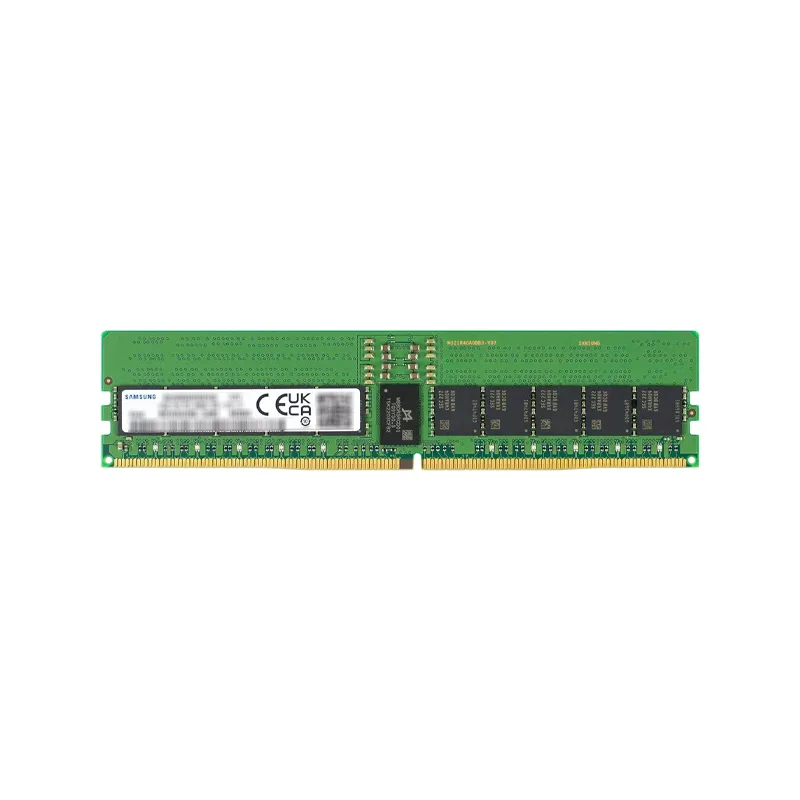
This 32GB DDR5-4800 unbuffered ECC UDIMM is purpose-built for professional workstations and entry-level server platforms requiring data integrity, such as systems based on Intel W680 chipsets or AMD Ryzen with ECC motherboard support. Its dual-rank x8 organization paired with an ultra-low CL4 column access strobe latency delivers exceptional responsiveness and rock-solid reliability for memory-intensive workloads like financial modeling, 3D rendering, and software compilation.
1. ECC protection silently corrects single-bit errors in real time, safeguarding transactional databases and long-running analytics from in-memory data corruption.
2. The 32-gigabyte capacity per stick enables dense server configurations to run more virtual machines and large in-memory caches without hitting capacity bottlenecks.
3. DDR5-4800 bandwidth supplies the massive concurrent data throughput that modern multi-core server processors demand to avoid memory-induced stalls under load.
4. Dual rank x8 organization interleaves memory accesses across multiple ranks, keeping channels fully utilized and maintaining consistent low response times during peak consolidation.
5. Operating at an ultra-low base voltage dramatically cuts per-DIMM power draw, which directly shrinks cooling overhead and energy spend in scaled-out data center deployments.
In a high-performance desktop workstation, the Samsung M324R4GA3BB0-CQKOL 32 GB DDR5 UDIMM isn’t just a memory module; it’s the foundation your projects rely on when every bit counts. This unbuffered ECC DIMM runs at a fast DDR5-4800 speed, yet its standout feature is error-correcting code. If you’re rendering a 4K video sequence overnight or running a multi-day structural simulation, a single bit-flip from background radiation can silently corrupt your output—wasting hours of compute and forcing costly re-renders. ECC catches and corrects these errors in real time, delivering final files you can trust without validation passes.
The 32 GB capacity on a dual-rank design keeps your workflow fluid during memory-hungry tasks like 8K compositing or running multiple virtual machines for cross-platform testing. Dual-rank interleaving unlocks higher sustained bandwidth, so your CPU cores stay fed when shuttling large datasets between RAM and storage. Because this is a standard 1.1 V 288-pin UDIMM, it drops directly into a growing number of pro-grade AMD and Intel desktop platforms that support ECC, without the cost or power overhead of registered server memory. That lower voltage also reduces thermals inside a tightly packed chassis—preserving stability when your workstation is running flat out for 12 hours, not just a benchmark lap.
General Virtualization
For general virtualization, start with two 32 GB DDR5-4800 ECC UDIMMs running in dual-channel mode to get 64 GB of reliable, error-correcting memory — ideal for a moderate number of VMs. Scale to four identical modules (128 GB total) when hosting dense or memory-hungry workloads, always populating both channels symmetrically to maintain balanced interleaving and maximum throughput.
In-Memory Database
To serve large in-memory datasets, populate all available DIMM slots with identical 32 GB dual-rank x8 ECC modules, typically achieving 128 GB on dual-channel server platforms. The dual-rank organization elevates bank-level parallelism, reducing latency and sustaining high transaction rates. ECC protection is essential here to guard against silent data corruption in critical database records.
HPC
Configure at least two 32 GB modules in a dual-channel symmetric layout to deliver a theoretical peak bandwidth of roughly 76.8 GB/s, minimizing access delays for parallel kernels. For memory-bound simulations, fully load all channels with matching ECC UDIMMs — this eliminates NUMA imbalances and provides consistent, low-latency performance across all cores while preserving data integrity during long-running calculations.
Strictly tested server memory, compatible with Dell PowerEdge T160, R260, HPE DL20 Gen11, Lenovo ST50 V3.
Q: Can I mix this M324R4GA3BB0-CQKOL with other memory modules of different brands or speeds?
A: Mixing is not advised. Using mismatched modules may compromise ECC integrity and cause system instability. For server reliability, always install identical M324R4GA3BB0-CQKOL modules.
Q: Is this memory compatible with my server system?
A: This DDR5 ECC UDIMM is compatible with server platforms supporting DDR5-4800 ECC UDIMMs, such as Intel Xeon E-2400 series or AMD Ryzen 7000/9000 with ECC-enabled chipsets. Please verify your motherboard’s QVL.
Q: What is the recommended DIMM population order for optimal performance?
A: Populate identical modules in matching slots per your board’s manual—usually fill the farthest slot from the CPU in each channel first. This dual-rank x8 module benefits from a balanced dual-channel configuration.
Q: Does this module support overclocking or XMP profiles?
A: No, it does not support overclocking or XMP. This is a JEDEC-standard DDR5-4800 module built for server stability, operating with fixed, validated timings without user-adjustable profiles.
Q: What warranty and typical failure rate can I expect?
A: This module carries a 1-year warranty. Under typical server environments, the expected annualized failure rate is well under 0.5%, reflecting high reliability and rigorous manufacturing standards.