











 Secure payments
Standard refund policy
Trade Assurance
Secure payments
Standard refund policy
Trade Assurance
| Product Type | Memory Module |
|---|---|
| Memory Capacity | 32 GB |
| Memory Technology | DDR5 |
| Product Voltage | 1.1 V |
| RAM Speed | 5600 MHz |
| RAM Standard | DDR5-5600/PC5-44800 |
| Error Identifying | ECC |
| Signal Type | Registered |
| Column Access Strobe (CAS) | CL46 |
| Rank | Dual Rank |
| Quantity of Pins | 288-pin |
| RAM Genre | RDIMM |
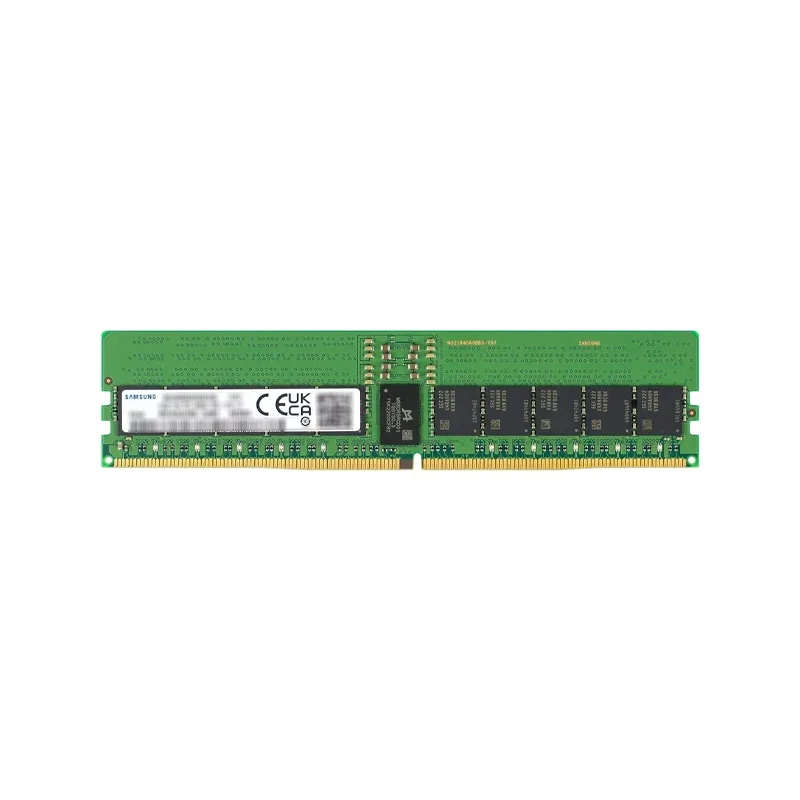
This 32 GB DDR5-5600 Registered ECC RDIMM is purpose-built for enterprise server platforms running virtualization, in-memory databases, and data-integrity-critical workloads. Its dual-rank configuration enables rank interleaving for higher effective bandwidth, while the registered signal architecture and ECC deliver robust signal integrity and real-time single-bit error correction to ensure maximum uptime under heavy load.
1. Registered signal type buffers command and address lines, enabling stable multi-DIMM configurations in dense server racks without signal degradation.
2. ECC protection detects and corrects single-bit memory errors in real time, preserving data integrity for mission-critical enterprise workloads.
3. Dual rank organization interleaves access across two internal rank sets, increasing effective bandwidth and boosting virtualization density under heavy consolidation.
4. 32GB capacity per module maximizes the memory footprint per channel, allowing high-density server nodes to host more VMs and containers without swapping.
5. 5600MT/s transfer rate accelerates data throughput for in-memory databases and real-time analytics, reducing latency in large-scale transactional environments.
In enterprise computing, the Samsung M321R4GA3PB0-CWMCJ registered DIMM is engineered to eliminate the exact failures that keep IT managers awake at night. This 32GB DDR5-5600 module’s ECC actively corrects single-bit memory errors in real time, so a random cosmic ray strike in a dense virtualization cluster will not silently corrupt a critical financial transaction or flip a hypervisor pointer into a kernel panic. Its registered architecture buffers command and address signals, which directly translates to rock‑solid signal integrity when you populate all channels in a database server—crucial for in‑memory platforms like SAP HANA where terabytes of hot data demand dozens of modules without compromise. The dual‑rank layout interleaves internal banks to serve requests in parallel, cutting latency and boosting sustained throughput during heavy analytical query storms. Running at just 1.1V, it draws less power per DIMM, reducing thermal load inside rack‑dense nodes. For your virtualized cluster, that means consistent performance under memory‑intensive consolidation; for your transactional database, it means accelerated commit rates and fewer silent retries, turning hardware reliability into a measurable business advantage.
This capacity planning guide focuses on the 32 GB DDR5-5600 Registered ECC RDIMM, a server-class memory module. Recommendations for three key workloads are outlined below.
General Virtualization
Start by installing one 32 GB RDIMM per memory channel to balance capacity and speed. This prevents bandwidth penalties from multiple DIMMs per channel and simplifies expansion. A 16‑channel server with sixteen modules delivers 512 GB, comfortably hosting dense VM workloads.
In-Memory Database
Populate all DIMM slots with matched dual‑rank 32 GB modules to maximize capacity. Using two DIMMs per channel may reduce frequency to around 4400‑4800 MT/s, but the capacity gain is essential for large in‑memory datasets. A server with 24 modules provides 768 GB of resilient ECC memory for demanding analytics.
High-Performance Computing
For HPC, deploy one DIMM per channel to maintain the full 5600 MT/s transfer rate and low latency. Symmetric population of dual‑rank RDIMMs enables interleaving across banks for uniform access. Eight modules per socket typically offer 256 GB, ideal for parallel simulation codes.
Server memory rigorously tested, compatible: Dell PowerEdge R760, HPE ProLiant DL360 Gen11, Lenovo ThinkSystem SR650 V3, Cisco UCS C240 M7.
Q: Can I mix this M321R4GA3PB0-CWMCJ with other memory modules of different brands or speeds?
A: Mixing is not recommended. Registered ECC modules demand identical specifications. Combining different speeds or brands may cause instability, force fallback to the lowest speed, or prevent the system from POSTing.
Q: Is this memory compatible with my server's Intel or AMD platform?
A: This DDR5-5600 RDIMM is compatible with 4th Gen Intel Xeon Scalable and AMD EPYC 9004 series platforms. Always verify your motherboard's qualified vendor list and support for 288-pin Registered ECC modules.
Q: What is the recommended DIMM population order for optimal performance?
A: Populate identical DIMMs per channel, starting with the farthest slot from the CPU. For dual-rank modules, follow the platform's guide to maximize interleaving and maintain balanced memory channels.
Q: Does this module support overclocking or XMP profiles?
A: No. Server-class RDIMMs operate at JEDEC standard speeds for reliability. They do not support XMP or overclocking. The certified speed is fixed at 5600MT/s to ensure data integrity under continuous workloads.
Q: What warranty and typical failure rate can I expect?
A: This module includes a one-year warranty. Enterprise DDR5 RDIMMs have an annualized failure rate below 0.5% under proper thermal conditions, ensuring exceptional long-term reliability for mission-critical environments.