











 Secure payments
Standard refund policy
Trade Assurance
Secure payments
Standard refund policy
Trade Assurance
| Product Type | Memory Module |
|---|---|
| Memory Capacity | 32 GB |
| Memory Technology | DDR5 |
| Product Voltage | 1.1 V |
| RAM Speed | 5600 MHz |
| RAM Standard | DDR5-5600/PC5-44800 |
| Error Identifying | ECC |
| Signal Type | Registered |
| Column Access Strobe (CAS) | CL46 |
| Rank | Dual Rank |
| Quantity of Pins | 288-pin |
| RAM Genre | RDIMM |
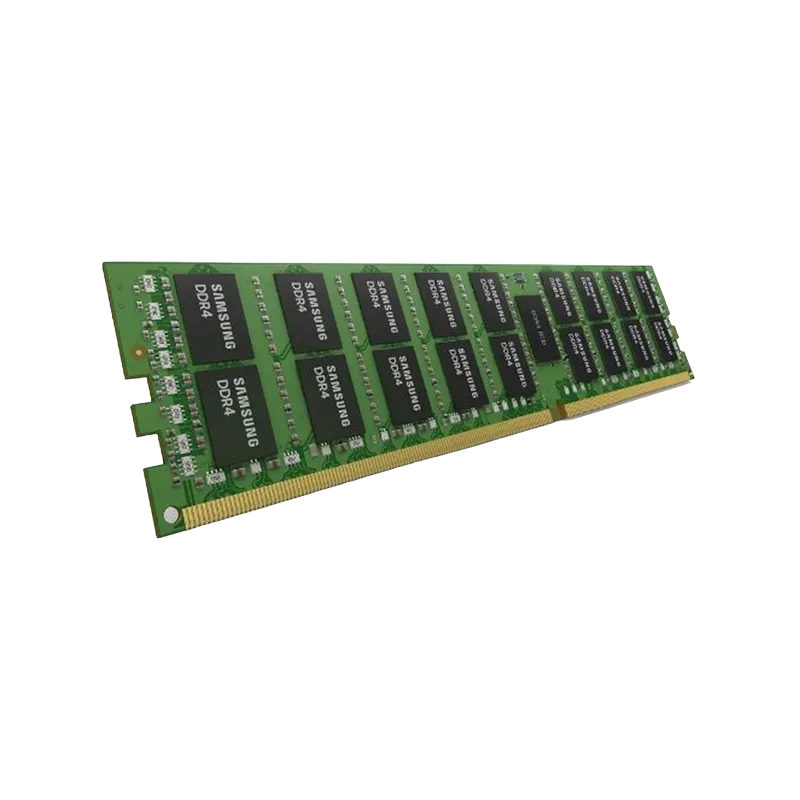
This is a server-class DDR5-5600 Registered ECC memory module specifically engineered for enterprise platforms handling virtualization, in-memory databases, and data-intensive analytics. Its dual‑rank configuration maximizes throughput through rank interleaving, while the registered signal architecture and on‑die ECC provide robust signal integrity and seamless single‑bit error correction across high‑density memory populations.
1. ECC memory detects and corrects single-bit errors on the fly, eliminating silent data corruption that could compromise financial ledger accuracy or crash long-running database transactions.
2. Registered signal buffering stabilizes the command and address bus under heavy load, enabling dense dual-socket servers to reliably host hundreds of virtual machines without signal degradation.
3. DDR5 technology elevates per-DIMM bandwidth to new ceilings, accelerating memory-bound cloud workloads such as real-time analytics and large-scale in-memory caching.
4. Delivering 5600 megatransfers per second, the high transfer rate keeps modern multi-core server processors fed with uninterrupted data streams during concurrent user spikes.
5. A generous 32-gigabyte module footprint increases consolidation ratios per rack, letting IT teams deploy fewer physical nodes for the same virtualized service tier while leaving room for future scaling.
In the enterprise data center, unplanned downtime or silent data corruption can inflict catastrophic financial and reputational damage. The Samsung M321R4GA3PB0-CWMXJ, a 32GB DDR5-5600 Registered DIMM, is engineered to eliminate these risks through four vital design characteristics. Its end-to-end ECC actively detects and corrects single-bit errors caused by background radiation, safeguarding the integrity of every financial transaction and patient record processed in your in-memory databases. The registered clock driver buffers command and address signals, which stabilizes communication when fully populating a server with multiple modules; this allows a dense virtualization cluster running dozens of virtual machines to operate continuously without memory-induced hangs or crashes. Operating at 5600MT/s, the sheer bandwidth feeds data-hungry analytics platforms like SAP HANA, slashing query latency even under heavy concurrent loads. Meanwhile, the dual-rank architecture employs bank interleaving to keep data pipelines saturated during simultaneous read and write storms, meaning a containerized Kubernetes node or a busy Exchange server maintains smooth responsiveness as workload spikes. For IT administrators, this translates directly into ironclad data fidelity, unshakable platform scalability, and the low-latency performance that modern, mission-critical services demand from day one.
General Virtualization
For a dual-socket server platform, populate memory channels symmetrically with at least eight 32GB RDIMMs per CPU to provide 256GB total capacity, enabling dozens of moderate VMs. ECC and registered buffering assure data integrity and signal stability under sustained multi-tenant workloads, and Dual Rank DIMMs offer a strong balance of capacity and bandwidth.
In-Memory Database
Maximize capacity without sacrificing bandwidth by installing identical 32GB RDIMMs across all memory channels—12 modules per CPU yields 384GB, ideal for large Redis or SAP HANA datasets. The 1.1V DDR5-5600 speed and CL46 latency deliver low access times, while ECC guards against in-memory bit errors that could corrupt critical transactional data.
High-Performance Computing
Configure one 32GB Dual Rank RDIMM per channel (8 modules per socket) to sustain peak memory bandwidth for MPI or simulation codes. Registered ECC memory enables stable operation under full load across hundreds of nodes, and the 5600MT/s data rate keeps the CPU’s memory controllers efficiently fed during large-scale parallel runs.
Rigorously tested server memory compatible with Dell PowerEdge R760, HPE ProLiant DL380 Gen11, and Lenovo ThinkSystem SR650 V3.
Q: Can I mix this M321R4GA3PB0-CWMXJ with other memory modules of different brands or speeds?
A: Mixing RDIMMs of different brands or speeds is not recommended. Mismatched timings can cause instability, and mixed ECC/Registered modules often lead to POST failures in server environments.
Q: Is this memory compatible with my system?
A: This DDR5-5600 RDIMM is compatible with servers using Intel Xeon Scalable or AMD EPYC 9000 series platforms. Confirm your system's Qualified Vendor List supports DDR5 Registered ECC memory.
Q: What is the recommended DIMM population order for optimal performance?
A: Follow your server manual for balanced memory channels. Typically, populate equal dual-rank DIMMs per memory controller, starting with the slots farthest from the CPU, to enable optimal interleaving.
Q: Does this module support overclocking or XMP profiles?
A: No. As an enterprise RDIMM, it strictly adheres to JEDEC DDR5-5600 standards. Overclocking and XMP are not supported to guarantee data integrity and 24/7 stability.
Q: What warranty and typical failure rate can I expect?
A: This module carries a 1-year warranty. Enterprise-grade DDR5 RDIMMs exhibit extremely low annualized failure rates, typically under 0.5%, when operated within specified environmental conditions.