











 Secure payments
Standard refund policy
Trade Assurance
Secure payments
Standard refund policy
Trade Assurance
| Product Type | Memory Module |
|---|---|
| Memory Capacity | 32 GB |
| Memory Technology | DDR5 |
| Product Voltage | 1.1 V |
| RAM Speed | 5600 MHz |
| RAM Standard | DDR5-5600/PC5-44800 |
| Error Identifying | ECC |
| Signal Type | Registered |
| Column Access Strobe (CAS) | CL46 |
| Rank | Dual Rank x8 |
| Quantity of Pins | 288-pin |
| RAM Genre | RDIMM |
This DDR5-5600 Registered ECC RDIMM is ideally suited for enterprise-class servers running memory-intensive workloads such as virtualization, in-memory databases, and transactional systems where data integrity is paramount. Its dual-rank x8 organization maximizes interleaving and bandwidth efficiency under heavy load, while the registered signal architecture stabilizes command/address lines for large-capacity deployments and integrated ECC ensures end-to-end error correction without performance compromise.
1. DDR5 memory technology delivers the higher transfer rates and improved power efficiency that modern server processors demand for accelerating concurrent data-intensive workloads.
2. ECC error correction actively detects and repairs bit-flips, providing the end-to-end data integrity required for financial ledgers and mission-critical database transactions.
3. Registered signaling buffers the command and address buses, preserving signal integrity across large memory populations so hyperscale servers stay stable under full load.
4. 5600 MT/s throughput keeps the data pipeline saturated, reducing response tail latency in virtualized environments running real-time analytics.
5. Dual Rank x8 organization leverages rank interleaving to maximize memory bandwidth utilization, supporting denser VM consolidation without trading off consistent performance.
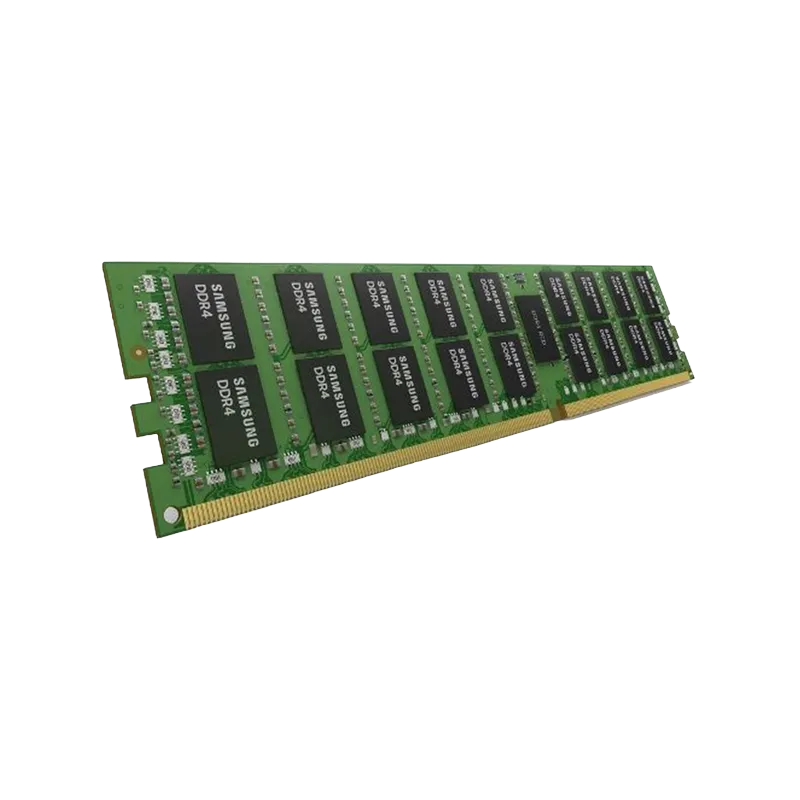
The M321R4GA3EB0-CWMKJ is a 32GB DDR5-5600 Registered DIMM engineered for modern servers, where uptime and data integrity are non-negotiable. Its four defining characteristics directly tackle the most painful realities of data center operations.
First, ECC error correction actively defends against silent data corruption caused by background radiation or electrical noise. In a memory-intensive transactional database, a single unnoticed bit flip can cascade into financial discrepancies or application crashes; ECC catches and corrects these errors before they reach your application, preserving trust in every query. Second, the registered signal buffer stabilizes communication between the CPU and large clusters of high-density DIMMs. When you are running a dense virtualization host with dozens of virtual machines, unbuffered designs degrade under heavy load, while the RCD on this module ensures clean command delivery, allowing you to populate all channels without sacrificing stability during peak VM migrations.
Third, the dual-rank x8 organization paired with DDR5’s 5600MT/s bandwidth saturates your memory controller with parallel data paths. An in-memory analytics platform like Redis or SAP HANA will see markedly lower tail latencies because dual rank interleaves access across internal banks, shortening effective wait states. Finally, the 1.1V operating voltage slices power consumption per DIMM, which directly lowers cooling costs and raises power capacity headroom inside constrained rack environments—critical when scaling out a cluster. This module does not just fill a slot; it becomes the reliability and performance backbone for always-on enterprise workloads.
General Virtualization
For dense VM consolidation, populate a balanced number of identical 32 GB RDIMMs across all memory channels—typically one DIMM per channel (1DPC) to preserve 5600 MT/s speed. A dual‑socket server with eight channels per CPU can reach 512 GB using sixteen modules, comfortably supporting 50+ light to medium VMs without swapping.
In‑Memory Database
In‑memory analytics platforms like SAP HANA or Redis demand both capacity and reliability. Fill all channels with these dual‑rank 32 GB DIMMs, but keep population to 2DPC only if the platform tolerates the slight speed drop to 4800 MT/s; otherwise scale horizontally with 1DPC per server. ECC and registered signaling protect against bit flips during large in‑memory joins, making this module ideal for mission‑critical datasets exceeding 256 GB per node.
High‑Performance Computing
HPC workloads favor bandwidth over latency, so install at least one DIMM per channel to saturate all memory controllers. A typical dual‑CPU compute node with 16 such RDIMMs delivers 512 GB of ECC‑protected DDR5‑5600, supporting CFD, weather modeling, or molecular dynamics simulations. For capacity‑hungry MPI jobs, scale to 1 TB by populating two DIMMs per channel, accepting the regulated 4800 MT/s speed while retaining full RAS features.
Strictly tested server memory; compatible with Dell PowerEdge R760, HPE ProLiant DL380 Gen11, Lenovo ThinkSystem SR650 V3, and more.
Q: Can I mix this M321R4GA3EB0-CWMKJ with other memory modules of different brands or speeds?
A: Mixing RDIMMs of different brands or speeds is strongly discouraged in servers. It can cause signal integrity issues, instability, and POST failures. For validated performance, use identical part numbers across all channels.
Q: Is this memory compatible with my server?
A: This DDR5-5600 ECC Registered DIMM targets platforms like Intel Xeon Scalable (Sapphire Rapids) or AMD EPYC 9004. Please consult your server’s memory QVL or compatibility matrix to confirm support for this specific part number.
Q: What is the recommended DIMM population order for optimal performance?
A: Populate identical DIMMs starting from the farthest slot per channel, following your server’s population guide. Usually, fill blue or labeled slots first to balance memory channels and maximize bandwidth while maintaining signal integrity.
Q: Does this module support overclocking or XMP profiles?
A: No. This JEDEC-compliant server RDIMM operates at 1.1 V with fixed CL46 timings. It does not support XMP profiles or overclocking; enterprise memory prioritizes error-free stability and uptime over frequency tuning.
Q: What warranty and typical failure rate can I expect?
A: This module includes a 1-year warranty. Enterprise-grade DDR5 RDIMMs typically exhibit an annualized failure rate below 0.5% under proper conditions, ensuring high reliability for mission-critical workloads.