











 Secure payments
Standard refund policy
Trade Assurance
Secure payments
Standard refund policy
Trade Assurance
| Product Type | Memory Module |
|---|---|
| Memory Capacity | 32 GB |
| Memory Technology | DDR5 |
| Product Voltage | 1.1 V |
| RAM Speed | 5600 MHz |
| RAM Standard | DDR5-5600/PC5-44800 |
| Error Identifying | ECC |
| Signal Type | Registered |
| Column Access Strobe (CAS) | CL46 |
| Rank | Single Rank |
| Quantity of Pins | 288-pin |
| RAM Genre | RDIMM |
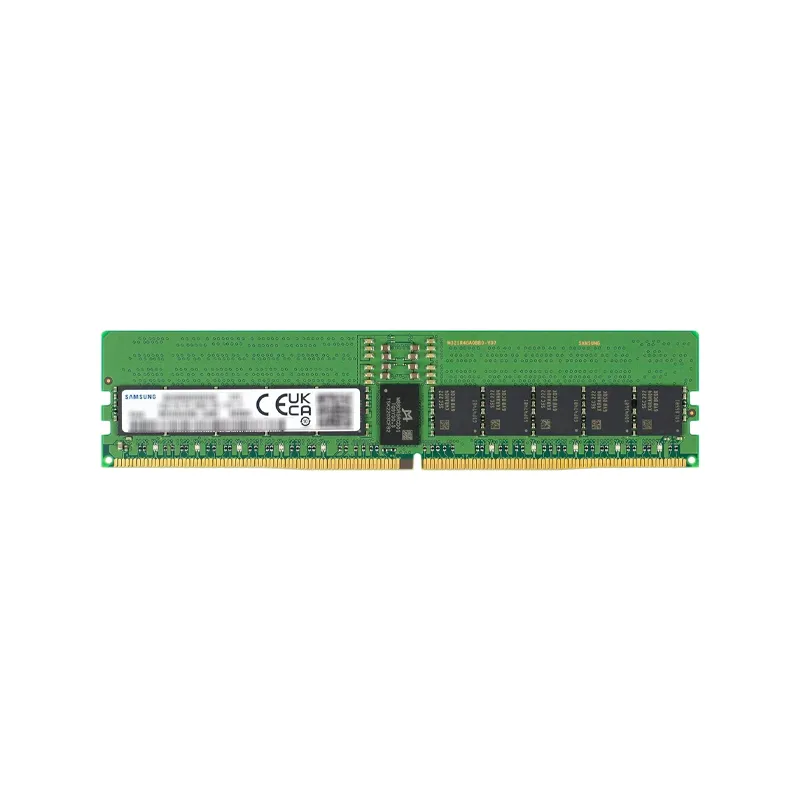
This Samsung M321R4GA0PB0-CWMCH is a DDR5-5600 Registered ECC RDIMM engineered for enterprise servers and workstations, making it ideal for memory-intensive workloads such as virtualization, in-memory databases, and mission-critical applications where data integrity is paramount. Its single-rank configuration and registered signal type enhance signal stability and enable higher memory population density, while integrated ECC corrects single-bit errors to ensure reliable operation under continuous heavy load.
1. DDR5 architecture dramatically raises memory throughput, allowing multi-core server CPUs to feed data-hungry analytics and in-memory databases without stalling.
2. A 32-gigabyte single-module capacity lets IT operators pack far more virtual machines onto each physical host, maximizing consolidation density while preserving responsive tenant performance.
3. 5600 megatransfers per second of raw speed translates into over 44 gigabytes per second of per-channel bandwidth, slashing latency for large-scale AI inference and real-time financial processing.
4. On-die ECC coupled with side-band error correction guarantees data integrity end-to-end, preventing silent data corruption in always-on enterprise environments where reliability directly impacts revenue.
5. The registered buffer chip stabilizes command and address buses under heavy DIMM populations, enabling server platforms to reach terabyte-scale total memory without sacrificing signal quality or uptime.
As a DDR5 Registered ECC module, the M321R4GA0PB0-CWMCH is engineered for servers where every clock cycle and every bit of data can impact business outcomes. Its four core characteristics directly address the relentless demands of modern datacenters. In a dense virtualization cluster hosting hundreds of VMs, the module’s Error-Correcting Code does more than check parity—it actively prevents silent data corruption that could cascade into host crashes, safeguarding your multi-tenant cloud services without downtime. Meanwhile, the Registered buffer circuitry stabilizes signal integrity when you fully populate memory channels, allowing an in-memory database like SAP HANA to scale to massive capacities while holding steady at the full 5600MT/s data rate. This means real-time analytics on transactional data never stutter under load. The Single Rank design further reinforces that stability, letting the module run at its rated speed without derating even in balanced, multi-DIMM configurations, ensuring consistent low-latency access for latency-sensitive financial trading platforms. Finally, the DDR5-5600 interface delivers a peak bandwidth of 44.8 GB/s, pushing large dataset transfers and virtualization overheads aside so your CPU stays fed with instructions. This is not just a spec sheet—it is the foundation for uninterrupted service, data accuracy, and faster query responses that define your infrastructure’s reliability and total cost of ownership.
General Virtualization
For a hypervisor hosting numerous VMs, populate at least two modules per memory channel to maintain balanced interleaving. A common starting point is four modules of this 32GB RDIMM, yielding 128GB, which comfortably supports 20–30 lightweight VMs. Deploy identical part numbers across all channels to avoid performance penalties from non-uniform access.
In-Memory Database
In-memory databases such as Redis or SAP HANA demand low latency and high fault tolerance, making this ECC Registered DIMM essential. Start with eight modules (256GB) on dual-socket servers to keep the working set entirely in DRAM. Scale vertically by adding modules in multiples of eight—sixteen modules for 512GB—to preserve memory bandwidth and avoid swap-induced stalls.
High-Performance Computing
HPC workloads benefit from the registered buffer’s signal integrity at scale. Configure fully populated channels with eight or sixteen of these 5600 MT/s RDIMMs per node to saturate memory bandwidth. For memory-bound simulations, use one DIMM per channel first, then expand symmetrically; this single-rank module avoids rank conflicts and ensures predictable latency under heavy floating-point operations.
This server DDR5 RDIMM is rigorously tested, compatible with Dell PowerEdge R760, HPE ProLiant DL380 Gen11, Lenovo ThinkSystem SR630 V3.
Q: Can I mix this M321R4GA0PB0-CWMCH with other memory modules of different brands or speeds?
A: Mixing modules is strongly discouraged in server environments. Different brands or speeds may cause instability, POST failures, or unbootable states. For guaranteed reliability, populate all channels with identical M321R4GA0PB0-CWMCH RDIMMs.
Q: Is this memory compatible with my system?
A: This DDR5-5600 ECC Registered DIMM is designed for servers using Intel Xeon Scalable (Sapphire Rapids) or AMD EPYC 7002/7003/9004 series platforms. Verify your motherboard's QVL and ensure support for 1.1V, 288-pin RDIMMs.
Q: What is the recommended DIMM population order for optimal performance?
A: Follow the slot numbering in your server's manual. Typically, balance identical DIMMs across all memory channels: one DIMM per channel first, then symmetric second ranks. This M321R4GA0PB0-CWMCH is single-rank, so populate minimum one per channel.
Q: Does this module support overclocking or XMP profiles?
A: No. This is an enterprise-grade DDR5 ECC Registered DIMM adhering strictly to JEDEC standards. Overclocking and XMP profiles are not supported; it operates exclusively at the programmed SPD speed for mission-critical data integrity.
Q: What warranty and typical failure rate can I expect?
A: This module comes with a 1-year warranty. The annualized failure rate (AFR) for premium server memory like this is typically less than 0.5%, ensuring high reliability when operated within specified temperature and voltage ranges.