











 Secure payments
Standard refund policy
Trade Assurance
Secure payments
Standard refund policy
Trade Assurance
| Product Type | Memory Module |
|---|---|
| Memory Capacity | 32 GB |
| Memory Technology | DDR5 |
| Product Voltage | 1.1 V |
| RAM Speed | 6400 MHz |
| RAM Standard | DDR5-6400/PC5-51200 |
| Error Identifying | ECC |
| Signal Type | Registered |
| Rank | Dual Rank x8 |
| RAM Genre | DIMM |
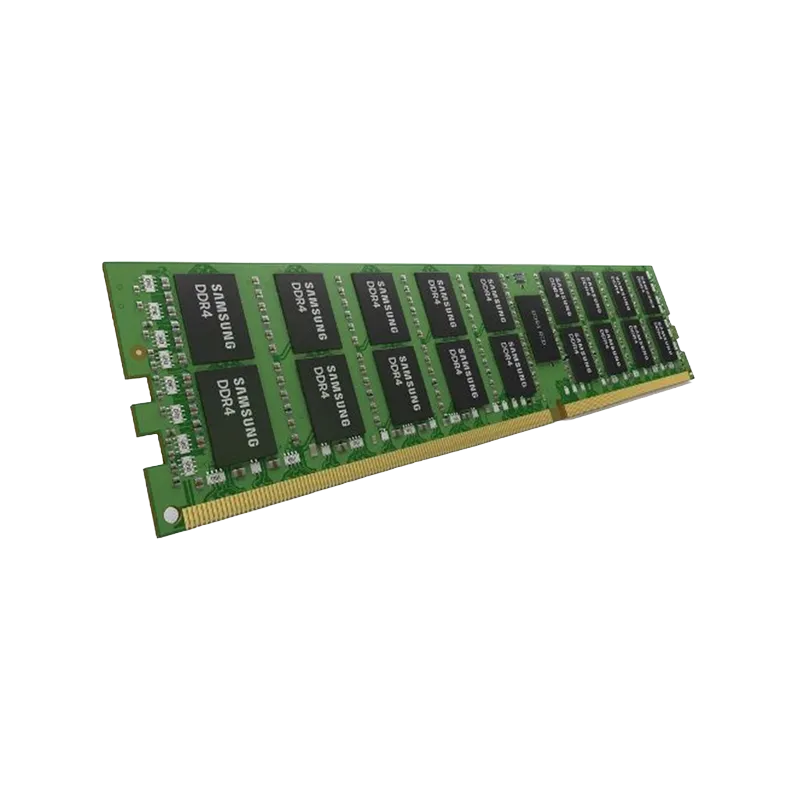
This is a server-class DDR5 Registered DIMM with ECC, purpose-built for enterprise platforms running memory-intensive workloads such as virtualization, in-memory databases, and mission-critical applications where data integrity is non-negotiable. Its dual-rank x8 organization and registered signal architecture maximize channel bandwidth and signal stability at 6400 MT/s, enabling dense, high-reliability memory configurations in multi-socket servers.
1. Each 32GB module maximizes virtual machine density in rack-scale deployments, allowing operators to pack more tenants per node without sacrificing memory headroom.
2. DDR5 technology doubles the bank groups for superior command efficiency, sustaining extreme throughput needed by in-memory databases and real-time analytics.
3. A 6400MT/s transfer rate supplies 51.2GB/s per channel, sharply reducing data starvation during concurrent VM migrations and heavy container orchestration.
4. ECC error correction continuously scrubs single-bit faults, enforcing data integrity for 24/7 financial transactions and compliance-sensitive record keeping.
5. Dual Rank x8 interleaving keeps the memory bus fully utilized under mixed workloads, delivering consistent low-latency access vital for busy virtualization hosts.
The M321R4GA3PB2-CCPEC is a 32GB DDR5-6400 Registered DIMM purpose-built for enterprise servers, and its four defining characteristics directly address the critical pain points of modern data centers. In a dense virtualization cluster hosting dozens of VMs per node, the combination of ECC and Registered signaling is non-negotiable. ECC corrects single-bit memory errors caused by background radiation before they can silently corrupt a hypervisor or guest OS, preventing application crashes and data loss that cascade across your tenancy. The registered clock driver buffers command/address signals, enabling you to populate all available memory channels with high-capacity modules without signal degradation, so you achieve maximum VM density and consistent low-latency performance under full load. When the workload shifts to an in-memory database like Redis or SAP HANA, the module’s dual-rank x8 organization and 6400MT/s bandwidth become decisive. Dual rank interleaves accesses across internal banks to deliver higher sustained throughput and lower transactional latency, turning every microsecond saved into faster user queries. The 1.1V DDR5 voltage then compounds these gains by reducing power draw per gigabyte, which directly shrinks cooling costs and extends hardware lifespan across a rack-scale deployment. This memory translates directly into fewer outages, higher workload consolidation, and a smaller energy footprint—essential for any team running mission-critical services at scale.
General Virtualization
Deploy one dual‑rank 32 GB DDR5‑6400 ECC RDIMM per memory channel to balance capacity and latency. For a typical dual‑socket server with eight channels per CPU, install a total of 16 modules (512 GB) to populate every channel with 1DPC, preserving the full 6400 MT/s speed. This configuration supplies enough headroom for dozens of mixed‑workload VMs while delivering consistent, predictable performance under memory overcommit scenarios.
In‑Memory Database
Maximize capacity by using two DIMMs per channel (2DPC) with these 32 GB RDIMMs, yielding up to 1 TB per socket in an eight‑channel system. The DDR5‑6400 rated speed will step down to 5600 MT/s or lower at 2DPC, but the sheer density accelerates large in‑memory datasets and reduces disk I/O. Deploy all channels identically to maintain lock‑step memory interleaving and ECC coverage across the entire dataset.
High Performance Computing
Install exactly one dual‑rank x8 module per channel (1DPC) to exploit peak 6400 MT/s bandwidth and fine‑grained bank interleaving. Dual‑rank DIMMs deliver superior command/address throughput over single‑rank alternatives. In a dense compute node with eight channels, eight modules (256 GB) provide enough fast memory for MPI‑ranked simulations while keeping latency minimal. If nodes scale out, supplement capacity with a second identical set only when capacity bottlenecks appear, accepting the resulting speed‑step.
Rigorously tested server memory, compatible with Dell PowerEdge R7625, HPE ProLiant DL385 Gen11, Lenovo ThinkSystem SR655 V3.
Q: Can I mix this M321R4GA3PB2-CCPEC with other memory modules of different brands or speeds?
A: Mixing different brands or speeds with this DDR5 ECC Registered DIMM is not recommended. It may cause stability issues, uncorrectable ECC errors, or system boot failure. Use identical modules to ensure validated signal integrity and reliable performance in server environments.
Q: Is this memory compatible with my system?
A: This DDR5-6400 ECC RDIMM is compatible with servers based on Intel Xeon Scalable (Sapphire Rapids) and AMD EPYC 9004 series platforms that support PC5-51200 memory. Verify your server board's qualified vendor list for specific model support before purchase.
Q: What is the recommended DIMM population order for optimal performance?
A: Follow your server board's population guide. Typically, populate identically across CPU memory channels, starting with the farthest slot from the CPU per channel. For this dual-rank x8 module, balanced interleaving maximizes bandwidth and minimizes latency.
Q: Does this module support overclocking or XMP profiles?
A: No, this module adheres to strict JEDEC DDR5-6400 specifications and does not support XMP or overclocking. It is engineered for fixed, reliable operating parameters essential in mission-critical enterprise and data center deployments.
Q: What warranty and typical failure rate can I expect?
A: This memory includes a one-year limited warranty. Engineered as an enterprise-class RDIMM, it undergoes rigorous production testing and exhibits an extremely low annualized failure rate, ensuring high MTBF for continuous server operation.